
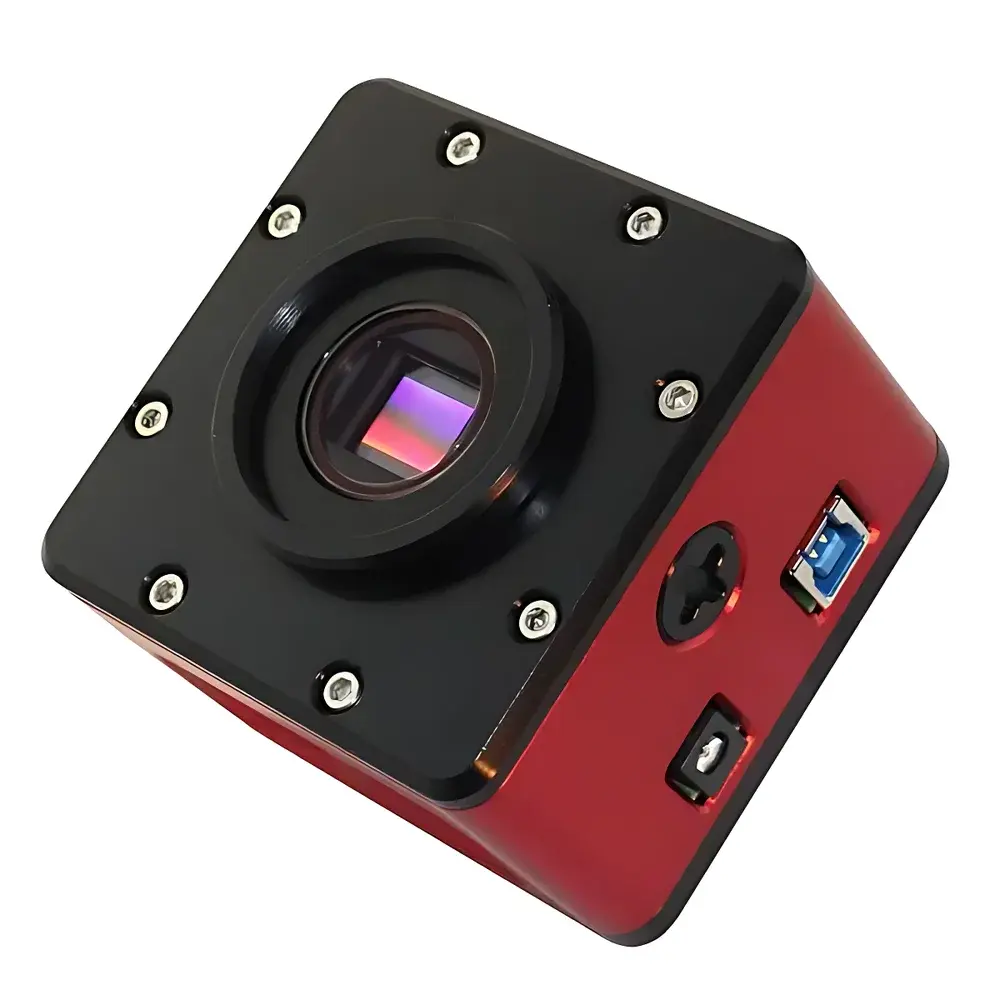
Auniontech ACIS Series Scientific CMOS Camera for Long-Exposure Imaging
| Brand | Auniontech |
|---|---|
| Origin | Shanghai, China |
| Model | ACIS Series |
| Sensor Types | Sony IMX249 / IMX428 / IMX304 CMOS |
| Resolution (H×V) | 1920×1200 / 3208×2208 / 4096×3000 |
| Pixel Size | 5.86 µm / 4.5 µm / 3.45 µm |
| Read Noise | 3 e⁻ (typical, low gain) |
| Bit Depth | 12-bit |
| Cooling | Regulated to Tₐₘb −35°C |
| Exposure Time | 1 ms to unlimited |
| Shutter Type | Global shutter |
| Interface | USB 3.0 |
| Optical Mount | M42×0.75 |
| Back Focus | 12.5 mm ±0.5 mm |
| Power Supply | 12 VDC, 2 A (centre-positive) |
| Weight | ~530 g |
| Monochrome/Color | Configurable per model |
| Full Well Capacity | ~33,000 e⁻ / ~20,000 e⁻ / ~11,000 e⁻ |
| Gain | Variable |
| Software SDK | Comprehensive cross-platform API (C/C++, Python, MATLAB, LabVIEW) |
Overview
The Auniontech ACIS Series Scientific CMOS Camera is engineered for high-fidelity, long-exposure imaging in demanding low-light scientific applications. Leveraging back-illuminated Sony CMOS sensors—IMX249, IMX428, and IMX304—the ACIS platform delivers quantum efficiency exceeding 80% in the visible to near-UV range, combined with exceptionally low read noise (3 e⁻ typical at low gain) and true global shutter operation. Unlike rolling-shutter architectures, the global shutter ensures pixel-synchronous exposure across the full frame—critical for time-resolved fluorescence, pulsed laser imaging, and quantitative intensity mapping where motion artifacts or temporal skew must be eliminated. The camera’s thermoelectric cooling system maintains sensor temperature at a regulated ΔT = −35°C below ambient, enabling stable dark current suppression (<0.001 e⁻/pixel/s at −20°C sensor temperature) over multi-minute exposures. This thermal stability is essential for applications such as chemiluminescence quantification, astronomical deep-sky imaging, and neutron radiography, where signal integration times extend from seconds to hours.
Key Features
- Three scalable models (ACIS 2.4, ACIS 7.1, ACIS 12.3) covering 2.4 MP to 12.3 MP resolution with optimized pixel pitch–well capacity trade-offs
- Regulated thermoelectric cooling to Tamb −35°C with PID feedback control, eliminating condensation risk even in humid laboratory environments
- Anodized aluminum housing designed for electromagnetic compatibility (EMC), minimizing RF interference during sensitive photometric measurements
- USB 3.0 interface delivering sustained 350 MB/s bandwidth for full-frame acquisition at up to 45 fps (ACIS 2.4) or 12 fps (ACIS 12.3) without frame dropping
- Hardware-triggered exposure synchronization with sub-microsecond jitter, compatible with external light sources, shutters, and timing controllers
- Configurable monochrome or color variants—monochrome models provide maximum QE and no Bayer interpolation; color models support CIE-compliant spectral response calibration
Sample Compatibility & Compliance
The ACIS Series supports standard optical interfacing via M42×0.75 threaded mount with precise 12.5 mm ±0.5 mm back focal distance—ensuring seamless integration with microscope infinity-corrected tubes, spectrograph slit couplers, and telescope focusers. All models comply with CE, FCC Class B, and RoHS directives. Firmware and driver architecture adhere to Windows/Linux/macOS kernel-level I/O standards, and the SDK includes native support for GenICam-compliant configuration protocols. For regulated environments—including GLP/GMP laboratories and clinical research facilities—the ACIS SDK provides audit-trail-enabled acquisition logging, timestamping with NTP synchronization, and metadata embedding per frame (exposure, gain, temperature, ROI coordinates). While not FDA 21 CFR Part 11 certified out-of-the-box, the system architecture supports third-party validation packages for electronic record integrity in life science applications.
Software & Data Management
Auniontech provides a fully documented, open-source-compatible SDK supporting C/C++, Python (via ctypes and NumPy), MATLAB Image Acquisition Toolbox, and LabVIEW Vision Development Module. The SDK includes real-time histogram analysis, on-the-fly flat-field and dark-frame correction, region-of-interest (ROI) binning, and non-uniformity correction (NUC) tables. Acquired images are saved in lossless TIFF or HDF5 format—with embedded EXIF-like metadata including sensor temperature, exposure log, and hardware trigger status. Batch acquisition scripts can be scheduled via command-line interface or integrated into Jupyter-based analysis pipelines. For large-scale deployments, the SDK supports networked camera discovery, centralized configuration management, and remote firmware updates via secure HTTPS endpoints.
Applications
- Chemiluminescence & Bioluminescence Imaging: Quantitative detection of low-photon-yield reactions in Western blotting, ELISA, and reporter gene assays
- Fluorescence Microscopy: Widefield and TIRF modalities requiring global shutter fidelity and high SNR at sub-100 ms exposures
- Astronomical Imaging: Deep-sky object capture with drift-scanning capability and dark frame subtraction workflows
- Neutron & X-ray Radiography: Scintillator-coupled imaging under pulsed beam conditions
- Spectroscopy: CCD-grade linearity (±0.5% over 99% of dynamic range) and photon-counting capability down to single-digit e⁻/pixel/frame
- Quantitative PCR & Digital PCR: Real-time fluorescence monitoring with calibrated intensity linearity across thermal cycling stages
- Ophthalmic Imaging: Fundus and OCT angiography requiring high spatial uniformity and minimal fixed-pattern noise
FAQ
Does the ACIS Series support hardware triggering with external TTL signals?
Yes—each model features a 5-pin LEMO connector supporting TTL-compatible start/stop, exposure gate, and frame sync inputs with programmable polarity and debounce filtering.
Can I operate the camera in vacuum or controlled-atmosphere enclosures?
The sealed anodized housing and absence of internal fans make the ACIS Series suitable for inert-gas-purged or low-pressure environments; however, active cooling performance degrades above 10 kPa due to reduced heat transfer coefficient—consult engineering documentation for derating curves.
Is the SDK compatible with Linux ARM64 platforms (e.g., NVIDIA Jetson)?
Yes—precompiled libraries and build scripts are provided for Ubuntu 20.04/22.04 ARM64, with verified support for real-time acquisition on Jetson AGX Orin at full bandwidth.
How is dark current characterized and corrected across temperature gradients?
Each unit undergoes factory dark frame calibration at five discrete setpoints between −10°C and −30°C; acquired darks are interpolated in real time using polynomial coefficients stored in non-volatile memory.
What is the warranty and calibration validity period?
Standard warranty covers three years parts-and-labor; factory photometric calibration (QE, linearity, PRNU) remains valid for 24 months under normal operating conditions and is traceable to NIST-standard reference detectors.






