
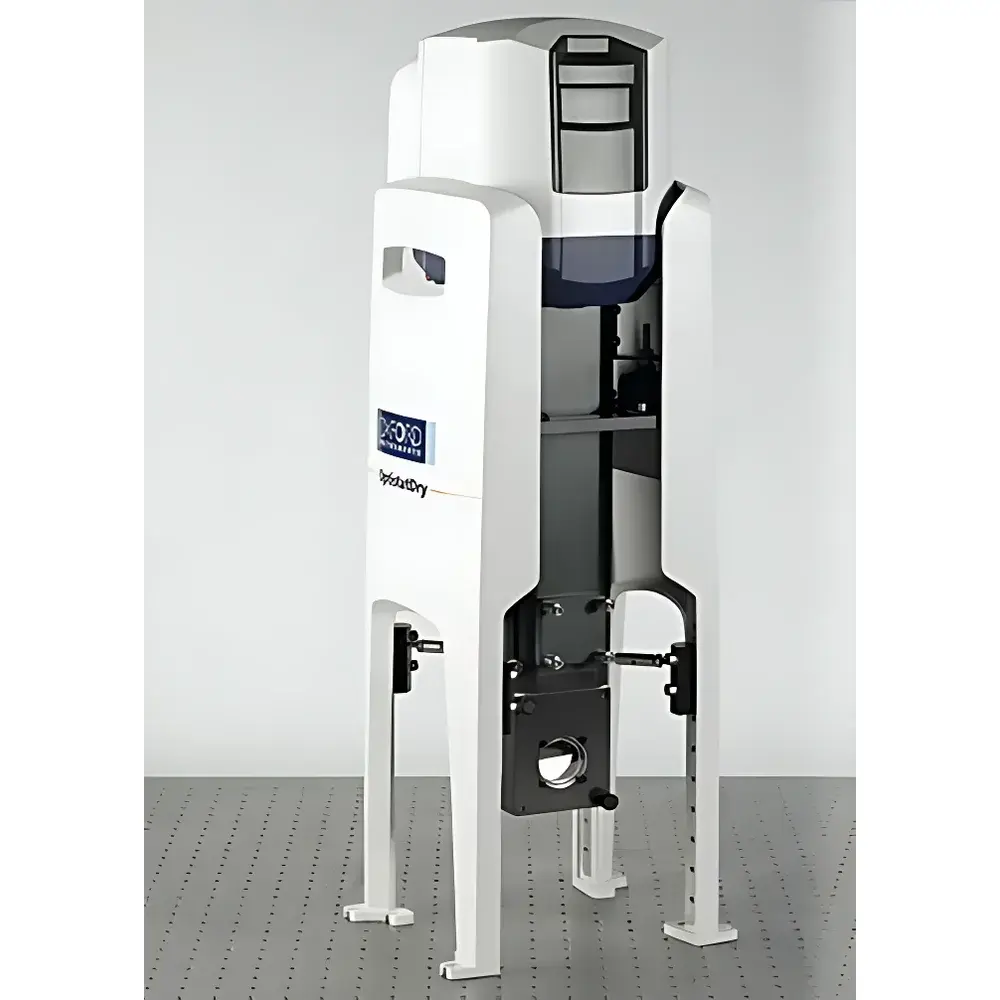
Oxford Instruments Optistat Dry Cryogenic Thermostat
| Brand | Oxford Instruments |
|---|---|
| Origin | United Kingdom |
| Model | Optistat Dry |
| Temperature Range | < 3 K to 300 K |
| Cool-down Time | ≤120 min to 10 K |
| Optical Aperture | Up to 28 mm diameter |
| Numerical Aperture | f/1 |
| Electrical Feedthroughs | Up to 12 leads |
| Cooling Options | Air-cooled or water-cooled cryocooler |
| Vibration Level | < 10 µm (when mounted on optical table) |
| Compliance | Designed for ISO/IEC 17025-compliant laboratories, compatible with GLP/GMP data integrity requirements |
Overview
The Oxford Instruments Optistat Dry is a helium-free, closed-cycle cryogenic thermostat engineered specifically for advanced spectroscopic applications requiring precise, stable, and vibration-isolated low-temperature environments. Unlike traditional liquid-helium-based cryostats, the Optistat Dry employs a high-reliability pulse-tube cryocooler to achieve base temperatures below 3 K without consumable cryogens—eliminating operational dependency on liquid helium supply chains, associated handling hazards, and recurring refilling costs. Its core thermal architecture integrates active temperature regulation with multi-stage heat sinking and low-thermal-conductance sample mounting, enabling high reproducibility in temperature-dependent measurements across UV–Vis, Raman, FTIR, photoluminescence (PL), fluorescence, and terahertz spectroscopies. The system’s mechanical design prioritizes optical stability: rigid monolithic construction, minimized thermal drift (< ±5 mK over 24 h at 4.2 K), and intrinsic compatibility with standard optical breadboards and commercial spectrometers ensure rapid integration into existing laboratory infrastructure.
Key Features
- Helium-free operation using a maintenance-optimized pulse-tube cryocooler, certified for >20,000 hours MTBF
- Wide, continuously tunable temperature range from < 3 K to 300 K with digital PID control and ±20 mK stability at setpoint
- Large optical access: 28 mm clear aperture with f/1 numerical aperture; single-window-per-path geometry maximizes transmission and minimizes wavefront distortion
- Modular electrical interface: Interchangeable sample stages support up to 12 coaxial or twisted-pair feedthroughs, rated for DC–1 GHz operation and vacuum-compatible up to 10⁻⁷ mbar
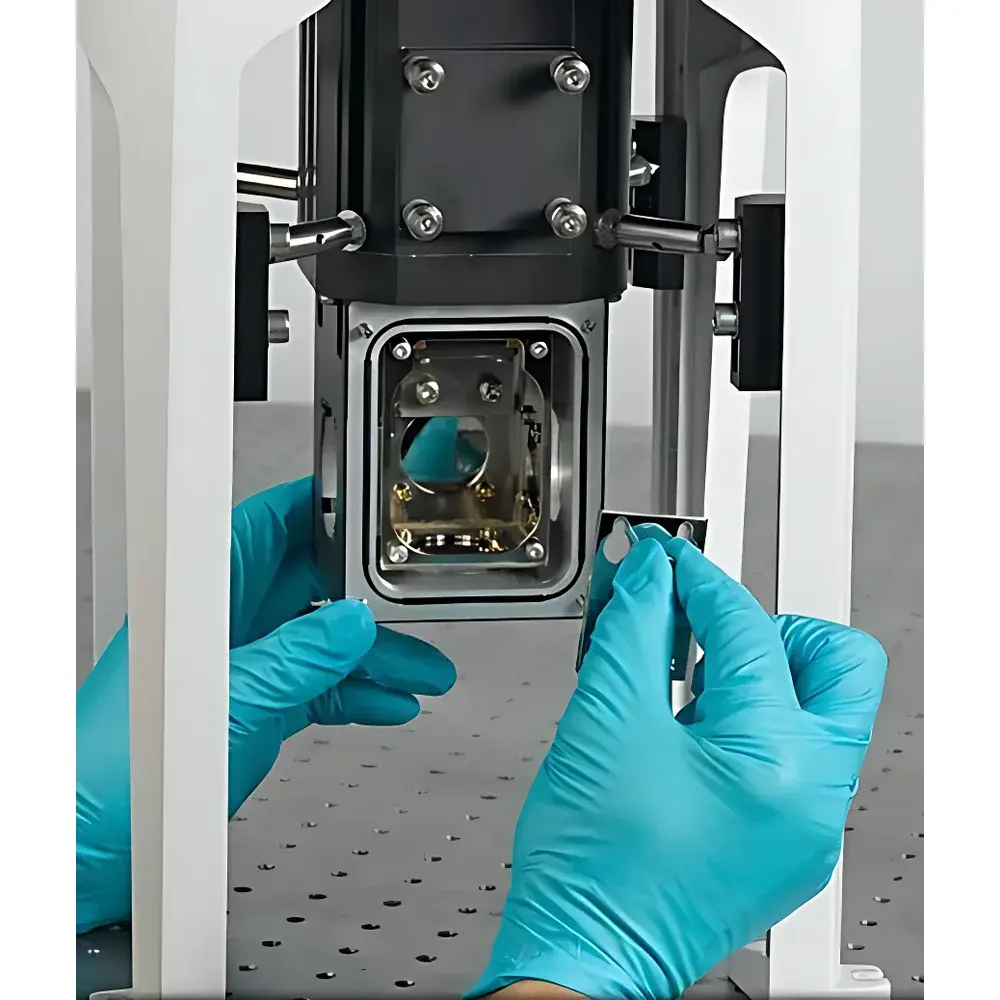
- Side-access sample exchange mechanism: Enables full sample replacement without realignment of optical paths or recalibration of spectrometer coupling
- Low-vibration performance: Integrated passive damping and cryocooler decoupling reduce mechanical noise to < 10 µm RMS displacement at the cold finger—critical for confocal microscopy and interferometric techniques
Sample Compatibility & Compliance
The Optistat Dry accommodates diverse sample geometries—including bulk crystals, thin films on substrates, powder pellets, and microfabricated devices—within a 32 mm diameter × 25 mm height cold-stage volume. Standard mounting options include spring-loaded copper clamps, thermally anchored sapphire holders, and customizable low-emissivity radiation shields. All optical windows are available with broadband anti-reflection (AR) coatings (UV–FIR), wedged variants to suppress etalon effects, and material options spanning fused silica (185–2000 nm), CaF₂ (125–8000 nm), ZnSe (500–16,000 nm), and polyethylene (50–1000 µm). The system conforms to IEC 61000-6-2 (immunity) and IEC 61000-6-3 (emission) standards. Its firmware supports audit-trail-enabled temperature logging aligned with FDA 21 CFR Part 11 requirements when paired with Oxford’s ILM software suite.
Software & Data Management
Control and monitoring are executed via Oxford Instruments’ Intelligent Laboratory Manager (ILM) software—a platform-certified application supporting Windows 10/11 and compliant with laboratory information management systems (LIMS). ILM provides synchronized acquisition of temperature, pressure, cooler status, and user-defined analog inputs (e.g., photodiode current, lock-in amplifier output). All parameter changes, setpoint adjustments, and alarm events are timestamped and stored with SHA-256 hash integrity verification. Export formats include CSV, HDF5, and vendor-neutral .tdms for seamless integration with Python (NumPy/Pandas), MATLAB, or LabVIEW analysis workflows. Remote operation via Ethernet (TCP/IP) enables secure, role-based access control and integration into centralized facility monitoring networks.
Applications
- UV–Vis Spectroscopy: Resolves excitonic fine structure and band-edge shifts in quantum dots and 2D materials below 10 K
- Raman Spectroscopy: Enhances spectral resolution by suppressing thermal broadening of phonon modes in graphene, transition metal dichalcogenides, and perovskites
- FTIR & Far-IR: Characterizes lattice vibrations and superconducting energy gaps with sub-wavenumber resolution down to 0.5 cm⁻¹
- Photoluminescence & Time-Resolved PL: Measures carrier recombination lifetimes, quantum yield, and Stark-shift dynamics under magnetic fields up to 9 T (with optional magnet integration)
- Terahertz Time-Domain Spectroscopy (THz-TDS): Supports coherent detection with >90 dB dynamic range at 4 K due to ultra-low blackbody background
- Combined Opto-Electronic Measurements: Simultaneous acquisition of polarization-resolved reflectance and I–V characteristics on van der Waals heterostructures
FAQ
Does the Optistat Dry require liquid nitrogen or liquid helium for operation?
No. It operates exclusively with electrical power and compressed helium gas supplied by an integrated or external cryocooler—no cryogenic liquids are used at any stage.
Can the system be upgraded to include magnetic field capability?
Yes. The Optistat Dry platform is mechanically and thermally compatible with Oxford Instruments’ Teslatron PT and SpectroMag cryo-electromagnet systems, supporting fields up to 9 T with persistent mode option.
What is the typical cooling time from room temperature to 4.2 K?
Approximately 110–120 minutes under standard conditions (23 °C ambient, water-cooled compressor); air-cooled configurations extend this by ~15–20%.
Is remote monitoring and control supported over a local network?
Yes. Full bidirectional Ethernet communication is standard, including real-time telemetry, script-based automation (via Python API), and TLS-encrypted web interface access.
How is data integrity ensured during long-duration experiments (e.g., 72+ hours)?
ILM enforces write-once archival logging, cyclic redundancy checks (CRC32) on all saved datasets, and automatic backup to network-attached storage (NAS) with configurable retention policies.
Related Products



