
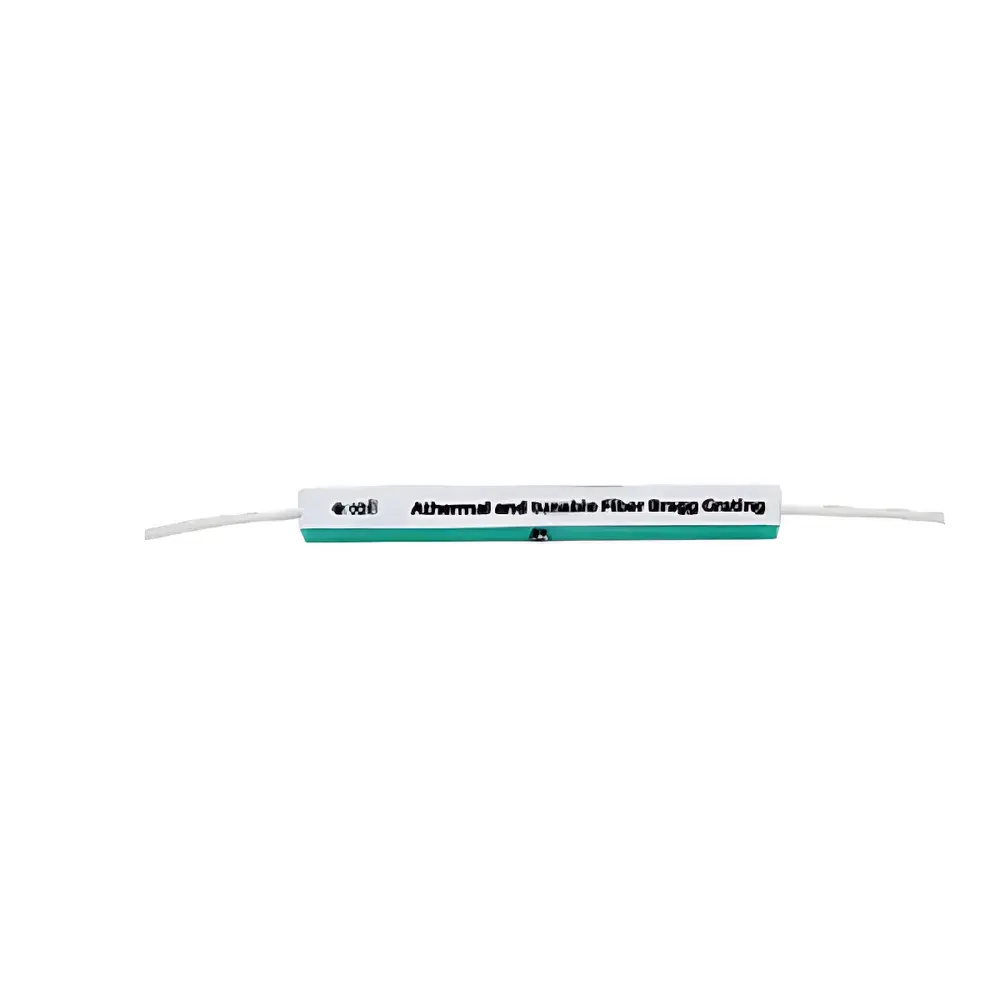
Ixblue Ultra-Narrow Bandwidth Phase-Shifted Fiber Bragg Grating (PS-FBG) Filter
| Brand | Ixblue / Ixblue Photonics |
|---|---|
| Origin | France |
| Manufacturer Type | Authorized Distributor |
| Product Category | Imported Optical Component |
| Model | Customizable Phase-Shifted FBG Device |
| Component Type | Precision Optical Filter Element |
| Operating Wavelengths | 795 nm, 810 nm, 1053 nm, 1064 nm, 1112 nm, C-band (1530–1565 nm), or customer-specified wavelength |
| 3-dB Bandwidth | Down to 1 GHz (0.008 nm @ 1550 nm) |
| Insertion Loss | < 1 dB @ resonance peak |
| Temperature Stability | ±1 pm/°C |
| Tuning Range | ±100 pm via strain or thermal actuation |
| Phase-Shift Engineering | Position- and magnitude-tunable for spectral line shape control |
| Compliance | RoHS-compliant |
Overview
The Ixblue Ultra-Narrow Bandwidth Phase-Shifted Fiber Bragg Grating (PS-FBG) is a high-fidelity, monolithic all-fiber optical filter engineered for applications demanding sub-gigahertz spectral selectivity and exceptional amplitude stability. Unlike conventional uniform FBGs, this device incorporates a precisely defined π-phase shift within the grating structure—enabling resonant transmission with a Lorentzian-like spectral profile and a full-width-at-half-maximum (FWHM) as narrow as 1 GHz (equivalent to ~0.008 nm at 1550 nm). Its operation relies on coupled-mode theory in index-modulated waveguides, where the phase defect creates a localized bound state within the photonic bandgap, resulting in a highly selective passband with minimal sideband ripple and steep spectral roll-off. Designed and fabricated in France using Ixblue Photonics’ proprietary femtosecond point-by-point inscription technology, the PS-FBG exhibits intrinsic polarization independence, low polarization-dependent loss (<0.05 dB), and robust mechanical integrity suitable for integration into fiber-pigtailed modules, laser cavities, or field-deployable sensing systems.
Key Features
- Sub-1 GHz optical bandwidth (down to 1 GHz FWHM) with high out-of-band rejection (>40 dB)
- Insertion loss < 1 dB at resonance—optimized for low-noise signal extraction and cavity feedback efficiency
- Phase-shift position and magnitude fully customizable during fabrication to tailor spectral symmetry, group delay, and dispersion slope
- Thermal stability of ±1 pm/°C—enabling passive stabilization in uncontrolled environments or active locking with minimal thermal drift compensation
- Strain-tunable resonance over ±100 pm range (≈12 GHz at 1550 nm), compatible with piezoelectric transducers or thermal actuators for dynamic wavelength alignment
- Fiber-pigtailed configuration with SMF-28 or PM-fiber options; optional FC/APC or custom connectors; hermetically sealed packaging available for harsh-environment deployment
Sample Compatibility & Compliance
This PS-FBG is compatible with standard single-mode fiber (ITU-T G.652.D) and polarization-maintaining fiber (PANDA or Bow-tie type), supporting both free-space coupling via collimators and direct splicing into fiber laser oscillators or interferometric sensor arrays. The device conforms to Telcordia GR-1221-CORE for reliability under temperature cycling (−40 °C to +85 °C), humidity exposure (85% RH, 168 h), and mechanical shock (50 g, 11 ms). While not classified as a medical or safety-critical device, its material composition complies with EU RoHS Directive 2011/65/EU. For regulated applications—including quantum key distribution (QKD) systems or aerospace-grade LIDAR receivers—the PS-FBG supports traceable calibration reports (NIST-traceable wavelength reference) and can be supplied with full manufacturing lot documentation for GLP/GMP-aligned traceability workflows.
Software & Data Management
As a passive optical component, the PS-FBG does not incorporate embedded firmware or digital interfaces. However, when integrated into tunable laser systems or interrogated using optical spectrum analyzers (OSAs) or high-resolution wavelength meters (e.g., Bristol 621/671 series), it supports full data logging and spectral characterization via industry-standard SCPI commands over USB/GPIB/Ethernet. Ixblue provides detailed spectral response datasets (S-parameters, group delay, dispersion) in CSV and S2P formats for simulation in Lumerical MODE, OptiSystem, or MATLAB-based optical modeling environments. For OEM integration, spectral performance certificates include uncertainty budgets compliant with ISO/IEC 17025:2017—supporting audit readiness in FDA 21 CFR Part 11–governed development pipelines.
Applications
- Telecom: Dense wavelength division multiplexing (DWDM) channel monitoring and multi-stage demultiplexing in C/L-band networks
- Laser Physics: Distributed feedback (DFB) and distributed Bragg reflector (DBR) fiber laser cavity mirrors with linewidth narrowing below 10 kHz
- Quantum Optics: Frequency filtering in spontaneous parametric down-conversion (SPDC) sources and atomic vapor cell interfaces for rubidium/cesium D-line transitions
- Microwave Photonics: Photonic-assisted radio-frequency (RF) filtering, channelized receivers, and analog optical link linearization
- High-Resolution Sensing: Strain- and temperature-compensated quasi-distributed sensing with resolution better than 1 µε or 0.01 °C over 10 km fiber spans
- LIDAR: Coherent detection pre-filtering for Doppler wind LIDAR and differential absorption LIDAR (DIAL) systems operating at 1064 nm or 1550 nm
FAQ
What wavelengths are supported beyond the standard C-band?
Custom designs are available from 795 nm (Rb-D2 line) through 1112 nm (HeNe transition), including 810 nm (Ti:sapphire pump), 1053 nm (Nd:glass), and 1064 nm (Nd:YAG). All wavelengths undergo identical phase-shift fidelity validation.
Can the PS-FBG be used in reflection mode?
Yes—the device operates natively in reflection, but its phase-shift design enables high-transmission functionality when deployed in transmission geometry with appropriate circulator or coupler routing.
Is polarization-dependent performance characterized?
Yes—each unit is tested for PDL < 0.05 dB and polarization mode dispersion (PMD) < 0.05 ps across the specified bandwidth, ensuring compatibility with coherent communication and quantum interference setups.
What is the typical lead time for custom wavelength or bandwidth requests?
Standard configurations ship within 4–6 weeks; custom phase-shift profiles or non-standard wavelengths require 8–10 weeks, subject to Ixblue Photonics’ fabrication schedule and metrology validation protocols.



