
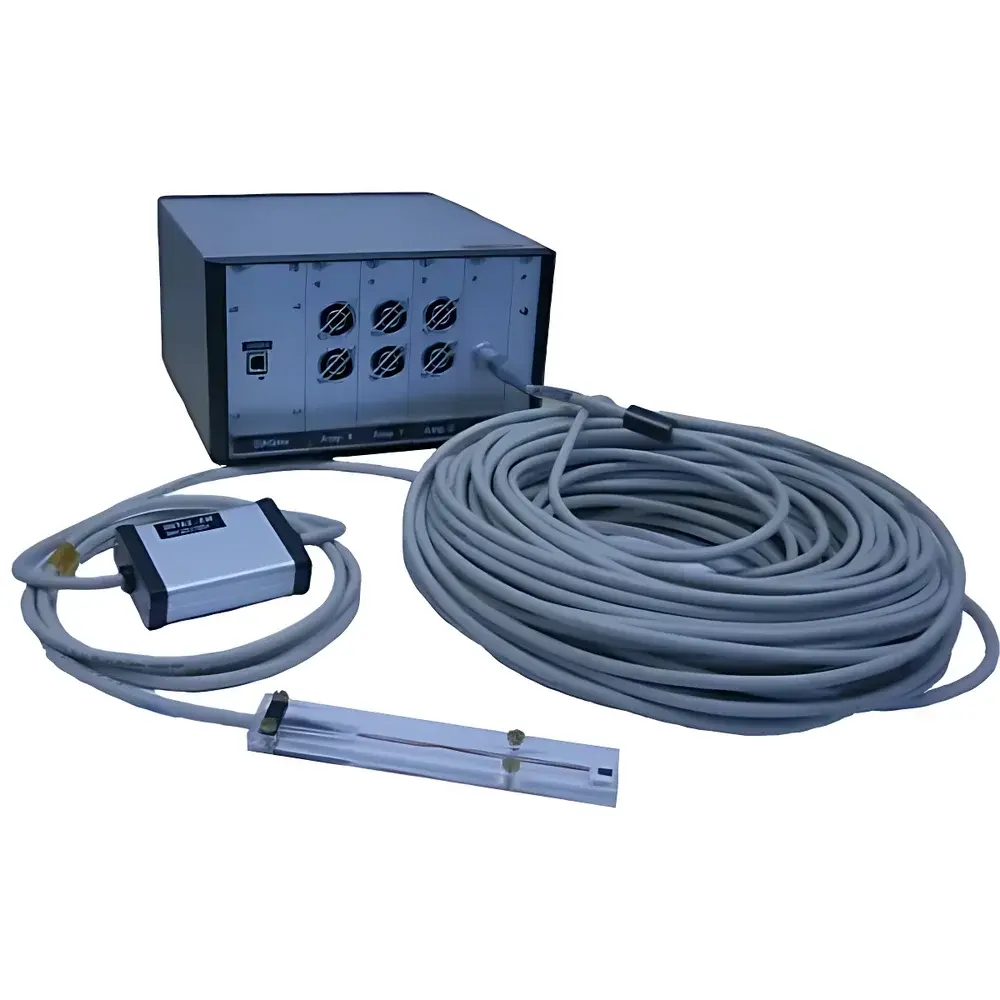
Auniontech 3NTA2 Nanotesla Magnetometer
| Brand | Auniontech |
|---|---|
| Origin | Shanghai, China |
| Manufacturer Type | Authorized Distributor |
| Product Category | Domestic |
| Model | 3NTA2 Nanotesla Magnetometer |
| Price | Upon Request |
| Measurement Range | 1 nT to 0.1 mT |
| Accuracy | <1% of reading |
| Magnetic Field Resolution | 500 pT |
| Noise Spectral Density | 1 nT/√Hz |
| Probe Configuration | 1-, 2-, or 3-axis AMR sensor |
| Probe Dimensions | 1.25 × 0.5 × 0.25 mm |
| Spatial Resolution | <2 mm |
| Max Cable Length | 40 m (with signal integrity preserved) |
| Extended Range Option | Up to 500 µT (5 G) via special interface |
| ADC Resolution | 16-bit |
| Temperature Compensation | Integrated |
| Power Supply | Integrated module with regulated DC output |
| Software Platform | LabVIEW-based acquisition and visualization suite |
| Compliance | Designed for GLP-compliant lab environments |
Overview
The Auniontech 3NTA2 Nanotesla Magnetometer is a high-sensitivity, vector-capable magnetic field measurement system engineered for precision characterization of ultra-weak static and quasi-static magnetic fields in research and industrial settings. Built upon anisotropic magnetoresistive (AMR) sensing technology, the instrument delivers sub-nanotesla resolution across its primary operating range (1 nT to 100 µT), with optional extension to 500 µT. Its core architecture comprises a miniaturized AMR probe—fabricated from non-ferromagnetic materials to avoid field distortion—paired with a low-noise, temperature-compensated electronics module housing a 16-bit analog-to-digital converter, programmable gain amplification, and real-time offset correction circuitry. Unlike Hall-effect or fluxgate-based systems, the AMR principle enables inherently higher spatial resolution (<2 mm) and superior signal-to-noise performance (1 nT/√Hz), making the 3NTA2 particularly suited for mapping localized field gradients, characterizing magnetic shielding efficacy, and quantifying residual fields in ultra-low-field environments.
Key Features
- Three-axis vector measurement capability with synchronized sampling across all channels
- Compact AMR probe (1.25 × 0.5 × 0.25 mm) enabling high-fidelity field mapping in confined geometries
- Factory-calibrated sensitivity traceable to NIST-equivalent reference standards
- Integrated temperature compensation ensuring stability over 15–35 °C ambient range
- Modular design: probe, signal conditioning module, and software operate as interoperable subsystems
- 40-meter probe cable support without signal degradation, achieved via proprietary low-capacitance differential interface
- Real-time bias field cancellation to suppress Earth’s geomagnetic background during differential measurements
Sample Compatibility & Compliance
The 3NTA2 is compatible with non-magnetic sample stages, vacuum-compatible fixtures (with optional non-metallic probe housings), and cryogenic platforms (down to 77 K with probe thermal isolation). It meets electromagnetic compatibility (EMC) requirements per IEC 61326-1 for laboratory use and conforms to safety standards IEC 61010-1. While not certified for medical device applications, its measurement traceability and repeatability align with ISO/IEC 17025 guidelines for calibration laboratories. When integrated into controlled environments with version-controlled software and electronic signatures enabled, the system supports compliance with FDA 21 CFR Part 11 for electronic records and signatures in regulated quality assurance workflows.
Software & Data Management
The included LabVIEW-based application provides real-time field vector visualization, time-series logging, FFT spectral analysis, and multi-point spatial scan automation. Data export formats include CSV, TDMS, and HDF5—enabling direct ingestion into MATLAB, Python (NumPy/Pandas), or statistical analysis platforms. The software implements configurable sampling rates (up to 1 kHz), digital filtering (Butterworth, Chebyshev), and automatic zeroing routines. Audit trail functionality records user actions, parameter changes, and calibration events with timestamps and operator IDs—essential for GLP/GMP-aligned documentation. Remote operation via TCP/IP is supported for integration into larger test benches or distributed monitoring networks.
Applications
- Environmental magnetic noise characterization and active cancellation system validation
- Stray field mapping around electric motors, transformers, and MRI fringe fields
- Geophysical survey support in directional drilling and borehole magnetometry
- Material science studies: detection of weak magnetic phases in superconductors, spintronic thin films, and metamaterials
- Calibration of Helmholtz coils and mu-metal shield performance verification
- Quantum sensor development: baseline field stabilization for atomic magnetometers and NV-center diamond sensors
FAQ
What is the minimum detectable field change under typical lab conditions?
At 1 Hz bandwidth, the effective resolution is 500 pT RMS, limited by intrinsic sensor noise and thermal drift.
Can the 3NTA2 be used inside a vacuum chamber?
Yes—the probe head is vacuum-compatible; the electronics module must remain external, connected via feedthrough-rated cable.
Is NIST-traceable calibration provided with the instrument?
Each unit ships with a certificate of calibration against reference fields generated by a metrology-grade coil system, with uncertainty stated per ISO/IEC 17025 Annex A.
Does the software support automated compliance reporting for ISO 17025 audits?
The LabVIEW application includes configurable report templates compliant with ISO/IEC 17025 section 7.8.2; full audit trail export is available in XML format.
How is probe alignment error compensated during multi-axis measurements?
Orthogonality errors are corrected using factory-measured misalignment matrices stored in probe EEPROM and applied in real time during vector reconstruction.



