
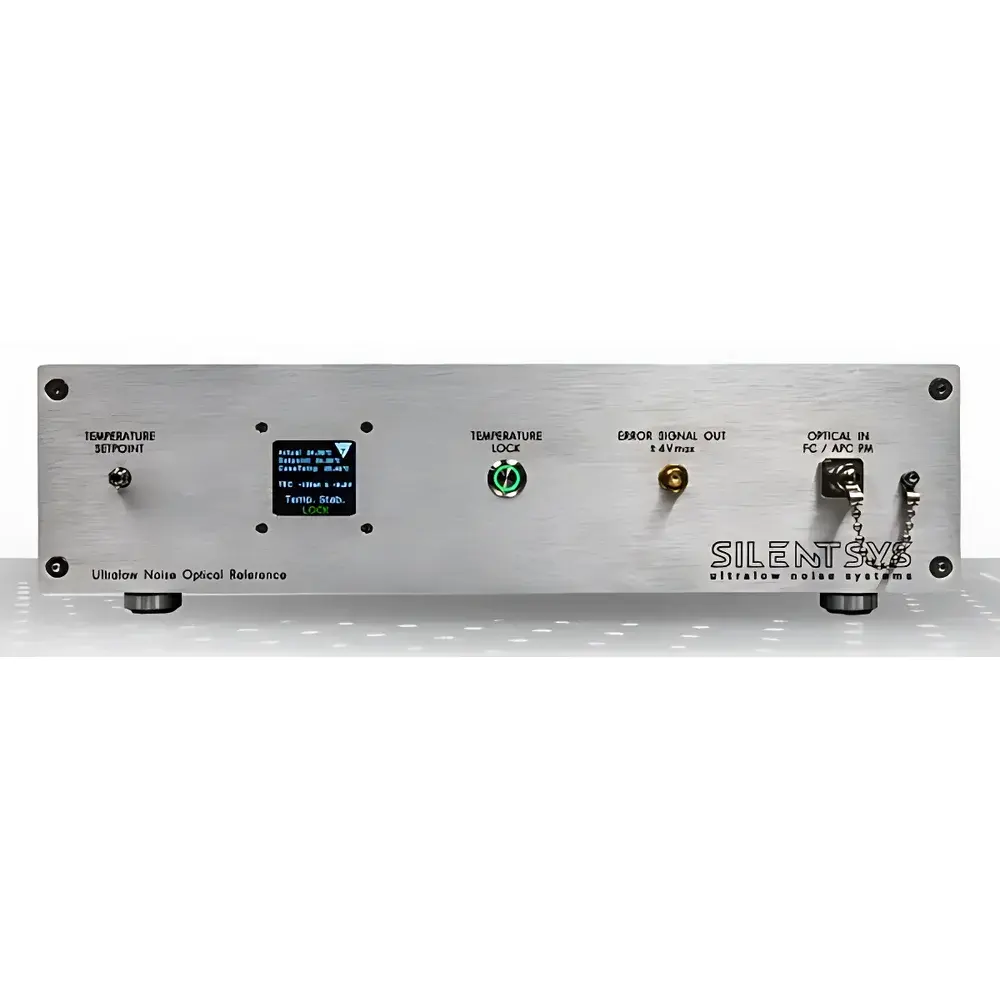
Auniontech OFD Optical Frequency Discriminator
| Brand | Auniontech |
|---|---|
| Model | OFD |
| Type | Optical Frequency Discriminator |
| Laser Compatibility | CW and single-frequency lasers |
| Input Power Max | 200 µW (damage threshold >3 mW) |
| Input Connector | FC/APC |
| Wavelength Ranges | 1050 ± 50 nm / 1550 ± 50 nm (customizable) |
| Channels | 1 or 2 |
| Output Voltage Range | ±4 V max |
| Sensitivity | 1 MHz/V (customizable) |
| Frequency Noise Floor | ≤0.1 Hz/√Hz |
| Linewidth Reduction Capability | From MHz-level to sub-Hz-level |
| Temperature Locking Range | ±5 °C around ambient |
| Operating Temperature | 15–30 °C |
| Dimensions | 334 × 260 × 94.7 mm³ |
| Weight | 6.5 kg |
Overview
The Auniontech OFD Optical Frequency Discriminator is a precision interferometric frequency reference instrument engineered for real-time laser frequency stabilization and quantitative frequency noise characterization. Based on a robust, passive optical cavity architecture with Pound–Drever–Hall (PDH)-compatible detection electronics, the OFD converts instantaneous laser frequency deviations into a linear, low-noise analog voltage signal proportional to detuning from a stable optical resonance. This enables active feedback control loops to suppress laser frequency drift and technical noise—effectively narrowing the effective linewidth from megahertz to sub-hertz levels without requiring external atomic or molecular references. Designed for integration into ultra-stable laser systems, optical clocks, quantum optics setups, and high-resolution spectroscopy platforms, the OFD delivers traceable, repeatable frequency discrimination across UV–VIS–NIR–MIR spectral bands via interchangeable cavity modules.
Key Features
- Ultra-low frequency noise floor of ≤0.1 Hz/√Hz (measured at 1 Hz offset), enabling sub-Hz closed-loop linewidth control
- Wide operational wavelength coverage: standard configurations at 1050 ± 50 nm and 1550 ± 50 nm; custom cavity designs available for UV (375 nm), visible (633 nm), or mid-IR (2–5 µm) ranges
- Single-button stabilization workflow: integrated front-panel potentiometer for rapid temperature-based cavity locking; no external software required for basic operation
- Dual-channel configuration option supports simultaneous monitoring or differential stabilization of two independent lasers
- High linearity and dynamic range: sensitivity calibrated to 1 MHz/V (adjustable via internal gain stages); output voltage swing ±4 V into 50 Ω load
- Passive thermal design with ±5 °C cavity locking range relative to ambient; no active temperature controllers or water cooling required
- Ruggedized benchtop enclosure (334 × 260 × 94.7 mm³, 6.5 kg) compliant with IEC 61000-6-2/6-4 for electromagnetic immunity and emissions
Sample Compatibility & Compliance
The OFD accepts continuous-wave (CW), single-frequency lasers with input power up to 200 µW (optical damage threshold: >3 mW). It is compatible with diode lasers, fiber lasers, solid-state lasers (e.g., Nd:YAG, Ti:sapphire), and OPOs operating within specified wavelength bands. All optical interfaces use industry-standard FC/APC connectors to minimize back-reflection and ensure polarization-maintaining coupling stability. The system conforms to ISO/IEC 17025-relevant calibration traceability requirements when used with NIST-traceable wavemeters or optical frequency combs. For regulated environments—including GLP-compliant spectroscopy labs or FDA-regulated photonic sensor development—the OFD supports optional audit-trail-enabled firmware (compatible with 21 CFR Part 11 data integrity protocols upon request).
Software & Data Management
While fully functional in stand-alone mode, the OFD integrates seamlessly with third-party control environments including LabVIEW, MATLAB, Python (via PyVISA), and EPICS. Digital I/O lines support TTL synchronization with external DAQ systems or lock-in amplifiers. Raw analog outputs are compatible with standard oscilloscopes and spectrum analyzers for real-time frequency noise power spectral density (PSD) analysis. Optional firmware upgrade includes timestamped binary logging (IEEE 754 double-precision), configurable sampling rates up to 1 MS/s, and built-in FFT engine for on-device PSD computation. All firmware revisions undergo regression testing per IEC 62304 Class B software lifecycle standards.
Applications
- Active stabilization of narrow-linewidth lasers for optical atomic clocks and gravitational wave detection interferometers
- Frequency noise metrology in semiconductor laser development—quantifying 1/f and white-noise contributions per IEEE Std 1139
- Reference source in dual-comb spectroscopy (DCS): OFD-locked CW lasers serve as robust local oscillators for asynchronous optical sampling (ASOPS)
- In-cavity dispersion compensation and cavity-length servoing in ultrafast amplifier chains
- Calibration transfer between optical frequency combs and stabilized cw lasers in metrology laboratories
- Real-time linewidth monitoring during laser aging tests or environmental stress screening (e.g., thermal cycling, vibration)
FAQ
What laser types are compatible with the OFD?
CW, single-longitudinal-mode lasers with linewidths from tens of Hz to several MHz—including distributed feedback (DFB) diodes, external cavity diode lasers (ECDLs), fiber lasers, and non-planar ring oscillators (NPROs). Pulsed lasers are not supported.
Can the OFD operate without a computer?
Yes. Basic frequency discrimination and analog output generation require only DC power and optical input; full stabilization requires an external PID controller, but the OFD itself needs no host PC.
Is the wavelength range field-upgradeable?
Cavity modules are mechanically and optically decoupled; replacement requires factory recalibration but no hardware modification to the base unit.
How is temperature stability achieved without active cooling?
The ultra-low-expansion (ULE) glass cavity is housed in a thermally symmetric, passively damped enclosure; thermal time constants exceed 10 minutes, enabling stable locking within ±5 °C ambient variation.
Does the OFD meet any international measurement standards?
The OFD’s frequency discrimination function aligns with definitions in ITU-T G.698.2 (optical frequency referencing) and supports uncertainty budgets compliant with EURAMET cg-19 guidelines for optical frequency measurements.




