
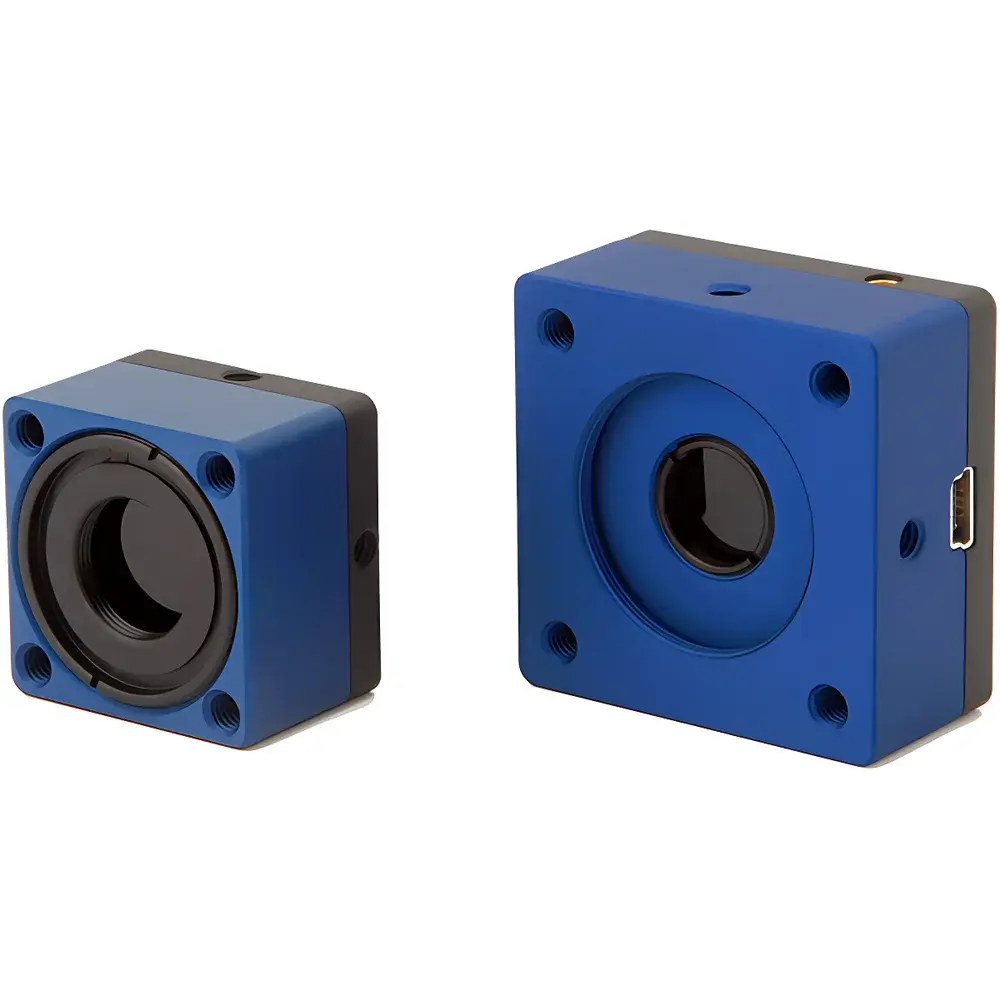
Cinogy CinAlign & CinFocus Telecom-Specific Beam Profilers
| Brand | Cinogy |
|---|---|
| Origin | Germany |
| Model | CinAlign / CinFocus for Telecom Applications |
| Wavelength Range | 320–1610 nm (covering 850 nm, 1310 nm, 1550 nm) |
| Spot Size Measurement Range | CinAlign: 52 µm – 4 mm |
| CinFocus | 1.1 µm – 4 mm |
| Camera Sensors | CinCam CMOS-1202 (320–1350 nm), CinCam CMOS-1201-IR (1470–1610 nm) |
| Pixel Size | 5.2–5.3 µm |
| Resolution | 1280 × 1024 |
| Bit Depth | 8-bit |
| Dynamic Range | >61 dB |
| Interface | USB 2.0 |
| Operating Modes | CW and pulsed (CinAlign) |
| Microscope Objectives | 10×, 20×, 40× (CinFocus) |
| Attenuation Options | OD 1.0–OD 5.0 |
| Max Input Power (CinFocus) | 100 mW |
| Compliance | ISO 11146-1/-2, ISO 13694, ISO 11554, IEC 60825-1 |
Overview
The Cinogy CinAlign and CinFocus beam profilers are purpose-engineered optical measurement instruments for high-precision characterization of laser beams in fiber-optic telecommunications infrastructure development, component manufacturing, and system alignment. These systems operate on the principle of direct-imaging beam profiling—capturing the spatial intensity distribution of a laser beam using calibrated CMOS sensors with spectral response optimized for telecom-relevant wavelengths (850 nm, 1310 nm, and 1550 nm). Unlike scanning-slit or knife-edge methods, imaging-based profilers provide full two-dimensional beam cross-sections in real time, enabling quantitative analysis of beam shape, centroid position, spatial stability, divergence, and M²-related propagation parameters per ISO 11146-1 and -2. The CinAlign variant targets collimated or large-diameter beams (≥52 µm), typically used in far-field characterization of laser sources, isolators, and collimators. The CinFocus system integrates microscope objectives with interchangeable magnification (10×, 20×, 40×) to resolve sub-micron focal spots—critical for evaluating lensed pigtailed lasers, micro-optics, and photonic integrated circuit (PIC) output facets.
Key Features
- Telecom-optimized spectral coverage: Dual-sensor architecture ensures seamless coverage from 320 nm to 1610 nm—including UV-visible (CinCam CMOS-1202: 320–1350 nm) and extended IR (CinCam CMOS-1201-IR: 1470–1610 nm)—with no gap across C-band (1530–1565 nm) and L-band (1565–1625 nm) windows.
- High-fidelity spatial resolution: CinFocus achieves optical resolution down to 1.0 µm at 40× magnification, validated per ISO 13694 using knife-edge transfer function measurements; CinAlign maintains <5.3 µm pixel pitch for accurate near-field profiling of beams ≥52 µm.
- Real-time dynamic monitoring: Full-frame acquisition at up to 30 fps (USB 2.0 interface) supports live tracking of beam centroid drift, pointing stability (per ISO 11554), and temporal intensity fluctuations during thermal cycling or drive-current modulation.
- Modular hardware design: CinFocus allows detachment of the CMOS sensor for standalone use as a CinAlign-style profiler—enabling one platform to serve both near-field focus characterization and far-field collimation verification.
- Traceable calibration: Factory-calibrated radiometric response, pixel uniformity correction, and certified attenuation filters (OD 1.0–5.0) ensure compliance with ISO/IEC 17025 traceability requirements for metrology-grade optical power and irradiance measurements.
Sample Compatibility & Compliance
The CinAlign/CinFocus systems accommodate continuous-wave (CW) and nanosecond-pulsed telecom lasers—including DFB, FP, and VCSEL sources—without saturation or blooming artifacts, provided input power remains within specified limits (≤100 mW for CinFocus; higher for attenuated CinAlign configurations). Beam diameters ranging from 1.1 µm (focused Gaussian mode at fiber facet) to 4 mm (collimated free-space output) are supported across both platforms. All measurements adhere to international standards governing laser beam parameter definitions and uncertainty reporting: ISO 11146-1 (determination of beam widths, divergence, and M²), ISO 11146-2 (alternative techniques), ISO 13694 (beam profiling method validation), and ISO 11554 (laser beam parameters—pointing stability and positional repeatability). Data export formats (CSV, TIFF, HDF5) support audit-ready documentation required under GLP and GMP environments.
Software & Data Management
Cinogy’s proprietary BeamStudio software provides a deterministic, scriptable environment for automated beam analysis workflows. It implements standardized algorithms per ISO 11146 for second-moment (D4σ) and knife-edge-derived beam width calculations, along with centroid tracking, ellipticity assessment, and peak-intensity normalization. The software includes built-in compliance reporting modules that generate PDF-certified measurement reports—including uncertainty budgets derived from sensor noise floor, pixel non-uniformity, and optical distortion corrections. For regulated laboratories, optional FDA 21 CFR Part 11-compliant configuration enables electronic signatures, role-based access control, and immutable audit trails for all acquisition and analysis events. Raw frame buffers and processed metadata are stored in vendor-neutral HDF5 containers, facilitating integration with LabVIEW, MATLAB, or Python-based QA pipelines.
Applications
- Qualification of fiber-coupled laser diodes and EMLs across 850/1310/1550 nm bands
- In-process alignment and verification of lensed ferrules, micro-lenses, and tapered fibers
- Characterization of beam quality degradation in active components under bias-temperature stress
- Validation of collimator performance in transceiver modules (e.g., QSFP-DD, OSFP)
- M² factor mapping for high-brightness pump lasers used in EDFA and Raman amplifier design
- Long-term pointing stability testing of tunable lasers per Telcordia GR-468-CORE
FAQ
What is the minimum measurable spot size with CinFocus?
The CinFocus system resolves focused spots down to 1.1 µm (full-width at half-maximum) when configured with the 40× objective and CinCam CMOS-1203 sensor.
Can CinAlign measure pulsed lasers?
Yes—CinAlign supports both CW and nanosecond-pulsed lasers, provided pulse energy and repetition rate remain within sensor damage thresholds and dynamic range constraints.
Is NIST-traceable calibration available?
Cinogy provides factory calibration certificates with uncertainty statements traceable to PTB (Physikalisch-Technische Bundesanstalt) standards; on-site recalibration services are available upon request.
Does BeamStudio support automated pass/fail testing against user-defined tolerances?
Yes—customizable test sequences with configurable thresholds for beam width, ellipticity, centroid deviation, and power stability can trigger visual alerts and export CSV logs for SPC analysis.
How is thermal drift compensated during extended measurements?
BeamStudio implements real-time background subtraction and auto-gain adjustment based on ambient temperature feedback from onboard sensors, minimizing drift-induced measurement bias over multi-hour sessions.



