
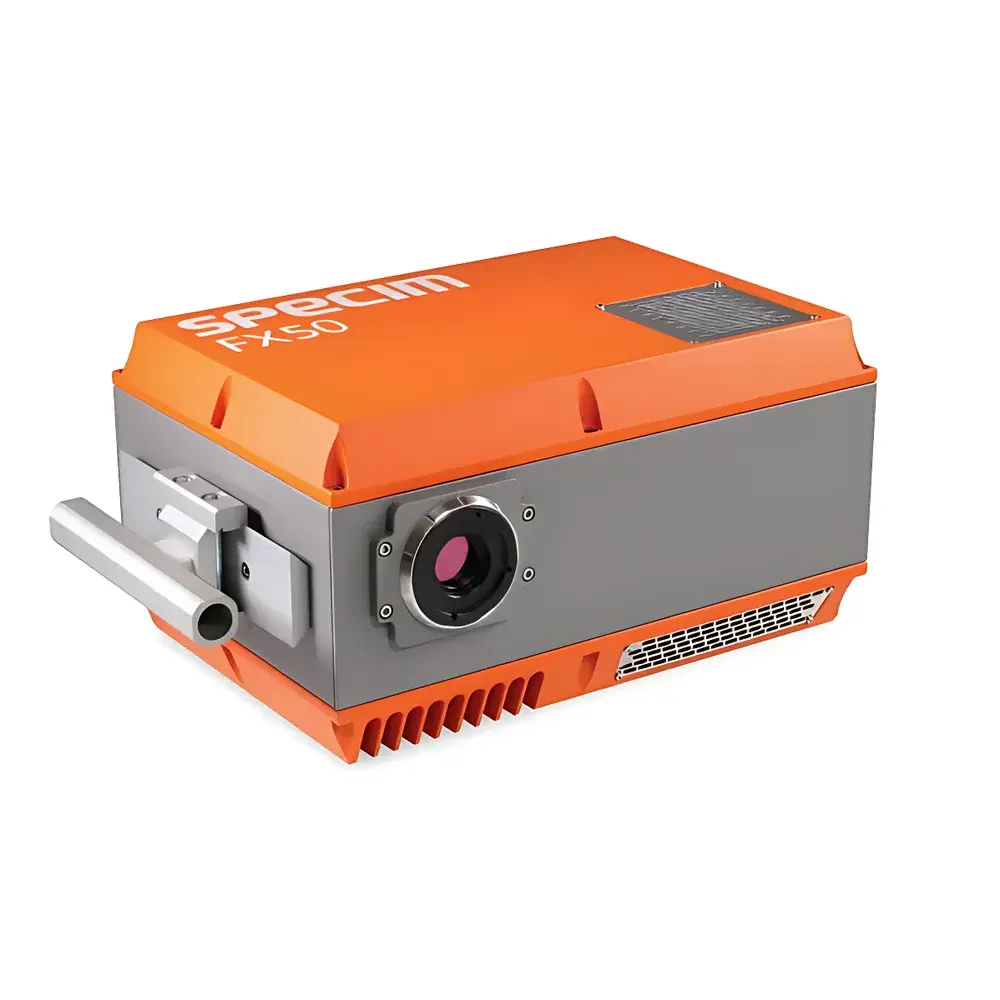
Specim FX50 MWIR Hyperspectral Imaging Camera
| Brand | Specim |
|---|---|
| Origin | Finland |
| Model | FX50 |
| Spectral Range | 2.7–5.3 µm |
| Spatial Resolution | 640 pixels |
| Frame Rate | 380 Hz |
| Number of Spectral Bands | Up to 150 (user-selectable) |
| Interface | GigE Vision |
| Cooling | Thermoelectrically Stabilized Optics |
| Lens Options | Three interchangeable MWIR-optimized lenses |
| Mounting | Industrial-grade, compact and rugged housing |
| Application Domain | Ground-based, laboratory & inline process monitoring |
| Compliance | CE, RoHS, ISO 9001-manufactured |
| Software Compatibility | Specim IQ Studio, HALCON, MATLAB, Python (via SDK) |
Overview
The Specim FX50 MWIR Hyperspectral Imaging Camera is a purpose-built, thermoelectrically stabilized imaging spectrometer engineered for high-fidelity spectral analysis in the mid-wave infrared (MWIR) region (2.7–5.3 µm). Unlike conventional NIR or VIS-NIR hyperspectral systems, the FX50 leverages cooled InSb focal plane array (FPA) technology to deliver high signal-to-noise ratio (SNR) data across its full spectral span—enabling molecular-level identification based on fundamental vibrational absorption features. Its push-broom scanning architecture ensures spatial-spectral data cube acquisition with consistent radiometric integrity, making it suitable for both stationary laboratory characterization and dynamic ground-based industrial inspection. Designed for operational robustness in non-laboratory environments, the FX50 integrates temperature-stabilized optics and factory-applied spectral calibration traceable to NIST-traceable blackbody references—ensuring long-term measurement repeatability without routine recalibration.
Key Features
- Compact, lightweight form factor (≤1.2 kg) with IP52-rated enclosure for dust resistance and limited moisture protection—optimized for integration into robotic arms, UAV gimbals, and conveyor-mounted inspection stations.
- Thermoelectric (TEC) cooling system maintains optical path stability within ±0.1 °C, minimizing thermal drift in spectral peak positions and enabling sub-pixel registration accuracy over extended acquisition periods.
- GigE Vision-compliant interface supports deterministic frame delivery up to 380 Hz at full 640 × 512 spatial resolution, with hardware-triggered synchronization for precise temporal alignment with external sensors or process events.
- Onboard image correction engine applies pixel-wise non-uniformity correction (NUC), bad-pixel replacement, and dark-current subtraction in real time—reducing post-processing latency and computational load on host systems.
- Flexible spectral binning and region-of-interest (ROI) selection allow users to prioritize bandwidth efficiency or spectral fidelity depending on application constraints—supporting up to 150 discrete bands across the full MWIR range.
- Three factory-calibrated lens options (f/2.0, f/3.0, and f/4.0) provide field-of-view adaptability from wide-area survey (e.g., 30° HFOV) to high-magnification surface inspection (e.g., 5° HFOV), all optimized for minimal chromatic aberration in the MWIR band.
Sample Compatibility & Compliance
The FX50 is validated for non-contact, non-destructive analysis of opaque and semi-transparent materials exhibiting strong fundamental absorption in the MWIR—particularly polymers, hydrocarbons, oxides, carbonates, and metal oxides. It complies with IEC 61000-6-2 (immunity) and IEC 61000-6-4 (emissions) for industrial electromagnetic compatibility. All spectral calibration data are generated under ISO/IEC 17025-accredited procedures, with documentation supporting GLP and GMP-aligned validation protocols. The system meets ASTM E1982-20 requirements for infrared spectral imaging instrumentation used in material identification, and supports audit-ready metadata logging per FDA 21 CFR Part 11 when deployed with compliant software platforms.
Software & Data Management
Specim IQ Studio provides native support for FX50 data acquisition, spectral library creation (including ENVI-compatible .hdr/.dat export), and multivariate analysis (PCA, PLS-DA, SAM). A comprehensive C++ and Python SDK enables direct integration with custom machine learning pipelines—including TensorFlow Lite and PyTorch inference engines deployed on edge hardware. Raw data streams adhere to the GenICam standard, ensuring interoperability with common vision middleware (e.g., Common Vision Blox, NI Vision). All acquired cubes include embedded EXIF-like metadata: exposure time, integration time, TEC setpoint, lens ID, and calibration timestamp—facilitating automated QA/QC workflows and regulatory traceability.
Applications
- Plastic sorting in recycling facilities—differentiating black polyethylene (PE), polypropylene (PP), and acrylonitrile butadiene styrene (ABS) via C–H and C=O stretching modes at 3.4–3.5 µm and 5.7–5.8 µm (extended shoulder detection).
- In-line detection of hydrocarbon contamination (e.g., lubricants, solvents) on metallic surfaces during automotive or aerospace component manufacturing—leveraging distinct C–H overtone and combination bands between 3.3–3.5 µm.
- Mineralogical mapping in geoscience laboratories—identifying quartz, kaolinite, montmorillonite, and carbonate species through Si–O, Al–OH, and CO32− vibrational signatures.
- Pharmaceutical coating uniformity assessment—quantifying polymer film thickness and composition heterogeneity on tablet surfaces using spectral unmixing algorithms trained on reference spectra.
- Defect detection in composite materials—revealing subsurface delamination or resin-rich zones via localized thermal emission anomalies captured in calibrated radiance mode.
FAQ
What spectral resolution does the FX50 achieve in the MWIR range?
The FX50 delivers nominal spectral sampling intervals of ≤10 nm across 2.7–5.3 µm, with effective resolution dependent on selected slit width and lens configuration—typically 15–25 nm FWHM for standard operation.
Is active cooling required beyond the built-in TEC system?
No. The integrated single-stage thermoelectric cooler maintains optimal detector operating temperature under ambient conditions up to 45 °C; no liquid nitrogen or external chiller is needed.
Can the FX50 be synchronized with external lighting or motion stages?
Yes. It supports hardware triggering via TTL input (rising-edge) with jitter <1 µs, and offers programmable exposure delay and pulse-width modulation for gated illumination control.
Does the system support real-time classification onboard?
The FX50 itself performs only raw data capture and basic correction. Real-time classification requires external processing—but its low-latency GigE stream and SDK enable sub-100 ms inference loops on NVIDIA Jetson AGX Orin or equivalent edge AI platforms.
How is spectral calibration maintained over time?
Factory calibration is stable for ≥12 months under normal operating conditions. Optional annual verification services include blackbody-based radiometric recalibration and wavelength drift assessment against certified line sources.






