
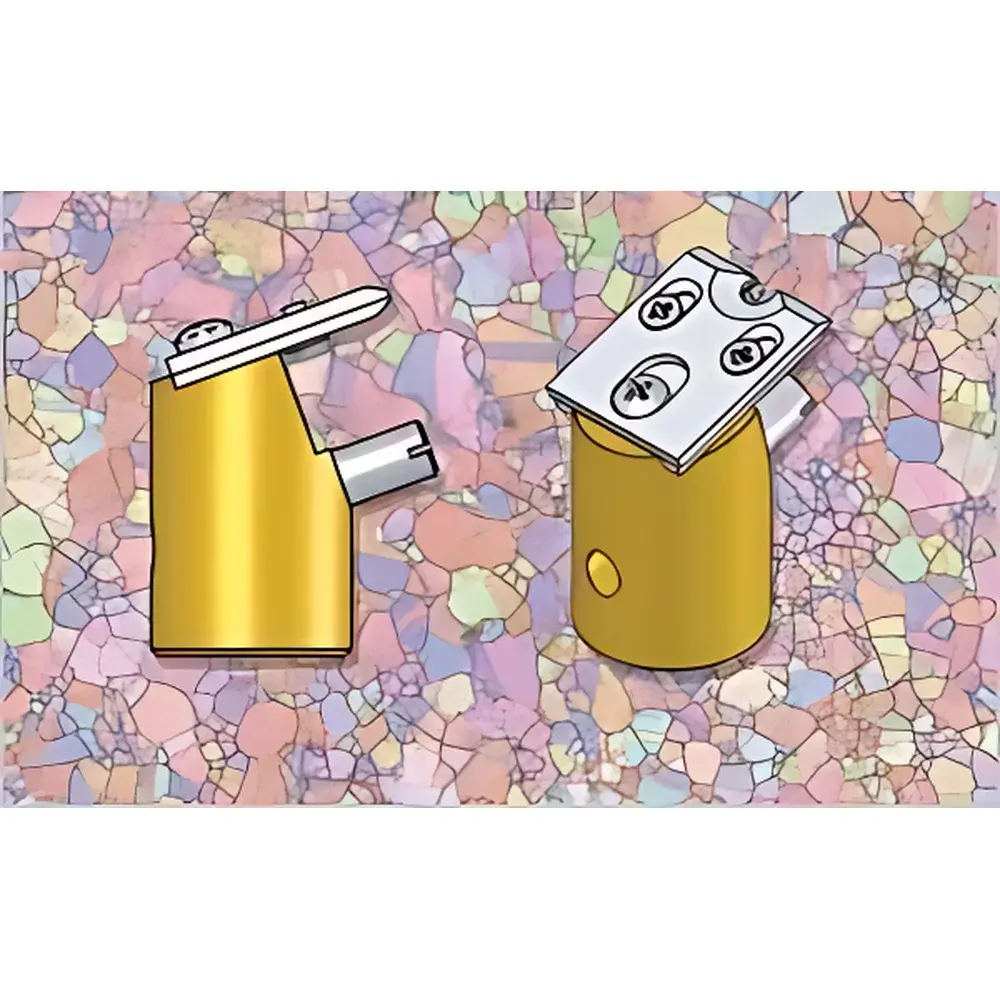
Oxford Instruments TKD Sample Holder
| Brand | Oxford Instruments |
|---|---|
| Origin | United Kingdom |
| Manufacturer Type | Authorized Distributor |
| Origin Category | Imported |
| Model | TKD |
| Price Range | USD 1,400 – 7,000 |
Overview
The Oxford Instruments TKD Sample Holder is a precision-engineered mechanical stage accessory designed exclusively for Transmission Kikuchi Diffraction (TKD) analysis in scanning electron microscopes (SEM). TKD is an advanced variant of electron backscatter diffraction (EBSD) that enables crystallographic characterization of ultra-thin specimens—typically 20–100 nm thick—by collecting Kikuchi patterns transmitted through the sample rather than reflected from its surface. This technique leverages the high spatial resolution afforded by thin-foil geometry and optimized beam-specimen-detector kinematics, delivering orientation mapping resolution down to ~2–5 nm under optimal conditions—approximately one order of magnitude finer than conventional EBSD. The holder ensures strict adherence to the geometric constraints required for efficient transmission-mode pattern acquisition: precise control over sample tilt (typically −10° to +10° relative to horizontal), minimal shadowing from holder components, and unobstructed line-of-sight between the thinnest region of the specimen and the EBSD detector’s active area.
Key Features
- Optimized mechanical design for transmission-mode EBSD geometry, accommodating standard TEM lamellae, FIB-prepared foils, and electropolished thin sections
- High-precision angular positioning with micrometer-adjustable tilt to fine-tune the incident electron beam incidence angle relative to the thin zone
- Low-background, non-magnetic construction using high-purity aluminum alloy and ceramic insulators to prevent stray diffraction and charging artifacts
- Integrated fiducial markers and alignment notches compatible with Oxford Instruments’ AZtec EBSD software auto-calibration routines
- Modular interface compatible with standard SEM stubs (e.g., 12.7 mm diameter) and Oxford’s Symmetry® and Ultim Max™ EBSD detector mounts
- Minimal protrusion below the sample plane to avoid interference with pole piece clearance and detector solid-angle optimization
Sample Compatibility & Compliance
The TKD Sample Holder supports specimens prepared via focused ion beam (FIB) lift-out, electropolishing, or mechanical thinning followed by low-energy ion milling. It accommodates samples up to 3 mm × 3 mm in plan view and thicknesses ≤150 nm in the analyzed region. The holder complies with SEM chamber vacuum requirements (operational range: 1×10⁻⁵ to 1×10⁻⁷ mbar) and meets ISO 14644-1 Class 5 cleanroom handling specifications when used with appropriate glove-box protocols. Its mechanical tolerances align with ASTM E2627–20 (Standard Guide for Electron Backscatter Diffraction Measurement) and support GLP-compliant workflow documentation when paired with AZtec’s audit-trail-enabled acquisition modules.
Software & Data Management
Fully integrated with Oxford Instruments’ AZtec EBSD platform (v4.5+), the holder enables automated pattern indexing, grain reconstruction, and phase identification without hardware recalibration. AZtec’s TKD-specific acquisition templates include preconfigured beam parameters (e.g., 15–30 kV acceleration voltage, 0.5–2 nA probe current), stage tilt compensation algorithms, and dynamic background subtraction optimized for low-signal-to-noise transmission patterns. All metadata—including holder orientation, sample thickness estimate, and detector geometry—is embedded in HDF5-formatted data files, ensuring FAIR (Findable, Accessible, Interoperable, Reusable) compliance per OECD principles. Export options include CSV, CTF, and OIM ASCII formats for third-party analysis in MTEX or Channel 5.
Applications
- Nanoscale grain boundary characterization in nanocrystalline metals and oxide dispersion-strengthened alloys
- Crystallographic phase mapping across cross-sectional interfaces in semiconductor heterostructures and MEMS devices
- Deformation twin analysis in magnesium and titanium alloys at sub-10 nm resolution
- Strain field quantification via high-resolution TKD-based HR-EBSD (high-resolution EBSD) with sub-pixel pattern shift tracking
- In situ heating/cooling experiments using compatible cryo- or thermo-stages, provided thermal drift is compensated via AZtec’s real-time drift correction
FAQ
Is the TKD Sample Holder compatible with non-Oxford EBSD detectors?
Yes—it adheres to standard SEM stage mounting interfaces and detector working distance conventions; however, full geometric calibration and automated acquisition require Oxford AZtec software integration.
Can it be used for conventional EBSD as well?
While mechanically functional, its geometry is suboptimal for reflection-mode EBSD due to restricted tilt range and reduced detector solid angle; dedicated EBSD holders are recommended for routine surface analysis.
What sample preparation methods are validated for use with this holder?
FIB-liftout, twin-jet electropolishing (e.g., for Al, Cu, Ni alloys), and low-kV Ar⁺ ion milling are routinely validated; carbon coating is discouraged unless necessary for charge dissipation, as it attenuates transmitted signal intensity.
Does the holder include calibration standards?
No—calibration is performed using certified reference materials (e.g., NIST SRM 2840 Si single crystal) mounted separately on standard stubs; the holder itself contains no built-in reference features.
Is vacuum compatibility verified for extended high-vacuum operation?
Yes—tested per ISO 20483:2017 for outgassing rates (<1×10⁻¹⁰ Pa·m³/s per cm²) and confirmed stable under 72-hour continuous pump-down at 1×10⁻⁸ mbar base pressure.



