
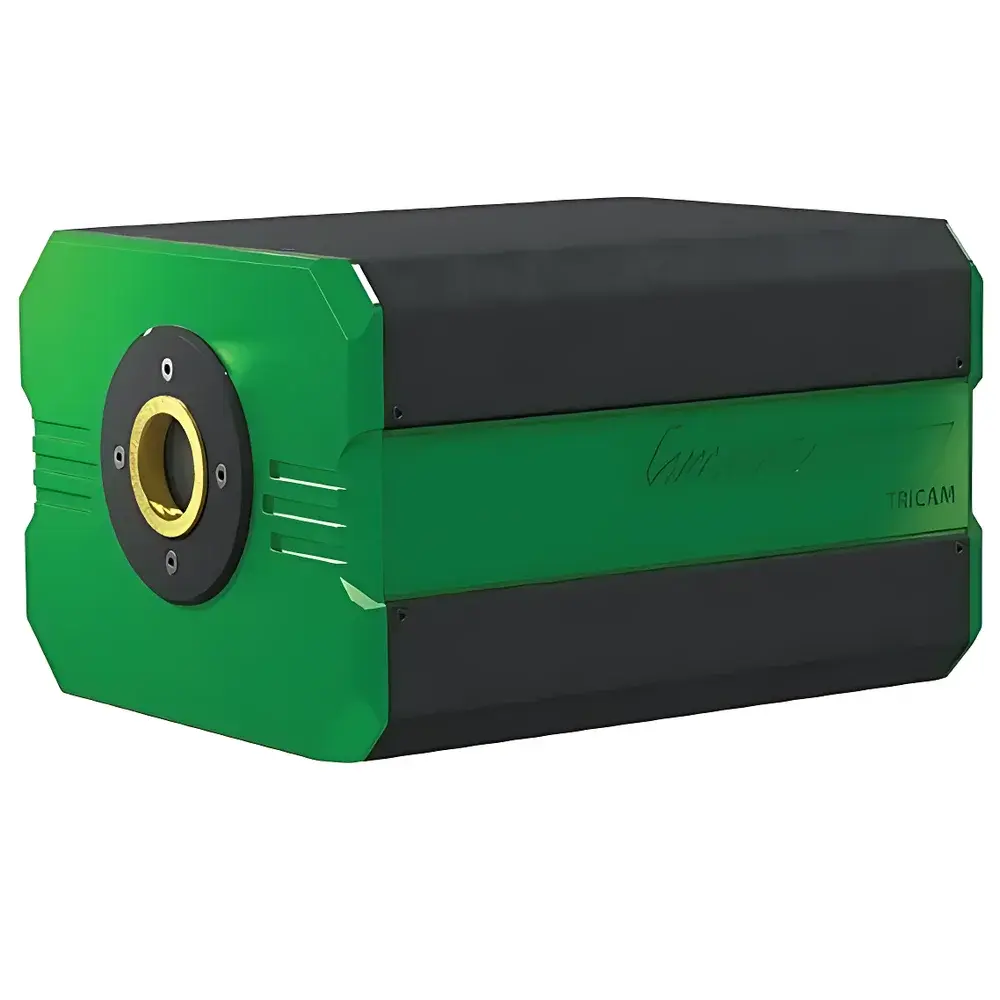
Auniontech TRiCAM Series Time-Resolved Intensified CMOS Camera
| Brand | Auniontech |
|---|---|
| Origin | Imported |
| Manufacturer Type | Authorized Distributor |
| Model | TRiCAM G / TRiCAM M |
| Image Resolution | Up to 2048 × 2048 (sensor-dependent) |
| Pixel Size | 6.5 µm (typical) |
| Sensor Format | 18 mm diagonal (customizable IIT coupling) |
| Readout Speed | Up to 162 fps at full resolution (gated mode dependent) |
| Dynamic Range | >12-bit effective (with gain modulation and pixel binning) |
| Gating Width | As low as 3 ns (FWHM), <100 ps jitter |
| Modulation Bandwidth | 120 MHz (standard, up to 200 MHz with external generator) |
| Spectral Response | UV–NIR (185–900 nm, configurable via photocathode & phosphor) |
| Synchronization | Dual TTL outputs (A/B), programmable delay & width |
| Compliance | CE, RoHS, compatible with ISO 17025-aligned lab environments |
| Software | LI-Capture v4.x (Windows), SDK for Python/C++/LabVIEW integration |
Overview
The Auniontech TRiCAM Series is a scientific-grade time-resolved intensified CMOS camera engineered for ultra-low-light, high-temporal-resolution imaging across physics, life sciences, and industrial diagnostics. Built upon a fiber-optically coupled image intensifier tube (IIT) architecture, the TRiCAM integrates a high-speed CMOS sensor with sub-nanosecond electronic gating—enabling true single-photon sensitivity while preserving spatial fidelity. Its core measurement principle relies on gated optical amplification: incident photons strike a photocathode, generating photoelectrons accelerated through a microchannel plate (MCP) for signal multiplication, before being converted back to visible light on a phosphor screen and relayed via fiber taper to the CMOS detector. This hybrid intensification strategy delivers both quantum efficiency optimization (via selectable photocathodes: S20, GaAs, or solar-blind CsTe) and temporal precision unattainable with conventional EMCCD or sCMOS platforms. The system operates in two primary configurations: TRiCAM G for time-domain applications requiring precise laser-synchronized gating, and TRiCAM M for frequency-domain fluorescence lifetime imaging (FLIM) with low-phase-noise gain modulation.
Key Features
- Sub-3 ns optical gate width (FWHM) with <100 ps timing jitter—enabling picosecond-scale temporal slicing of transient phenomena
- Programmable dual-TTL synchronization outputs (A/B) for precise triggering of pulsed lasers, LEDs, or external detectors
- Integrated timing pulse generator and gate control unit—supporting independent adjustment of gate delay (0–10 ms range), width (3 ns–10 ms), repetition rate (DC–10 MHz), and MCP gain
- Single-chip digital synthesizer (TRiCAM M) delivering 120 MHz sinusoidal gain modulation with phase noise <−130 dBc/Hz @ 1 kHz offset—critical for high-fidelity phasor-based FLIM
- Fiber-optic IIT coupling ensures >85% photon transmission efficiency and eliminates geometric distortion common in lens-coupled systems
- Modular intensifier configuration: interchangeable photocathodes (UV-enhanced, red-sensitive, NIR-extended), phosphors (P43, P46), and MCP pore sizes (6–12 µm) to optimize resolution vs. gain trade-offs
- LI-Capture software provides real-time preview, multi-parameter gating control, histogram-based exposure optimization, and timestamped metadata logging compliant with GLP audit trails
Sample Compatibility & Compliance
The TRiCAM supports diverse sample modalities—from aqueous biological specimens in confocal FLIM setups to high-energy plasma plumes in fusion diagnostics. Its spectral flexibility (185–900 nm) accommodates standard fluorophores (e.g., GFP, mCherry), lanthanide chelates, and chemiluminescent substrates without filter swapping. All variants meet CE marking requirements and adhere to RoHS Directive 2011/65/EU. When deployed in regulated environments (e.g., pharmaceutical QC labs), the LI-Capture software supports 21 CFR Part 11-compliant user authentication, electronic signatures, and immutable audit logs—facilitating FDA inspection readiness. The mechanical design conforms to standard C-mount and SM1-thread interfaces, enabling direct integration into commercial microscopes (Olympus IX, Zeiss Axio), spectrographs (Acton SP series), and PIV illumination rigs.
Software & Data Management
LI-Capture v4.x serves as the native acquisition and analysis interface, offering intuitive parameter mapping for gate timing, gain, and binning—alongside live FFT-based frequency response monitoring for TRiCAM M users. Raw data exports in TIFF, HDF5, and vendor-neutral NIfTI formats preserve full bit-depth and metadata (including absolute UTC timestamps, gate settings, and sensor temperature). A comprehensive SDK (C++, Python, LabVIEW) enables seamless integration into custom acquisition pipelines—supporting synchronized multi-camera triggering, hardware-timed ROI readout, and real-time GPU-accelerated lifetime decay fitting (e.g., multi-exponential τ estimation via Levenberg–Marquardt). All firmware updates undergo ISO/IEC 17025 traceable validation, with version history archived per instrument serial number.
Applications
- Fluorescence Lifetime Imaging Microscopy (FLIM): Quantitative mapping of molecular interactions (FRET), metabolic state (NADH/FAD ratio), and microenvironmental pH in live cells
- Laser-Induced Fluorescence (LIF) & Particle Image Velocimetry (PIV): Single-shot velocity field reconstruction in turbulent combustion or microfluidic flows using nanosecond-gated excitation
- Time-Resolved Raman Spectroscopy: Isolation of weak Raman signals from strong Rayleigh scatter via optical gating
- Plasma Diagnostics: Sub-nanosecond imaging of ionization front propagation and electron density evolution in Z-pinch or laser-plasma experiments
- X-ray Imaging: Indirect detection via scintillator coupling—leveraging UV-sensitive photocathodes for synchrotron beamline applications
- Bioluminescence & Chemiluminescence Imaging: Background-free recording of ultra-weak emission from luciferase reporters or reactive oxygen species assays
FAQ
What is the minimum achievable gate width, and how is timing jitter characterized?
The TRiCAM achieves a full-width-at-half-maximum (FWHM) optical gate width of 3 ns, with RMS timing jitter <100 ps—measured using streak camera cross-calibration against a stabilized femtosecond oscillator.
Can TRiCAM be synchronized with third-party laser systems?
Yes—dual programmable TTL outputs support master-slave or slave-master configurations; LI-Capture allows user-defined delay offsets (±10 ms, 10 ps resolution) relative to external trigger inputs.
Is pixel binning supported during gated acquisition?
Yes—hardware binning (2×2, 4×4) is available in all gating modes, maintaining temporal resolution while improving SNR for photon-starved applications.
How does TRiCAM handle gain nonlinearity in quantitative FLIM?
Each intensifier module undergoes factory calibration for MCP gain linearity (±0.5% over 10⁴ dynamic range); LI-Capture applies per-pixel correction maps derived from uniform-field flat-field measurements.
What spectral ranges are supported by default, and how are photocathodes selected?
Standard configurations include bialkali (S20, 185–650 nm), GaAs (600–900 nm), and solar-blind CsTe (115–200 nm); selection is based on application-specific quantum efficiency targets and vacuum compatibility requirements.






