
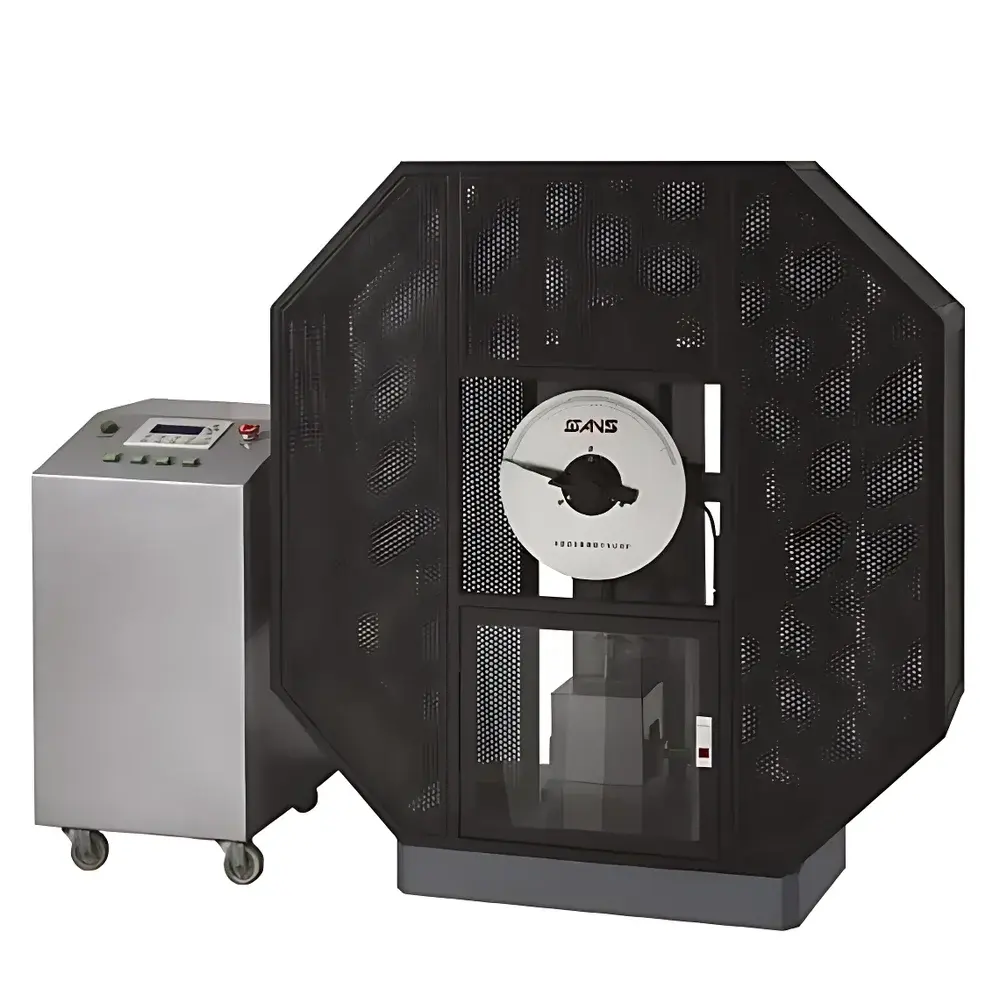
MTS ZBC4000 Pendulum Impact Testing Machine for Metallic Materials
| Brand | MTS |
|---|---|
| Origin | Guangdong, China |
| Manufacturer Type | Authorized Distributor |
| Origin Category | Domestic |
| Model | ZBC4000 |
| Pricing | Upon Request |
| Max Impact Energy | 150 J |
| Pendulum Torque (Impact Constant) | 80.3848 N·m |
| Angular Resolution | 0.1° |
| Pre-lift Angle | 150° |
| Distance from Pendulum Pivot to Impact Point | 430 mm |
| Impact Velocity | 4.0 m/s |
| Hammer Blade Included Angle | 75° ± 1° |
| Hammer Blade Tip Radius | 0.5–1 mm |
| Specimen Dimensions (L × W × H) | 10 × 10 × (70 / 98 / 126) mm |
| Overall Dimensions (L × W × H) | 1200 × 450 × 1290 mm |
| Net Weight | 400 kg |
| Power Supply | 3-phase 5-wire AC 380 V ± 10%, 50 Hz |
| Environmental Requirements | Non-corrosive atmosphere, vibration-free installation, no strong electromagnetic interference |
Overview
The MTS ZBC4000 Pendulum Impact Testing Machine is a precision-engineered instrument designed for Charpy and Izod impact testing of metallic materials under dynamic loading conditions. It operates on the classical pendulum principle—measuring the energy absorbed by a notched specimen during fracture by quantifying the loss in gravitational potential energy of a calibrated swinging hammer. This method complies with internationally recognized mechanical testing standards including ASTM E23-07a (Izod configuration), GB/T 3808–2002, and JJG 608–89. Unlike legacy analog-only systems, the ZBC4000 integrates dual-readout capability (analog pointer + digital LCD), real-time angular position tracking via high-resolution rotary encoder, and industrial-grade PLC-based motion control—ensuring traceable, repeatable, and audit-ready test execution. The machine is engineered for laboratory environments where compliance with GLP and pre-audit readiness for ISO/IEC 17025 accreditation is essential.
Key Features
- Robust structural architecture: machined solid steel baseplate and cast iron upright columns provide exceptional rigidity and minimize vibrational coupling during impact events, directly enhancing measurement reproducibility.
- Simply supported pendulum shaft design eliminates torsional deflection and ensures consistent impact geometry across repeated cycles.
- Patented buffer-assisted pendulum hanging mechanism reduces mechanical shock during setup, suppresses operational noise, maintains fixed release angle (150°) over time, and extends service life of critical components.
- Industrial two-stage reduction gearbox replaces outdated chain-and-pulley or belt-driven systems—delivering higher transmission efficiency, zero backlash, and elimination of periodic maintenance associated with wear-prone mechanical linkages.
- Dual-energy display system (mechanical pointer + backlit LCD) enables cross-verification of results, supporting error detection and metrological validation per ISO/IEC 17025 Clause 7.7.
- Full-enclosure safety guard meets EN ISO 13857 requirements for hazardous moving parts—preventing access to the pendulum swing zone and containing fragmented specimens during brittle fracture events.
- PLC-controlled actuation sequence with encoder feedback guarantees precise timing of release, impact, and post-fracture arrest—critical for data integrity in regulated QA/QC workflows.
Sample Compatibility & Compliance
The ZBC4000 accommodates standard Izod-configured metallic specimens per ASTM E23-07a and GB/T 229: dimensions 10 mm × 10 mm × (70 / 98 / 126) mm, with standardized notch geometry (V-notch or U-notch). It supports manual specimen loading only—no automated feeding or post-test retrieval functionality. Calibration and verification procedures align with GB/T 3808–2002 for pendulum impact testers, covering energy scale accuracy, pendulum geometry tolerance, anvil alignment, and blade radius verification. All measurement outputs—including absorbed energy (J), impact toughness (kJ/m²), and pendulum rotation angle (°)—are traceable to national metrological standards. The system satisfies foundational requirements for inclusion in GMP-relevant mechanical property documentation packages, though full 21 CFR Part 11 compliance requires external audit-trail software integration.
Software & Data Management
While the ZBC4000 operates as a standalone hardware platform without embedded PC-based software, its PLC controller outputs analog voltage signals proportional to angular displacement and digital pulse trains from the rotary encoder. These interfaces support connection to third-party DAQ systems (e.g., National Instruments cDAQ, Keysight DAQ970A) for time-synchronized waveform capture, real-time energy calculation, and automated report generation. Test records—including specimen ID, test date/time, energy value, operator ID, and environmental notes—can be exported in CSV or PDF format via optional serial-to-PC communication modules. Built-in non-volatile memory retains calibration coefficients and user-defined test parameters across power cycles. For laboratories requiring electronic record retention, integration with LIMS platforms is feasible using Modbus RTU or ASCII protocol extensions.
Applications
This impact tester serves core functions across metallurgical R&D, production QA, and third-party certification labs. Typical use cases include: comparative evaluation of alloy heat treatment effects on notch sensitivity; batch acceptance testing of structural steels per ASTM A6/A6M; verification of weld metal toughness in pressure vessel fabrication; qualification of aerospace-grade aluminum alloys against AMS specifications; and teaching impact mechanics principles in university materials science curricula. Its 150 J capacity covers most common ferrous and non-ferrous engineering metals—including carbon steels, stainless grades, titanium alloys, and nickel-based superalloys—within standard Izod configurations. The system is routinely deployed in CNAS-accredited testing facilities for issuing ISO/IEC 17025-compliant test certificates.
FAQ
Does the ZBC4000 support Charpy impact testing?
No—it is configured exclusively for Izod impact testing (clamped vertical specimen, striker impacts above notch). Charpy testing requires inverted specimen orientation and different anvil geometry, which this model does not accommodate.
Is automatic specimen feeding available as an option?
No. The ZBC4000 is a manually loaded system. No factory or aftermarket auto-feeder kits are offered or validated for this model.
Can test data be exported directly to Excel or LIMS?
Yes—via optional RS-232/485 interface modules that transmit ASCII-formatted result strings compatible with spreadsheet import or LIMS ingestion scripts.
What maintenance intervals are recommended?
Biannual verification of pendulum torque, blade geometry, and anvil alignment per GB/T 3808–2002; annual recalibration of angular encoder and energy scale by accredited metrology lab.
Is the machine suitable for ISO/IEC 17025 accreditation?
Yes—the mechanical design, traceable calibration path, dual-readout redundancy, and documented uncertainty budgeting framework meet Clause 6.4 (Equipment) and Clause 7.7 (Results Reporting) requirements when operated within specified environmental conditions.



