
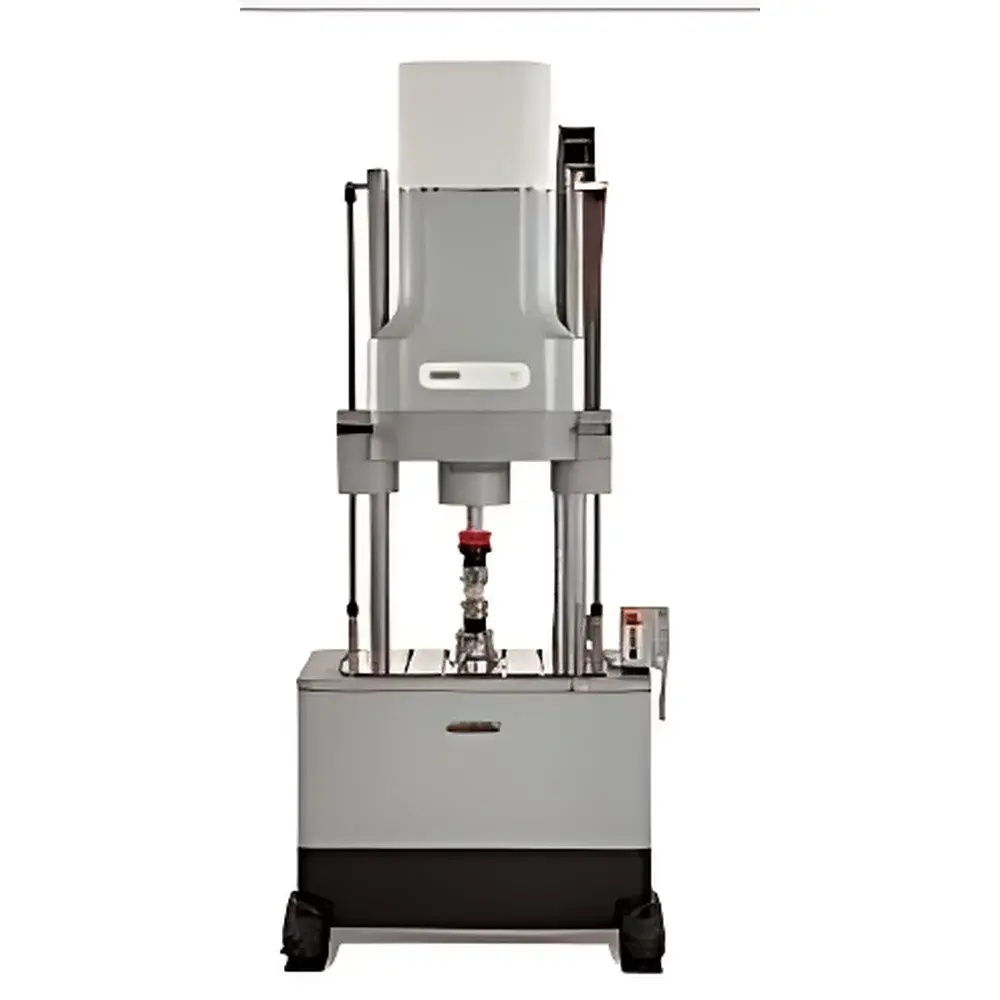
ElectroPuls E10000 Biaxial Tension-Torsion Testing System
| Brand | INSTRON |
|---|---|
| Origin | USA |
| Model | ElectroPuls E10000 |
| Dynamic Linear Load Capacity | ±10,000 N |
| Torsional Load Capacity | ±100 N·m |
| Linear Actuator Stroke | 60 mm |
| Standard Torsional Range | ±135° (optional extended range up to ±16 revolutions via INSTRON technical service) |
| Configuration | Floor-standing vertical installation |
| Drive Technology | Patented linear motor system |
| Force Sensing | Integrated Dynacell™ load cell |
| Displacement Measurement | High-resolution optical encoder |
| Control Software | INSTRON Console |
| Power & Environment | Oil-free operation, low energy consumption, low acoustic noise, compact footprint |
| Safety | CE-compliant safety enclosure with pneumatic fatigue grips |
Overview
The INSTRON ElectroPuls E10000 is a high-performance, floor-standing biaxial testing system engineered for synchronized tension-torsion dynamic mechanical characterization of advanced materials and structural components. Unlike conventional uniaxial servo-hydraulic or electromechanical testers, the E10000 employs a patented dual-axis linear motor architecture—eliminating hydraulic fluid, reducing thermal drift, and enabling precise, high-bandwidth control of both axial force and torsional moment in real time. Its core measurement principle relies on closed-loop coordination between a high-stiffness linear actuator (±10,000 N dynamic capacity) and a coaxial rotary actuator (±100 N·m torque capacity), each independently instrumented with traceable, factory-calibrated transducers: the integrated Dynacell™ multi-axis load cell ensures force accuracy per ISO 7500-1 Class 1, while optical encoders deliver sub-micron linear displacement resolution and arc-second angular position fidelity. Designed explicitly for fatigue-critical applications—including biomedical implant validation, aerospace fastener testing, and composite laminate shear-mode analysis—the system operates within strict regulatory frameworks supporting GLP-compliant test execution and audit-ready data provenance.
Key Features
- Patented oil-free linear motor drive system delivering zero fluid contamination risk, minimal maintenance, and consistent thermal stability across extended test durations.
- Dual independent closed-loop control architecture: simultaneous real-time regulation of axial load (±10,000 N) and torsional moment (±100 N·m) with phase synchronization capability down to 0.1°.
- Integrated Dynacell™ force sensor with built-in temperature compensation and overload protection—certified to ISO 7500-1 Class 1 for static and dynamic force measurement.
- High-resolution optical encoder suite: linear displacement resolution ≤ 0.1 µm; angular position resolution ≤ 0.001° over full ±135° standard range (extendable to ±16 revolutions upon request).
- CE-certified safety enclosure with interlocked pneumatic fatigue grips—designed to ASTM E466 and ISO 1099 compliance requirements for high-cycle fatigue testing environments.
- Compact floor-standing configuration (W × D × H ≈ 1,200 × 900 × 2,400 mm) optimized for laboratory space efficiency without compromising structural rigidity or modal damping performance.
Sample Compatibility & Compliance
The E10000 accommodates specimens ranging from miniature metallic wires (Ø0.2 mm) to large-diameter composite rods (up to Ø50 mm) and orthopedic screw assemblies. Customizable grip interfaces—including wedge-action, collet, and hydraulic self-tightening options—ensure secure clamping without slippage or stress concentration artifacts. All hardware and firmware comply with EU Machinery Directive 2006/42/EC and electromagnetic compatibility standards EN 61326-1. The system meets essential requirements for ISO 1099 (fatigue testing), ASTM E466 (force-controlled fatigue), and ASTM E606 (strain-controlled fatigue), and supports full traceability documentation required under FDA 21 CFR Part 11 when paired with validated Console software configurations.
Software & Data Management
INSTRON Console software provides intuitive, workflow-driven test definition—including pre-built biaxial fatigue templates (e.g., out-of-phase tension-torsion waveforms, constant amplitude vs. spectrum loading), real-time parameter monitoring, and automated pass/fail evaluation against user-defined thresholds. Raw data streams (force, torque, displacement, angle, cycle count) are recorded at ≥10 kHz sampling rate with embedded time stamps and metadata (operator ID, calibration certificate IDs, environmental logs). Export formats include .csv, .tdms, and XML-compliant .xmltest files compatible with third-party post-processing tools (MATLAB, Python Pandas, Minitab). Audit trails, electronic signatures, and role-based access control are available under validated GxP mode—fully aligned with ALCOA+ principles and supporting 21 CFR Part 11 electronic records compliance.
Applications
- Biomedical device validation: cyclic torsional fatigue of spinal rods, intramedullary nails, and dental abutments under combined axial-torsional loading per ISO 14801 and ASTM F2503.
- Aerospace material qualification: shear-mode fatigue of titanium alloy rivets and carbon-fiber reinforced polymer (CFRP) lap joints under multiaxial stress states.
- Automotive component testing: durability assessment of drive shafts, CV joints, and suspension bushings under realistic road-load spectra.
- Advanced material research: viscoelastic characterization of shape-memory alloys and polymer nanocomposites using controlled strain-rate biaxial protocols.
- Standards development support: generation of reference datasets for ISO/TC 108/SC 4 and ASTM Committee E28 on mechanical testing methodologies.
FAQ
What standards does the ElectroPuls E10000 support for biaxial fatigue testing?
The system complies with ISO 1099, ASTM E466, ASTM E606, and ASTM F2503, with optional validation packages available for ISO 14801 and FDA 21 CFR Part 11.
Can the torsional range be extended beyond ±135°?
Yes—INSTRON’s technical services can configure the system for up to ±16 full revolutions (±5760°) using specialized rotary actuator modules and extended-range encoders.
Is the system suitable for high-frequency testing?
With its linear motor design and low moving mass, the E10000 achieves stable closed-loop control up to 100 Hz for axial loading and 50 Hz for torsional loading under rated capacity.
Does it require external cooling or hydraulic power units?
No—fully electromechanical operation eliminates hydraulic fluid, chillers, or air compressors; only standard 208–240 VAC, 3-phase power is required.
How is calibration traceability maintained?
All transducers ship with NIST-traceable calibration certificates; INSTRON recommends annual recalibration per ISO/IEC 17025-accredited laboratories, with automated calibration verification routines embedded in Console software.



