
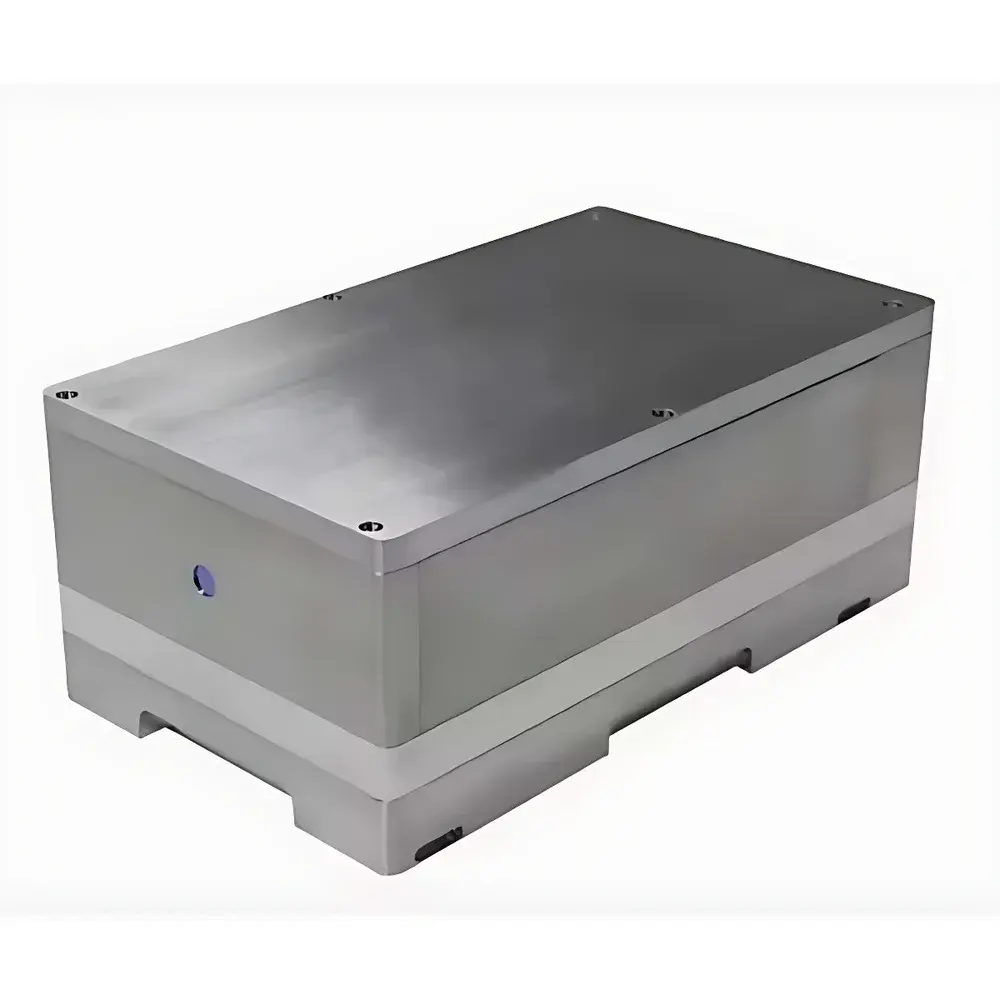
Auniontech 320/349 nm Single-Frequency Narrow-Linewidth Continuous-Wave Ultraviolet Laser System
| Brand | Auniontech |
|---|---|
| Wavelength | 320 nm / 349 nm |
| Output Power | ≤ 200 mW |
| Linewidth | < 0.5 MHz |
| Coherence Length | > 100 m |
| Spatial Mode | TEM₀₀ |
| Beam Divergence | 1.0 mrad |
| Beam Diameter | 0.6–1.2 mm |
| Power Stability | < 2.0 % (8 h) |
| Intensity Noise | < 0.1 % RMS (10 Hz–10 MHz) |
| Spectral Stability | ±0.2 pm (8 h) |
| Beam Pointing Stability | < 5 µrad/°C |
Overview
The Auniontech 320/349 nm Single-Frequency Narrow-Linewidth Continuous-Wave Ultraviolet Laser System is a high-stability, diode-pumped solid-state (DPSS) laser engineered for precision photonic applications requiring coherent, spectrally pure UV radiation. Operating on the principle of intracavity frequency doubling of a stabilized single-longitudinal-mode (SLM) infrared seed laser, this system delivers diffraction-limited TEM₀₀ output at two discrete ultraviolet wavelengths—320 nm and 349 nm—with sub-megahertz spectral linewidth and coherence lengths exceeding 100 meters. Designed as a direct replacement for aging HeCd and Ar⁺ ion lasers, it eliminates gas discharge complexity, thermal drift, and high-voltage hazards while delivering superior power stability (<2.0% over 8 hours), ultra-low intensity noise (<0.1% RMS, 10 Hz–10 MHz), and exceptional spectral fidelity (±0.2 pm drift over 8 h). Its integrated controller, compact thermo-electric and air-cooled architecture, and robust mechanical design enable reliable deployment in space-constrained environments including cleanroom-based semiconductor metrology stations, optical fabrication labs, and university quantum optics setups.
Key Features
- Single-frequency operation with linewidth < 0.5 MHz, enabling high-resolution interferometry and coherent spectroscopy
- TEM₀₀ spatial mode with M² < 1.1 and beam divergence of 1.0 mrad for optimal coupling into single-mode fibers and waveguides
- Output power up to 200 mW—significantly higher than conventional HeCd lasers (typically ≤ 30 mW at 325 nm) and more power-efficient than water-cooled Ar⁺ systems
- Integrated digital temperature stabilization and active power feedback control ensuring long-term amplitude and wavelength repeatability
- Beam pointing stability < 5 µrad/°C, critical for alignment-sensitive applications such as holographic lithography and FBG inscription
- Compact OEM-ready housing (including driver, TEC controller, and heat dissipation) reduces footprint by >60% versus legacy ion-laser systems
Sample Compatibility & Compliance
This laser system is compatible with standard UV-grade fused silica optics, CaF₂ lenses, and reflective coatings optimized for the 300–350 nm range. It meets IEC 60825-1:2014 Class 3B laser safety requirements when operated with appropriate interlocks and beam enclosures. The optical design avoids ozone-generating wavelengths below 240 nm, making it suitable for ambient-air operation without forced ventilation. For regulated environments—including ISO 17025-accredited calibration labs and GMP-compliant photomask manufacturing—the system supports optional analog/digital modulation inputs and TTL-triggered start-up sequences compliant with GLP audit trails. While not FDA-cleared as a medical device, its spectral purity and stability align with ASTM E2912–22 guidelines for UV source characterization in materials testing.
Software & Data Management
The laser includes RS-232 and USB-C interfaces for remote parameter control via ASCII command protocol. A Windows-compatible configuration utility enables real-time monitoring of output power, head temperature, diode current, and error logs. All operational parameters—including setpoints, calibration offsets, and thermal history—are stored in non-volatile memory with timestamped logging (UTC-synchronized). Optional LabVIEW™ and Python SDKs support integration into automated test platforms adhering to IEEE 1622.1-2021 data acquisition standards. Audit-trail functionality records user-initiated changes with operator ID and timestamp, satisfying basic 21 CFR Part 11 electronic record requirements when deployed with validated IT infrastructure.
Applications
- Photothermorefractive (PTR) glass grating fabrication via UV-induced refractive index change
- High-fidelity UV Raman spectroscopy of biological macromolecules and semiconductor defects
- Deep-UV inspection of 28 nm and smaller node wafers using laser-scanned dark-field imaging
- Coherent anti-Stokes Raman scattering (CARS) microscopy with pump-probe synchronization
- Writing of volume Bragg gratings (VBGs) and chirped fiber Bragg gratings (CFBGs) with sub-nanometer spectral control
- Calibration of UV spectroradiometers traceable to NIST SRM 2031 and 2032 reference sources
- Stimulated emission depletion (STED) super-resolution microscopy requiring stable, narrowband excitation
FAQ
What is the typical warm-up time to achieve spectral and power stability?
The system reaches full thermal equilibrium and specified stability metrics within 30 minutes after cold start, verified per ISO 11554 Annex B protocols.
Is external water cooling required?
No—this is an air-cooled, thermoelectrically stabilized platform; no chiller or plumbing is needed.
Can the 320 nm and 349 nm versions be operated simultaneously?
No—each unit is factory-configured for one fixed wavelength; dual-wavelength operation requires separate modules.
Does the laser support analog modulation?
Yes—0–5 V analog input allows continuous power modulation from 10% to 100% of rated output with bandwidth up to 100 kHz.
What beam delivery options are available?
Standard output is free-space collimated beam; fiber-coupled variants (with UV-grade SMF-28 or Fused Silica PANDA polarization-maintaining fiber) are available upon request with FC/PC or SMA905 connectors.



