
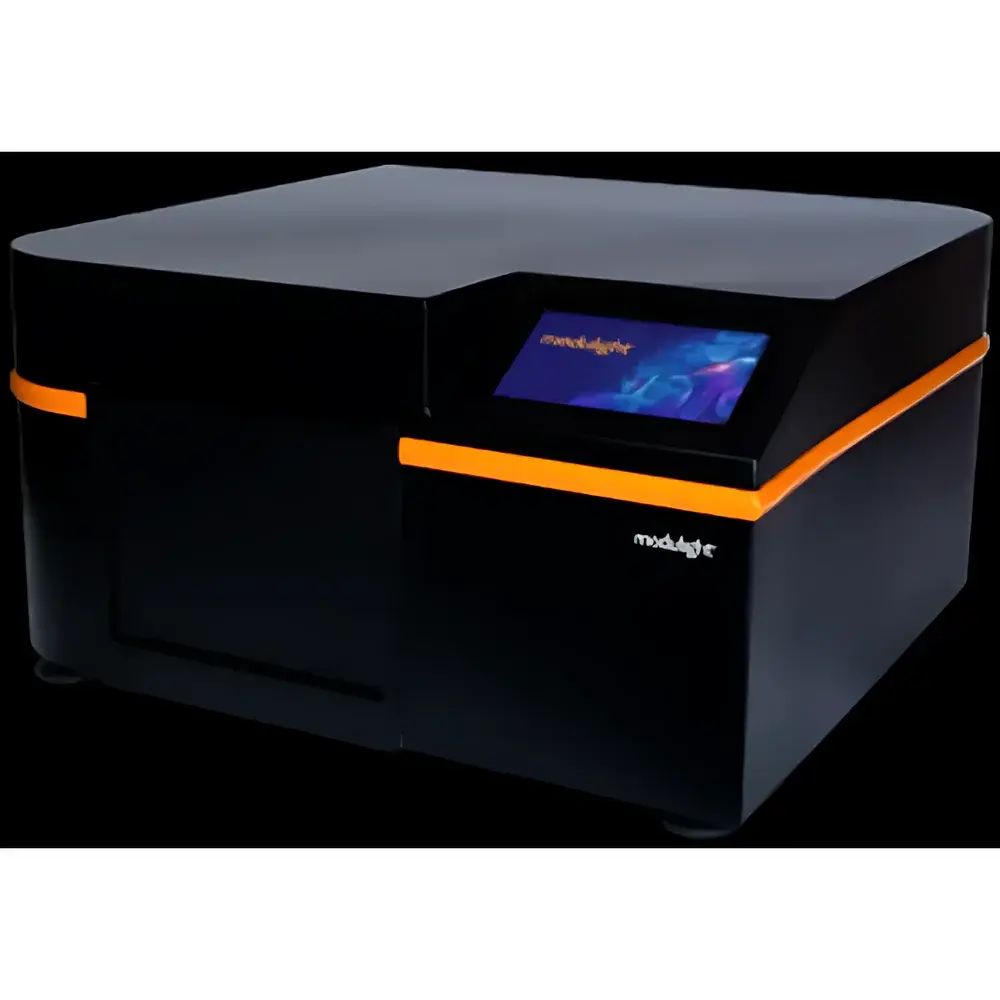
Modulight ML8500 Automated Biomedical Illumination System
| Brand | Modulight |
|---|---|
| Origin | Finland |
| Model | Tunable Broadband Light Source |
| Illumination Mode | External Illumination |
| Light Source Types | Xenon Lamp, Mercury Lamp |
| Compliance | CE, IEC 61000-6-3, IEC 61000-6-4 |
| Environmental Control | Integrated Hypoxia/O₂ Regulation (0.1–21% O₂) |
| Illumination Stations | Up to 4 configurable stations (e.g., 95 mm dish, 24/96/384/1536-well plates) |
| Wavelength Flexibility | Simultaneous multi-wavelength output (7 discrete channels, 350–850 nm range) |
| Control Interface | 10.1″ capacitive touchscreen + Modulight Cloud platform |
| Data Management | Audit-trail-enabled logging compliant with GLP/GMP principles |
| Software | MLControl v4.x with protocol scheduling, dose calibration (J/cm²), irradiance control (mW/cm²), and time-resolved exposure sequencing |
Overview
The Modulight ML8500 Automated Biomedical Illumination System is a precision-engineered platform for controlled, reproducible, and physiologically relevant photobiological experimentation. Designed around the fundamental requirements of modern photopharmacology and photodynamic therapy (PDT) research, the ML8500 implements calibrated external illumination using high-stability broadband sources—including xenon and mercury arc lamps—combined with tunable spectral filtering and real-time irradiance monitoring. Its core architecture integrates optical delivery, environmental regulation, and automated sample handling into a single modular system. Unlike conventional light boxes or manual lamp setups, the ML8500 enforces traceable light dosimetry per defined region-of-interest (ROI), enabling compliance with ISO 15312:2019 (photobiological safety) and supporting experimental rigor required for preclinical drug development under GLP conditions.
Key Features
- Multi-station illumination architecture: Supports up to four independently configurable illumination zones—optimized for standard formats including 95 mm Petri dishes, 24-, 96-, 384-, and 1536-well microplates—with spatially resolved irradiance mapping and per-well dose control.
- Physiological environment integration: Built-in hypoxia chamber maintains oxygen concentrations from 0.1% to 21% O₂ with programmable gas mixing (N₂/O₂/CO₂), enabling studies under tumor-relevant hypoxic conditions critical for evaluating oxygen-dependent therapies.
- Calibrated spectral flexibility: Delivers simultaneous or sequential illumination across seven user-selectable wavelength bands (350–850 nm), supported by interchangeable bandpass filters and real-time irradiance feedback via integrated photodiode sensors (±2% linearity, NIST-traceable calibration).
- Automated protocol execution: Touchscreen-driven workflow management enables definition of complex illumination sequences—including variable intensity ramps, timed intervals between drug incubation and light exposure, and multi-dose escalation schemes—without manual intervention.
- Cloud-connected operation: MLControl software interfaces with Modulight Cloud (cloud.modulight.com) to provide remote instrument diagnostics, over-the-air firmware updates, secure data export (CSV/JSON), and audit-log archiving compliant with FDA 21 CFR Part 11 requirements for electronic records.
Sample Compatibility & Compliance
The ML8500 accommodates standard cell culture vessels and assay plates used in high-content screening and mechanistic photobiology. Its illumination geometry ensures uniform irradiance distribution (±5% variation across 96-well footprint) validated per ASTM E2919-19 for radiometric uniformity testing. The system meets electromagnetic compatibility (EMC) standards IEC 61000-6-3 (emissions) and IEC 61000-6-4 (immunity), and carries CE marking for laboratory equipment. Environmental controls comply with ISO 14644-1 Class 8 cleanroom specifications when operated within enclosed biosafety cabinets. All irradiance values are reported in SI units (W/m², J/m²) and traceably referenced to NIST-calibrated reference detectors. For regulatory submissions, raw irradiance logs—including timestamped exposure events, ambient O₂ levels, and thermal drift compensation data—are stored with immutable digital signatures.
Software & Data Management
MLControl v4.x provides a deterministic, version-controlled environment for defining, validating, and executing illumination protocols. Each experiment generates a structured metadata bundle containing instrument configuration, environmental parameters, dose history, and operator credentials. Data files adhere to MIAME-compliant naming conventions and support direct ingestion into LIMS platforms via RESTful API. Audit trails record all user actions—including parameter edits, session start/stop timestamps, and cloud synchronization events—with SHA-256 hashing for integrity verification. Remote troubleshooting is facilitated through encrypted VNC sessions initiated only upon explicit user authorization. Software updates undergo ISO/IEC 17025-accredited validation prior to release, ensuring continuity of compliance during long-term study deployments.
Applications
The ML8500 serves as a foundational tool in multiple translational research domains: photodynamic drug activation (e.g., verteporfin-based HSP90 inhibitors in inflammatory breast cancer models), hypoxia-selective photosensitizer characterization (e.g., osmium-based compounds activated at 525 nm and 630 nm), light-triggered liposomal payload release (e.g., indocyanine green–loaded vesicles), and systematic irradiance–dose response profiling for novel photoactivatable prodrugs. Its capacity to decouple light parameters (irradiance, fluence, spectral composition, temporal profile) from biological variables (O₂ tension, cell confluency, drug uptake kinetics) makes it indispensable for mechanism-of-action studies requiring orthogonal parameter control. Pharmaceutical partners routinely deploy the ML8500 in early-stage photopharmacology screening aligned with ICH S9 and USP analytical instrument qualification guidelines.
FAQ
Does the ML8500 support GMP-compliant documentation workflows?
Yes—the system generates ALCOA+–compliant electronic records, including full audit trails, electronic signatures, and 21 CFR Part 11–enabled user access controls.
Can irradiance be calibrated in situ without external metrology equipment?
Yes—integrated photodiodes with factory-applied NIST-traceable correction factors enable routine self-calibration; optional annual recalibration services are available via Modulight’s accredited service center.
Is the hypoxia module compatible with live-cell imaging systems?
Yes—the chamber design allows integration with inverted microscopes via standardized optical ports and maintains stable temperature (±0.3°C) and humidity (≥85% RH) during extended hypoxic exposures.
What wavelength ranges are supported beyond the default 350–850 nm?
Custom filter sets extending into UV-C (254 nm) or NIR-II (1064 nm) are available upon request, subject to source lamp spectral output and thermal management constraints.
How is thermal load managed during prolonged illumination cycles?
Active Peltier cooling and forced-air heat dissipation maintain sample surface temperature within ±1.5°C of setpoint across all illumination modes, verified per ISO 8596:2018 thermal stability protocols.




