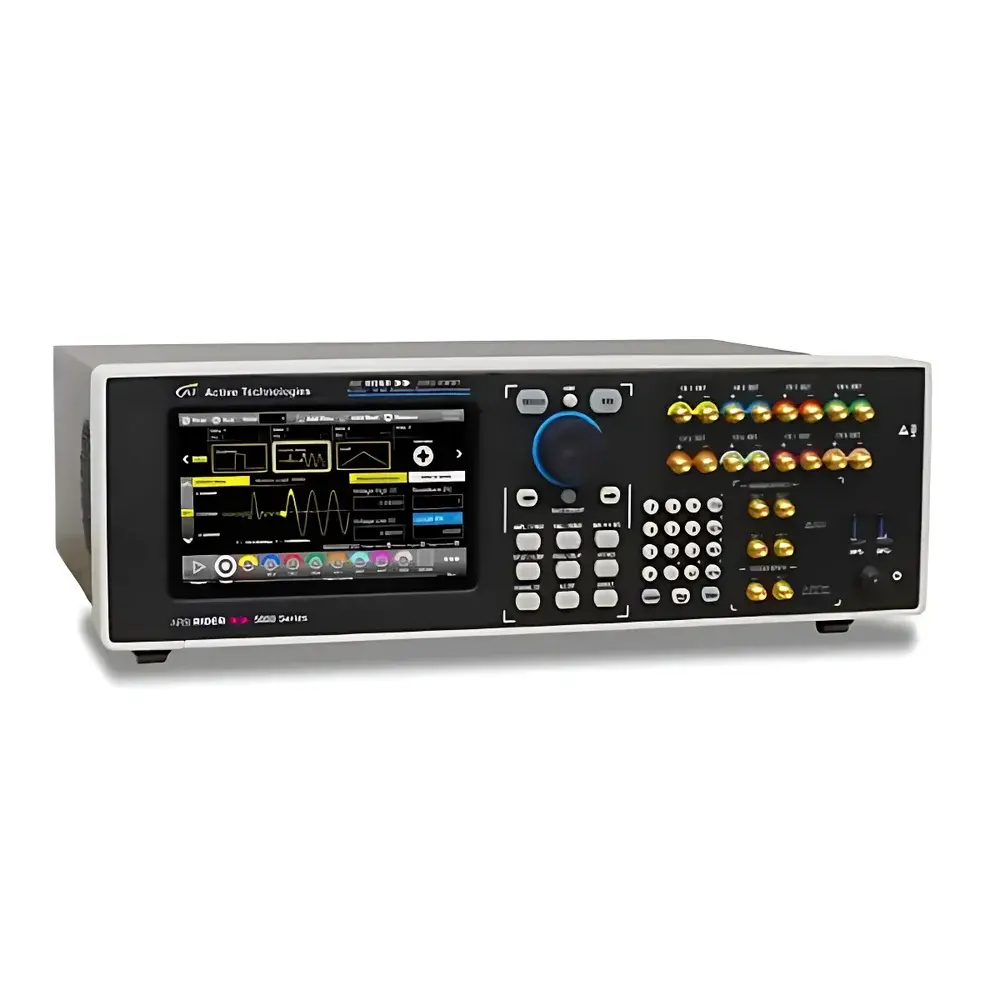
Auniontech Pulse Rider PG-1000 High-Speed Pulse Generator
| Brand | Auniontech |
|---|---|
| Origin | Shanghai, China |
| Model | PG-1000 |
| Instrument Type | Function/Arbitrary Waveform Generator (AWG) |
| Vertical Resolution (DAC) | 16-bit |
| Output Amplitude | 0–5 Vpp (programmable into 50 Ω) |
| Baseline Offset | ±2.5 V |
| Rise/Fall Time | 70 ps (20%–80%, fixed) |
| Minimum Pulse Width | 300 ps |
| Channel Count | 2 or 4 |
| Pulse Modes | Single, Dual, Triple, Quadruple (independent timing per pulse) |
| Interface | Touchscreen GUI (SimpleRider™) |
Overview
The Auniontech Pulse Rider PG-1000 is a high-performance, benchtop-grade high-speed pulse generator engineered for precision timing-critical applications in research laboratories and industrial test environments. It operates on a deterministic digital pulse synthesis architecture—leveraging direct digital synthesis (DDS) and high-speed FPGA-controlled output stages—to deliver sub-nanosecond temporal fidelity with exceptional amplitude stability and edge reproducibility. Unlike conventional function generators, the PG-1000 is purpose-built to generate clean, jitter-free, high-slew-rate pulses with defined rise/fall characteristics, making it suitable for applications where signal integrity, timing resolution, and inter-pulse phase coherence are paramount. Its core measurement principle relies on synchronous clock-domain control of pulse onset, width, delay, and amplitude—enabling deterministic generation of multi-pulse sequences without software-induced latency or timing drift. Designed for integration into automated test systems and physics experiments, the PG-1000 meets the stringent requirements of ultrafast electronics characterization, time-resolved spectroscopy, and pulsed RF subsystem validation.
Key Features
- Sub-100 ps rise/fall time (70 ps @ 20–80%, measured into 50 Ω load)
- 16-bit DAC resolution ensures fine-grained amplitude control (10 mV LSB at full scale)
- Independent timing control for dual-, triple-, and quadruple-pulse modes—each pulse configurable for delay, width, amplitude, and polarity
- Touchscreen-based SimpleRider™ interface enables intuitive waveform construction with ≤3 taps for basic pulse definition
- Programmable baseline offset (±2.5 V) supports DC-biased pulse injection into active devices
- Modular chassis design allows scalable multi-channel synchronization (2- or 4-channel configurations)
- Low-jitter internal clock (<100 fs RMS phase noise @ 10 MHz offset) ensures repeatable timing across long-duration pulse trains
- Front-panel BNC outputs with 50 Ω impedance matching; compatible with standard oscilloscope and digitizer trigger inputs
Sample Compatibility & Compliance
The PG-1000 is designed for use with passive and active electronic components requiring precise transient excitation—including laser diodes, electro-optic modulators, avalanche photodiodes, RF switches, and semiconductor memory test fixtures. Its output compliance (0–5 Vpp into 50 Ω, ±2.5 V offset range) aligns with JEDEC JESD22-A114 and IEC 61000-4-2 ESD pulse specifications for pre-compliance functional testing. While not certified for medical device production under IEC 62304 or ISO 13485, the instrument’s firmware implements non-volatile parameter storage with timestamped configuration logs—supporting GLP-aligned lab documentation practices. Traceability of generated pulse parameters (e.g., width, delay, amplitude) is maintained via ASCII export of setup files, enabling audit-ready records for ISO/IEC 17025-accredited calibration workflows.
Software & Data Management
The PG-1000 supports remote operation via USB 2.0 and Ethernet (TCP/IP), with native SCPI command set compliance (IEEE 488.2). AWindows/Linux-compatible SDK provides C/C++, Python, and MATLAB bindings for scripted test sequencing and integration into NI TestStand or Keysight PathWave environments. All user-defined pulse sequences—including multi-pulse timing trees—are stored as human-readable JSON files, facilitating version control and collaborative experiment replication. The instrument’s internal flash memory retains up to 128 waveform configurations with metadata (date, operator ID, notes), satisfying FDA 21 CFR Part 11 requirements for electronic record integrity when paired with network-authenticated login (via optional RADIUS integration). No cloud connectivity or telemetry is enabled by default—data residency remains fully on-premise.
Applications
- Semiconductor Device Testing: Generation of nanosecond-scale stress pulses for NVM (MRAM, ReRAM) switching characterization and TDDB reliability analysis
- Laser & Optoelectronics: Direct drive of pulsed laser diodes (PLDs) and electro-absorption modulators (EAMs); synchronization with streak cameras or single-photon avalanche diode (SPAD) arrays
- Ground-Penetrating Radar (GPR) Simulation: Replication of UWB radar waveforms (1–2 GHz bandwidth) with programmable PRF up to 400 MHz and pulse widths down to 300 ps
- Particle Physics Instrumentation: Triggering and gating of scintillation detectors, silicon strip sensors, and time-of-flight (ToF) systems in accelerator facilities
- Radar & LiDAR Development: Emulation of FMCW chirp envelopes and pulsed coherent radar waveforms for receiver chain validation
- Ultrafast Circuit Characterization: Stimulus-response testing of high-speed ADCs, comparators, and RF power amplifiers under realistic transient loading conditions
FAQ
What is the minimum achievable pulse width, and how is it verified?
The PG-1000 achieves a guaranteed minimum pulse width of 300 ps (FWHM), verified using calibrated 50-GHz real-time oscilloscopes traceable to NIST standards. Measurement uncertainty is ±15 ps (k=2) under controlled thermal conditions.
Can multiple PG-1000 units be synchronized for >4 channel operation?
Yes—units support external 10-MHz reference input and programmable trigger delay (0–100 ns, 1-ps resolution) for sub-10-ps inter-unit skew alignment. Synchronization requires a low-phase-noise distribution amplifier (e.g., Stanford Research Systems DG645 sync module).
Is the 70-ps rise time specified into 50 Ω or high-impedance loads?
All timing specifications—including rise/fall time and pulse width—are characterized into a matched 50-Ω termination. Performance degrades measurably into high-Z loads due to transmission-line reflections; 50-Ω source termination is mandatory for datasheet-compliant operation.
Does the PG-1000 support arbitrary waveform generation beyond discrete pulses?
No—the PG-1000 is a dedicated pulse generator. For full arbitrary waveform synthesis (including non-pulse shapes), Auniontech recommends the AWG-5000 series, which shares the same SimpleRider™ UI and synchronization architecture.
How is calibration maintained over temperature and time?
The unit incorporates onboard temperature-compensated voltage references and auto-nulling DAC circuitry. Factory calibration is valid for 12 months or 1,000 operating hours—whichever occurs first—and includes full amplitude, offset, and timing verification per IEEE Std 1057.
Related Products