
Ixblue Photonics Single-Frequency DFB Fiber Laser
| Brand | Ixblue Photonics |
|---|---|
| Origin | France |
| Type | Single Longitudinal Mode (SLM) DFB Fiber Laser |
| Wavelength Range | 1530–1565 nm & ~2000 nm |
| Linewidth | <100 kHz (typ.) |
| Polarization | Linear (PER >20 dB) |
| SMSR | >50 dB |
| Output Power | >10 mW (standard), >10 µW (low-noise version) |
| Optical Feedback Immunity | High |
| WDM Compatibility | Yes |
| Phase Noise | Ultra-low intrinsic (suitable for interferometric sensing) |
Overview
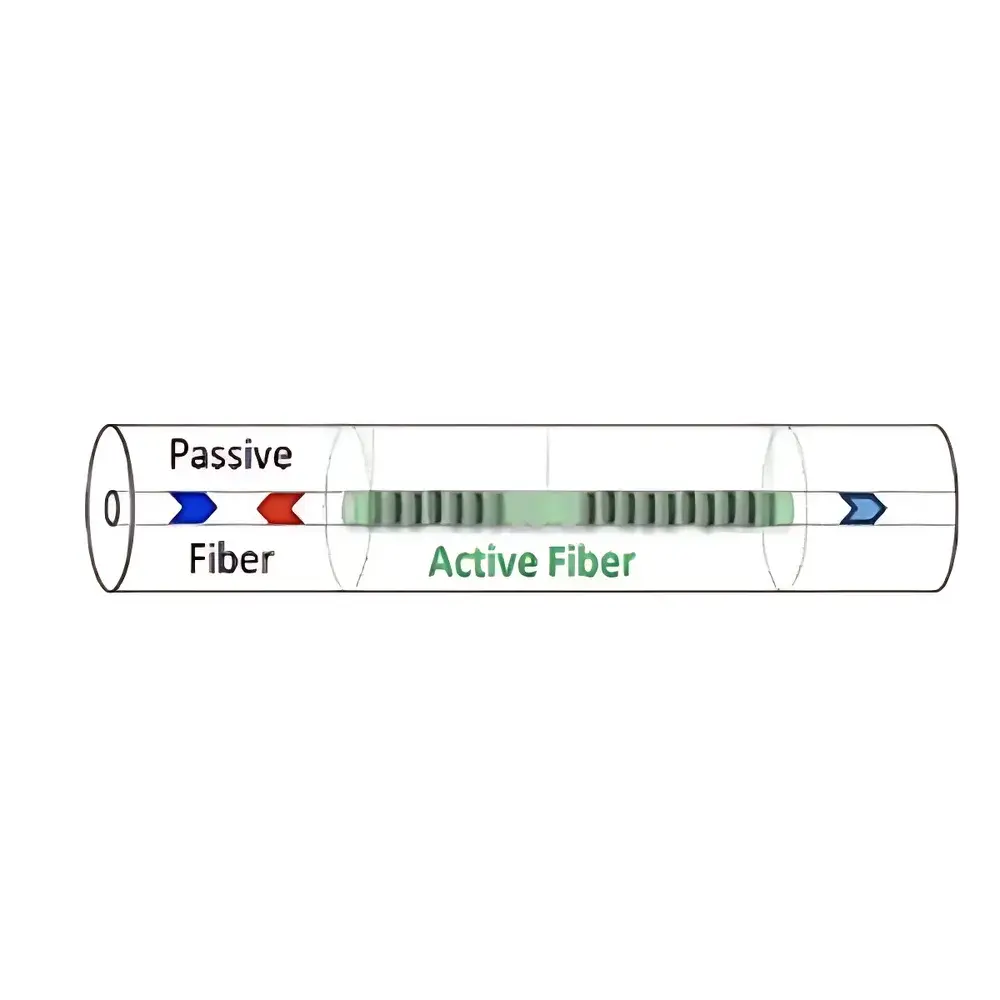
The Ixblue Photonics Single-Frequency DFB Fiber Laser is a highly stable, narrow-linewidth distributed feedback (DFB) laser source engineered for precision photonic applications requiring exceptional spectral purity and temporal coherence. Based on UV-induced fiber Bragg grating (FBG) technology written directly into rare-earth-doped photosensitive active fiber, this laser features an ultra-short monolithic cavity with integrated phase-shift design—enabling robust single longitudinal mode (SLM) operation without mode hops over extended temperature and current tuning ranges. Operating in the C-band (1530–1565 nm) and mid-infrared (~2000 nm) windows, it delivers fundamental performance advantages for coherent detection, heterodyne spectroscopy, and high-fidelity interferometry where phase stability, low relative intensity noise (RIN), and minimal back-reflection sensitivity are critical.
Key Features
- True single-frequency emission with linewidth <100 kHz (typ.), verified via delayed self-heterodyne interferometry
- High side-mode suppression ratio (SMSR) exceeding 50 dB ensures unambiguous SLM operation under varying environmental conditions
- Linearly polarized output with polarization extinction ratio (PER) >20 dB—optimized for polarization-sensitive interferometric setups
- Engineered optical feedback immunity: operates stably even with >−40 dB optical return loss, eliminating need for isolators in many embedded configurations
- Ultra-low intrinsic phase noise floor—critical for atom interferometry, gravitational wave detection precursors, and coherent LIDAR
- WDM-compatible spectral footprint enables integration into dense wavelength-division multiplexed (DWDM) sensing networks
- Two standard wavelength families: telecom C-band (1530–1565 nm) and eye-safe 2-µm band for gas sensing and biomedical applications
Sample Compatibility & Compliance
This laser is compatible with standard SMF-28 or PM1550 fiber pigtails (FC/APC or FC/PC connectors optional). It meets IEC 60825-1:2014 Class 1 laser safety requirements when properly housed. The device architecture supports integration into systems compliant with ISO/IEC 17025-accredited calibration workflows and is routinely deployed in laboratories adhering to GLP and GMP principles for sensor qualification. While not certified to FDA 21 CFR Part 11 out-of-the-box, its analog modulation interface and stable DC bias enable straightforward integration into audit-trail-capable data acquisition platforms.
Software & Data Management
The laser operates via precision current and temperature control interfaces (analog ±5 V or digital RS-232/RS-485). Optional OEM driver modules support LabVIEW, Python (PyVISA), and MATLAB instrument control libraries. Real-time monitoring of diode current, TEC voltage, and case temperature is provided for system-level diagnostics. All operational parameters—including setpoints, lock status, and fault logs—are timestamped and exportable in CSV format, facilitating traceability in regulated environments. Firmware updates are performed via secure UART protocol with CRC-verified packet transmission.
Applications
- Acoustic and seismic fiber-optic sensing (e.g., distributed acoustic sensing – DAS, hydrophone arrays)
- Cold atom physics: magneto-optical trap (MOT) cooling, atom interferometry, and optical lattice stabilization
- High-resolution absorption spectroscopy targeting trace gases (e.g., CO2, CH4, NH3) in the 2-µm window
- Coherent optical time-domain reflectometry (C-OTDR) and phase-sensitive OTDR (φ-OTDR)
- Optical gyroscopes and inertial measurement units (IMUs) requiring long coherence length (>1 km)
- Quantum optics experiments requiring indistinguishable photon generation and Hong–Ou–Mandel interference
- Calibration sources for wavemeters and optical spectrum analyzers (OSAs) with sub-pm resolution
FAQ
What is the typical coherence length of this DFB laser?
For a 50-kHz linewidth, the theoretical coherence length exceeds 3 km in air—practically limited by environmental path stability in interferometric implementations.
Can the laser be modulated for frequency or intensity tuning?
Yes: analog current modulation supports up to 10 MHz small-signal frequency dithering; external piezo-tuned fiber stretchers enable slow, precise wavelength scanning over ~1 GHz.
Is thermal tuning available for fine wavelength adjustment?
Yes: integrated TEC allows ±0.5 nm coarse tuning over −5 to +70 °C case temperature, with <1 pm/°C drift coefficient after thermal stabilization.
Do you provide optical isolation as a standard option?
No—due to its inherent feedback resilience, external isolation is typically unnecessary; however, 30-dB miniaturized isolators can be added upon request for ultra-high-stability configurations.
Are custom wavelengths within the 1530–1565 nm range supported?
Yes: Ixblue offers factory-wavelength setting with ±0.1 nm accuracy; custom FBG inscription allows discrete channel selection aligned with ITU-T G.694.2 grid points.





