
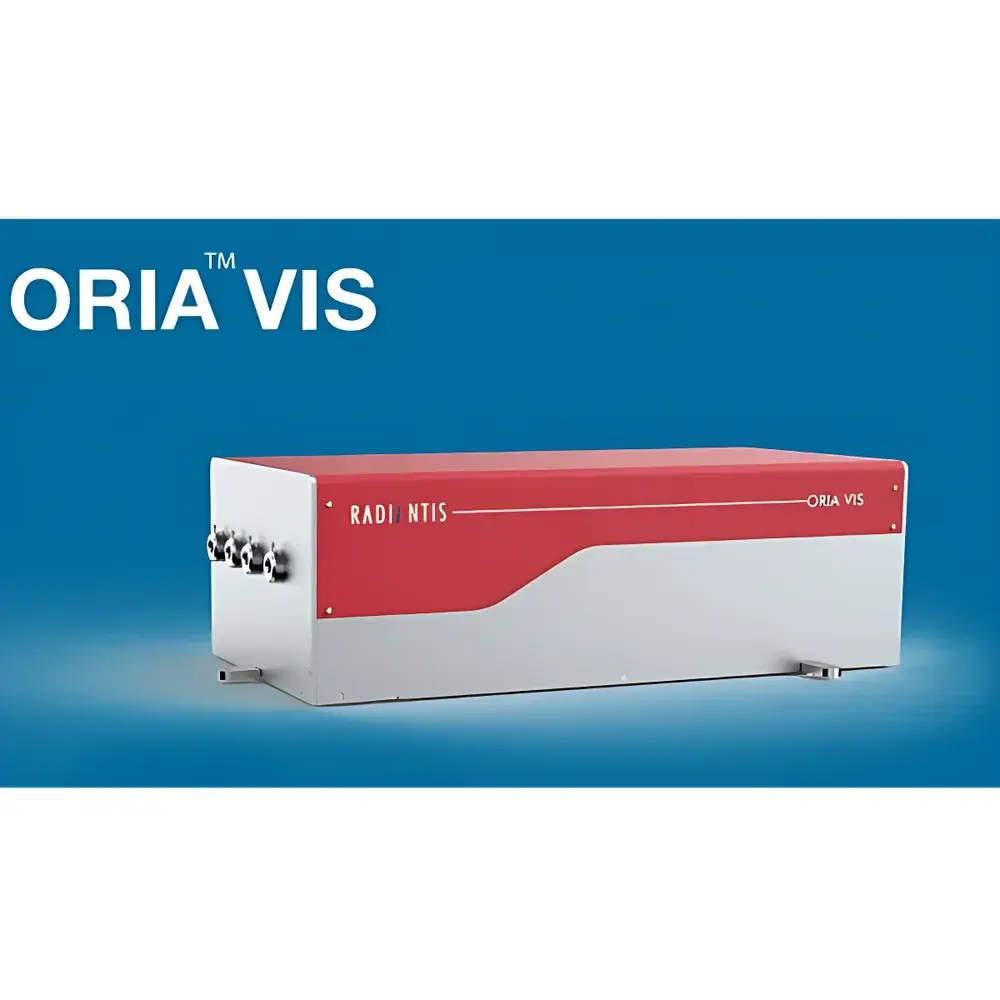
Radiantis Oria Vis Femtosecond Infrared-to-Visible Second-Harmonic Generation (SHG) Converter
| Brand | Radiantis |
|---|---|
| Origin | Spain |
| Type | Tunable Femtosecond SHG Frequency Doubler |
| Input Wavelength Range | 990–1550 nm (IR OPO) |
| Output Wavelength Range | 495–775 nm (Visible) |
| Conversion Efficiency | >40% |
| Average Output Power | >400 mW |
| Pulse Duration (FWHM) | <180 fs |
| Beam Diameter (at 525 nm) | 2.5 mm |
| Beam Divergence | 1 mrad |
| Spatial Mode | TEM₀₀ |
| Polarization | Vertical |
| Repetition Rate Compatibility | 80 MHz |
| Dimensions (W×L×H) | 568.0 × 366.5 × 189.2 mm |
Overview
The Radiantis Oria Vis is a fully automated, high-efficiency femtosecond second-harmonic generation (SHG) frequency doubler engineered for precise and stable conversion of infrared (IR) ultrafast pulses into the visible spectrum. Based on type-I or type-II phase-matched nonlinear optical processes in optimized birefringent crystals—such as BBO, LBO, or BiBO—the Oria Vis leverages the χ⁽²⁾ nonlinear susceptibility to generate coherent output at exactly twice the input photon frequency (2ω), enabling wavelength halving without temporal pulse distortion. Designed specifically for integration with commercial femtosecond optical parametric oscillators (OPOs) operating in the 990–1550 nm range, it delivers tunable visible output from 495 nm to 775 nm. This spectral coverage bridges critical gaps in ultrafast spectroscopy, particularly where Ti:sapphire-based systems lack flexibility and where broadband visible excitation is required with sub-100-fs temporal fidelity.
Key Features
- High conversion efficiency exceeding 40% across the full tuning range, delivering >400 mW average power under standard 80-MHz, ~100-fs IR pump conditions
- Minimal pulse broadening: output pulse duration maintained below 180 fs (FWHM), preserving time-domain resolution essential for pump-probe and time-resolved measurements
- Diffraction-limited spatial beam quality (TEM₀₀) with beam divergence of ≤1 mrad and wavelength-dependent beam displacement <2.5 µm—ensuring compatibility with high-NA microscopy and interferometric setups
- Motorized, software-controlled crystal angle and temperature tuning for rapid, repeatable wavelength selection; no manual alignment required after initial installation
- Compact monolithic housing (568 × 366.5 × 189.2 mm) with integrated thermal stabilization and vibration-damped optical mounts for long-term operational stability in shared laboratory environments
- Vertical linear polarization preservation at both input and output ports, facilitating straightforward integration into polarized excitation schemes and ellipsometric configurations
Sample Compatibility & Compliance
The Oria Vis is compatible with commercially available femtosecond IR OPOs emitting between 990 nm and 1550 nm, including those based on KTA, PPLN, and OP-GaAs gain media. It accepts free-space Gaussian beams with M² < 1.1 and input diameters up to 3 mm. The device meets CE marking requirements for electromagnetic compatibility (EMC Directive 2014/30/EU) and low-voltage safety (LVD Directive 2014/35/EU). While not classified as medical or industrial process equipment, its design adheres to ISO 10110 optical component manufacturing standards for surface quality and wavefront error. For GLP/GMP-aligned laboratories, the system supports audit-ready operation logs via its control software, including timestamped tuning history, power monitoring records, and error event reporting—facilitating traceability in regulated research environments.
Software & Data Management
The Oria Vis is operated via Radiantis’ proprietary Windows-based control suite, which provides real-time feedback on crystal orientation, temperature, output power, and wavelength calibration status. The interface includes programmable scan routines (linear, stepwise, or custom-defined), external trigger synchronization (TTL-compatible), and export of spectral tuning data in CSV and HDF5 formats. All motor positions and sensor readings are logged with microsecond timestamp resolution, satisfying basic requirements for 21 CFR Part 11-compliant electronic recordkeeping when deployed alongside validated laboratory information management systems (LIMS). Remote operation via TCP/IP is supported for integration into automated experiment workflows, and Python API bindings are available for custom scripting in scientific computing environments (e.g., Jupyter, LabVIEW, MATLAB).
Applications
- Ultrafast transient absorption and fluorescence upconversion spectroscopy requiring synchronized visible pump / IR probe pulses
- Single-molecule fluorescence imaging and polarization-resolved photodynamics studies demanding high peak intensity and minimal photodamage
- Pump-probe investigations of carrier dynamics in 2D materials (e.g., MoS₂, WS₂) and perovskite semiconductors
- CARS (Coherent Anti-Stokes Raman Scattering) and SRS (Stimulated Raman Scattering) microscopy using dual-wavelength excitation
- Nanophotonic characterization including near-field scanning optical microscopy (NSOM) and plasmonic hot-spot mapping
- Quantum optics experiments involving entangled photon pair generation via cascaded SPDC-SHG processes
FAQ
What input laser specifications are required to achieve rated output performance?
The Oria Vis is optimized for 80-MHz repetition rate, sub-100-fs pulses centered between 990 nm and 1550 nm, with average power ≥1 W and M² ≤1.1. Performance degrades outside these parameters due to phase-matching bandwidth limitations and thermal loading effects.
Can the Oria Vis be used with amplifier systems (e.g., regenerative amplifiers)?
No—it is designed exclusively for oscillator-level average powers (≤1.5 W) and MHz repetition rates. Higher pulse energies induce crystal damage and nonlinear back-conversion; for amplified sources, consult Radiantis’ Oria HP series.
Is vacuum or purged operation required for UV-extended variants?
Not for the standard Oria Vis (495–775 nm). However, operation below 495 nm requires optional fused silica windows and nitrogen purging to mitigate ozone absorption and surface contamination.
How frequently does the system require recalibration?
Factory calibration remains valid for ≥12 months under stable ambient conditions (±1°C, no mechanical shock). Annual verification using a NIST-traceable wavemeter is recommended for metrology-critical applications.
Does the device support dual-output configurations (e.g., simultaneous fundamental + SHG)?
Yes—via integrated dichroic beam sampling; the unconverted IR residual (990–1550 nm) is accessible through a dedicated port with <5% insertion loss and collinear spatial overlap within 10 µm tolerance.




