
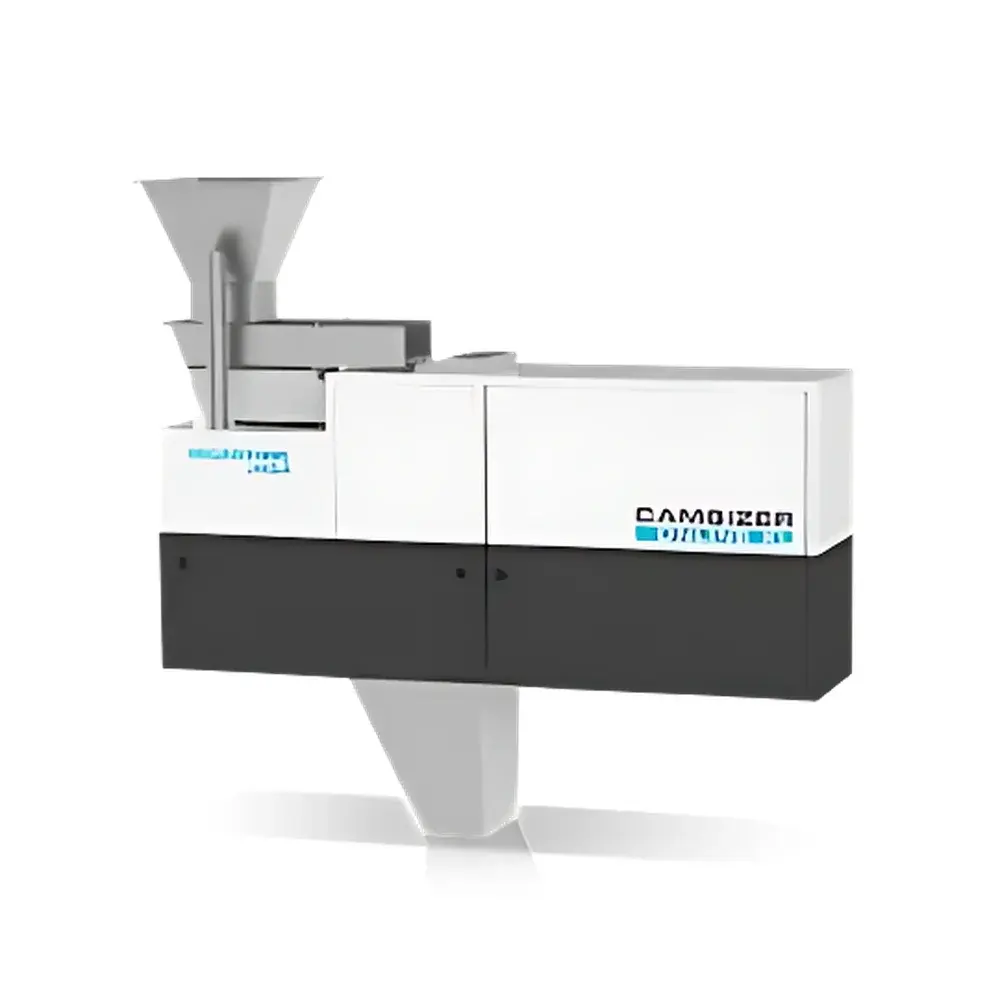
Microtrac MRB CAMSIZER ONLINE XL Image-Based Online Particle Size and Shape Analyzer
| Brand | Microtrac MRB |
|---|---|
| Origin | Germany |
| Manufacturer Type | Authorized Distributor |
| Product Origin | Imported |
| Model | CAMSIZER ONLINE XL |
| Instrument Type | Dynamic Online Analyzer |
| Measurement Range | 0.8 µm to 8 mm (standard) |
| Measured Parameters | Particle size distribution (D10, D50, D90, length, width, equivalent circular diameter, Feret diameters), particle shape descriptors (aspect ratio, symmetry, sphericity, convexity, solidity, roundness, roughness) per ISO 9276-6 |
Overview
The Microtrac MRB CAMSIZER ONLINE XL is an industrial-grade, image-based online particle size and shape analyzer engineered for real-time, non-contact monitoring of bulk solid materials in continuous production environments. Unlike static benchtop imaging systems, the CAMSIZER ONLINE XL employs high-speed, dual-camera stereoscopic imaging coupled with synchronized illumination and precise particle trajectory control to capture thousands of individual particles per second as they pass through the measurement zone via gravity-fed, pneumatic, or liquid dispersion pathways. Its core principle relies on digital image analysis of projected silhouettes and 3D surface reconstruction algorithms—enabling simultaneous quantification of both dimensional metrics (e.g., maximum Feret diameter, minimum bounding rectangle dimensions) and morphological descriptors derived from ISO 9276-6. Designed for integration into cement, mineral processing, pharmaceutical granulation, and battery electrode slurry lines, it delivers statistically robust data without sample withdrawal or manual intervention.
Key Features
- True online operation with fully automated, continuous measurement cycles—no offline sampling required
- Dual high-resolution CMOS cameras with telecentric optics ensure sub-pixel edge detection and minimal perspective distortion across the full 8 mm field of view
- Three configurable dispersion modules: free-fall (10–8,000 µm), compressed-air jet (0.8–5,000 µm), and recirculating wet cell (0.8–1,000 µm), each optimized for material-specific flow dynamics and agglomeration behavior
- Real-time calculation of over 30 standardized shape parameters—including sphericity (ISO 9276-6), convexity, solidity, and aspect ratio—with traceable calibration against NIST-traceable glass microspheres
- Ruggedized IP65-rated enclosure with integrated temperature and humidity monitoring for stable operation in harsh plant environments (ambient range: 5–40 °C)
- Modular design supports hot-swappable camera units, LED light sources, and dispersion nozzles—minimizing downtime during maintenance
Sample Compatibility & Compliance
The CAMSIZER ONLINE XL accommodates dry powders, granules, pellets, and slurries across diverse industries—including construction aggregates, metal powders for additive manufacturing, catalyst carriers, and active pharmaceutical ingredients (APIs). Its dispersion flexibility ensures reliable characterization of cohesive, friable, or fibrous materials without mechanical degradation. All shape metrics conform to ISO 9276-6:2019 (“Representation of results of particle size analysis — Part 6: Descriptive and quantitative representation of particle shape and morphology”) and are compatible with ASTM E2457 (Standard Practice for Characterization of Particles by Shape Analysis Using Digital Imaging). The system supports 21 CFR Part 11-compliant audit trails when paired with optional Microtrac’s TRU-SHAPE software suite, meeting GLP/GMP documentation requirements for regulated pharmaceutical and biotech manufacturing.
Software & Data Management
TRU-SHAPE v5.2 software provides real-time visualization of size distribution histograms, shape scatter plots (e.g., sphericity vs. aspect ratio), and trend dashboards with configurable alarm thresholds. Raw image archives, metadata logs (timestamp, environmental conditions, dispersion mode), and processed results are stored in a relational SQL database with role-based access control. OPC UA and Modbus TCP interfaces enable seamless integration into DCS/SCADA platforms (e.g., Siemens PCS7, Emerson DeltaV) for closed-loop process feedback. Batch export supports CSV, PDF, and XML formats compliant with LIMS and ERP systems. Optional AI-assisted anomaly detection identifies sudden shifts in shape distribution indicative of upstream equipment wear or feedstock variation.
Applications
- Cement and limestone grinding circuit optimization—correlating particle elongation with mill throughput and separator efficiency
- Pharmaceutical fluid-bed granulator endpoint determination using real-time sphericity and convexity trends
- Battery cathode powder quality assurance—monitoring graphite flake aspect ratio and surface roughness to predict electrode coating uniformity
- Metal injection molding (MIM) feedstock qualification—verifying spherical morphology and absence of satellite particles prior to debinding
- Recycled aggregate classification in concrete recycling plants—quantifying angularity and surface texture to meet EN 12620 specifications
FAQ
What dispersion method is recommended for fragile or heat-sensitive materials?
Free-fall dispersion is preferred for thermally labile or mechanically delicate samples, as it avoids shear forces associated with pneumatic or wet dispersion.
Can the CAMSIZER ONLINE XL replace offline laser diffraction for QC reporting?
It complements—not replaces—laser diffraction; while LD excels in speed and repeatability for monomodal distributions, the CAMSIZER XL provides orthogonal shape intelligence essential for functional performance prediction.
Is calibration traceable to national standards?
Yes—camera pixel calibration uses NIST-traceable stage micrometers, and shape algorithm validation follows ISO/IEC 17025-accredited protocols performed at Microtrac MRB’s German metrology lab.
How frequently does the system require recalibration?
Under stable environmental conditions and routine maintenance, recalibration intervals are typically 6–12 months; automated daily self-checks verify optical alignment and illumination stability.
Does the system support multi-stream switching for parallel line monitoring?
With optional multiplexer hardware and TRU-SHAPE MultiLine license, up to four independent feed streams can be sequentially analyzed with automatic context tagging and report generation.



