
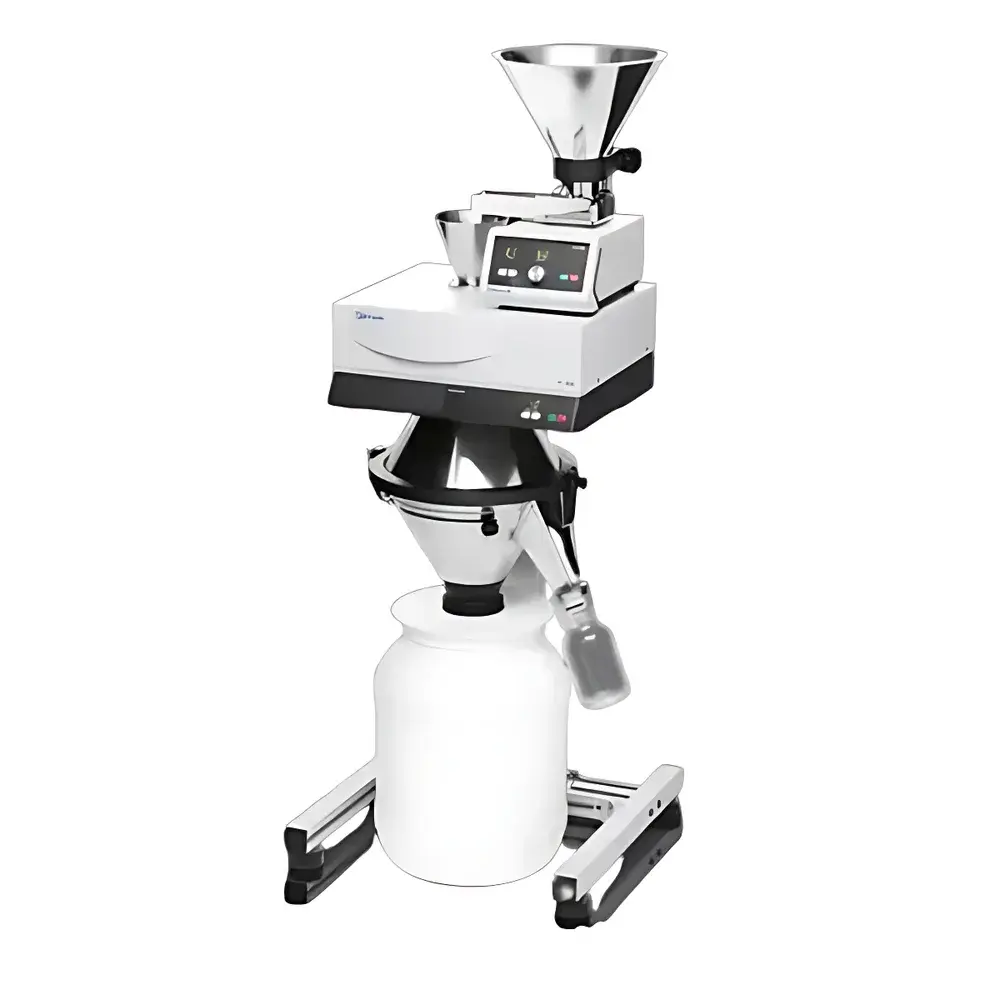
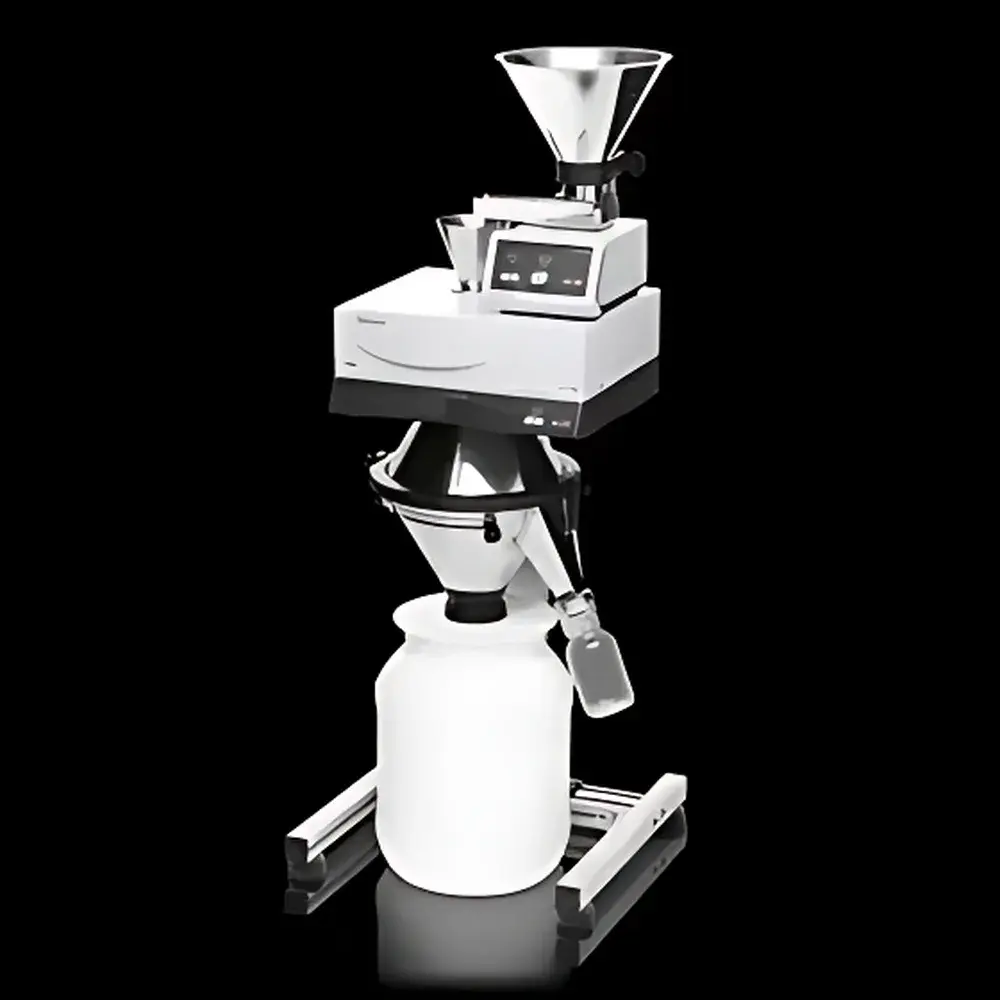
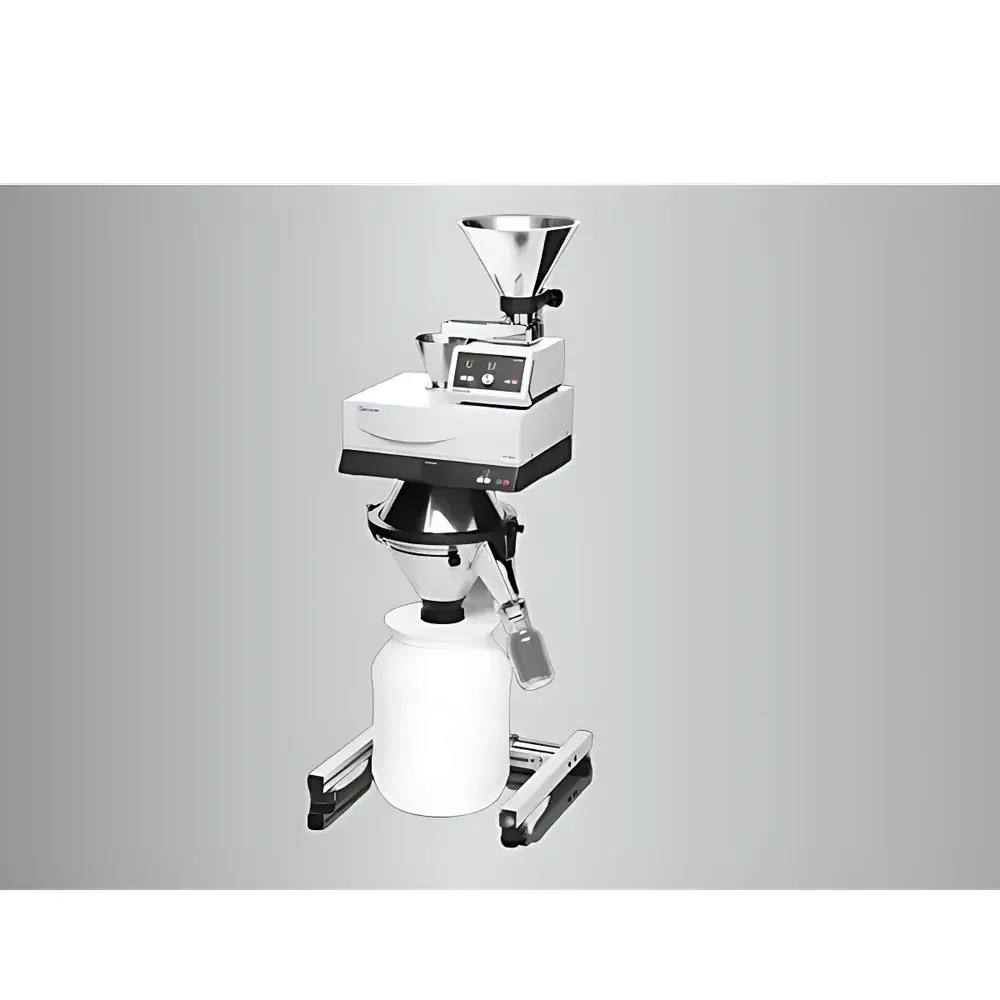
RETSCH PT 200 Rotary Sample Divider
| Brand | RETSCH |
|---|---|
| Origin | Germany |
| Model | PT 200 |
| Sample Type | Dry, free-flowing powders and granular materials |
| Dividing Principle | Rotating tube with adjustable slit (DIN 51701 compliant) |
| Division Ratio Range | Continuously adjustable via slit width |
| Output Ports | Up to 3 independent collection outlets |
| Throughput Capacity | Suitable for bulk sample volumes (up to several kg per cycle) |
| Drive | Variable-speed motor-controlled rotation |
| Compliance | DIN 51701, ISO 14887 (sample division for particulate materials) |
| Modular Integration | Compatible with RETSCH DR 100 dust-free feeding unit |
Overview
The RETSCH PT 200 Rotary Sample Divider is an engineered solution for the precise, reproducible subdivision of dry, free-flowing particulate materials in laboratory and quality control environments. It operates on the rotating tube principle — a gravimetric, mechanical division method standardized under DIN 51701 and aligned with ISO 14887 for representative sampling of powders and granules. Unlike riffle-type or cone splitters, the PT 200 employs a horizontally mounted, motor-driven rotating tube equipped with a precision-adjustable longitudinal slit. As material flows continuously through the tube, the slit periodically exposes discrete volumetric segments to gravity-fed discharge ports. This ensures statistically robust subsampling by eliminating segregation bias and maintaining mass proportionality across all fractions. The instrument is specifically designed for applications where analytical validity hinges on sample representativeness — such as raw material qualification, batch release testing, and homogeneity assessment prior to particle size analysis, chemical assay, or rheological characterization.
Key Features
- Continuously adjustable division ratio via calibrated slit-width mechanism — enabling precise control over subsample mass without requiring multi-stage splitting
- Three independently configurable discharge outlets — allowing simultaneous collection of up to three representative subfractions in a single operation
- Quick-release conical base and tool-free port disassembly — facilitating rapid cleaning, cross-contamination mitigation, and material changeover
- Variable rotational speed drive — optimized for consistent flow dynamics across diverse bulk densities and flow properties (e.g., fine metal powders vs. coarse agricultural grains)
- Modular compatibility with the RETSCH DR 100 dust-tight vibratory feeder — ensuring operator safety and environmental containment during handling of hazardous or inhalable particulates
- Robust stainless-steel construction and IP54-rated enclosure — supporting long-term reliability in industrial QC labs and regulated manufacturing settings
Sample Compatibility & Compliance
The PT 200 accommodates a broad spectrum of dry, non-cohesive solid materials including but not limited to cement clinker, mineral ores, pharmaceutical excipients, ceramic precursors, food-grade flours, fertilizers, and metallurgical powders. It is unsuitable for wet, sticky, fibrous, or highly electrostatic materials. All operational parameters adhere to DIN 51701 “Testing of Solid Fuels — Mechanical Sample Dividers” and support compliance with ISO 14887 “Fine Ceramics — Sampling of Powders”. When integrated into validated workflows, the system supports GLP and GMP documentation requirements — particularly when paired with traceable calibration records and audit-ready process logs from upstream feeders or downstream analyzers.
Software & Data Management
The PT 200 is a stand-alone electromechanical instrument without embedded firmware or digital interface. However, its deterministic mechanical operation enables seamless integration into automated sample preparation lines. Rotation speed, slit position, and cycle duration can be externally controlled via 0–10 V analog signals or relay-triggered I/O when interfaced with programmable logic controllers (PLCs) or LIMS-integrated sample handling platforms. For full regulatory traceability, users are advised to document slit calibration certificates, maintenance logs, and operational parameters (e.g., rpm, slit width setting, total feed mass) in accordance with 21 CFR Part 11-compliant electronic notebooks or validated paper-based SOPs.
Applications
- Preparation of representative sub-samples for laser diffraction particle size analysis (e.g., before measurement on Mastersizer or Horiba LA-960)
- Homogeneity verification of blended pharmaceutical powders prior to tablet compression
- Reduction of large field-collected soil or sediment composites to analytical aliquots for XRF or ICP-MS
- Quality assurance sampling of bulk construction aggregates and asphalt mix components
- Subdivision of certified reference materials (CRMs) for inter-laboratory comparison studies
- Feedstock conditioning in battery cathode material R&D — ensuring uniform distribution of Ni-Co-Mn oxide powders prior to slurry formulation
FAQ
What standards does the PT 200 comply with?
It conforms to DIN 51701 and supports implementation of ISO 14887 for mechanical sample division of dry particulates.
Can the PT 200 handle abrasive materials like silica sand or alumina?
Yes — its hardened stainless-steel tube and wear-resistant slit mechanism are rated for repeated use with moderately abrasive granular media.
Is calibration required, and how often should it be performed?
Slit width must be verified using certified gauge blocks at installation and after any mechanical impact or maintenance; routine checks are recommended per ISO/IEC 17025 internal audit schedules.
Does the PT 200 require compressed air or external utilities beyond mains power?
No — it operates solely on single-phase AC power (230 V / 50–60 Hz); optional DR 100 feeder may require separate power but no pneumatic supply.
How is sample cross-contamination prevented between runs?
The quick-detach conical base and smooth internal tube geometry allow complete manual or vacuum-assisted residue removal; validation protocols typically specify ≤10 ppm carryover for high-purity applications.



