
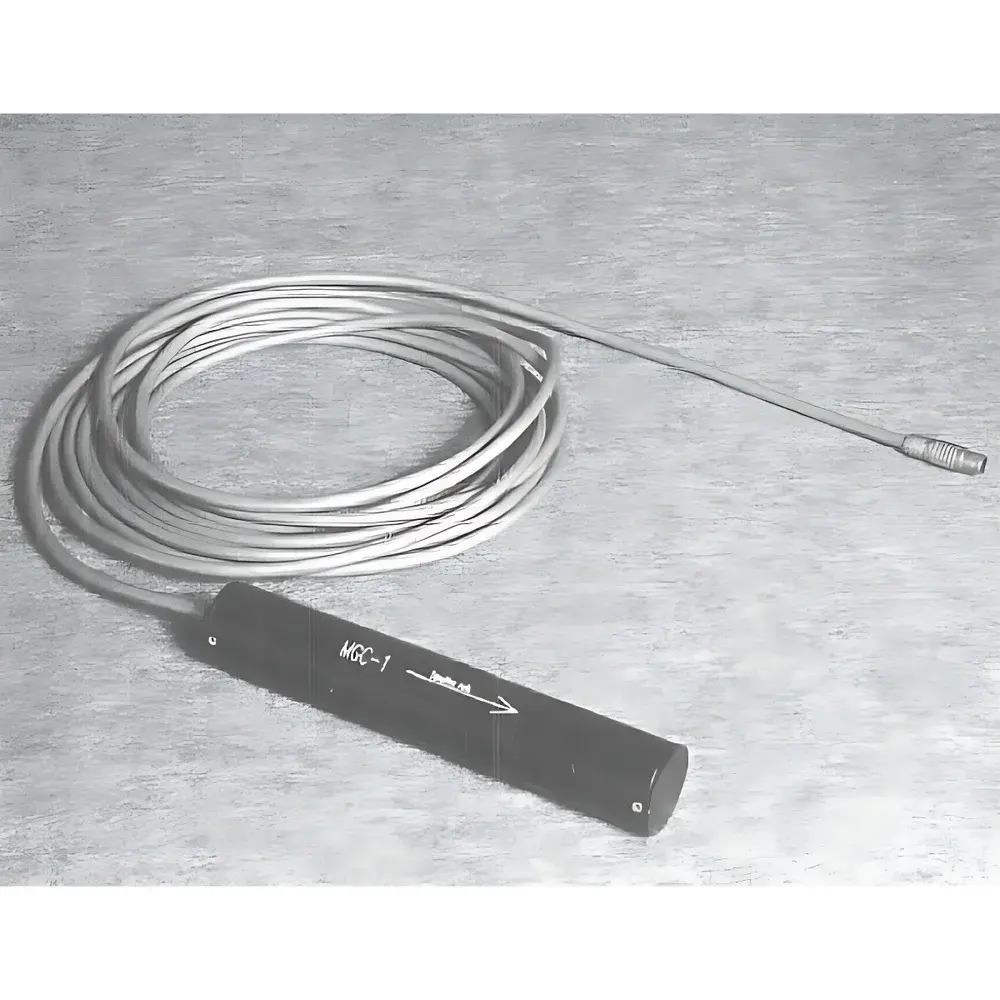
Auniontech AB300 Triaxial High-Frequency AC Magnetic Field Sensor (5 Hz – 100 kHz)
| Brand | Auniontech |
|---|---|
| Origin | Shanghai, China |
| Model | AB300 |
| Frequency Range | 5 Hz – 100 kHz |
| Noise Floor | 130 fT/√Hz @ 10 kHz |
| Amplitude Flatness | ±1 dB (300 Hz – 30 kHz, p-p ≤ 2 dB) |
| Sensitivity Stability | Frequency-independent response across operating bandwidth |
| Power Consumption | 250 mW nominal |
| Output | Differential low-impedance analog voltage (±5 V full scale, configurable) |
| Compliance | RoHS 3, CE-marked for EMC and LVD |
Overview
The Auniontech AB300 Triaxial High-Frequency AC Magnetic Field Sensor is an engineered solution for precision vector measurement of time-varying magnetic fields in the 5 Hz to 100 kHz range. Based on the principle of Faraday induction, the sensor employs three orthogonally oriented, ferrite-cored search coils—each optimized for minimal self-resonance, high winding uniformity, and controlled magnetic path reluctance. The induced electromotive force (EMF) in each coil is conditioned by a custom-designed, ultra-low-noise, wideband current-to-voltage amplifier with matched gain-bandwidth product and input impedance characteristics. This co-design of transducer and electronics ensures flat amplitude and phase response across the specified frequency span, eliminating the need for real-time frequency compensation during dynamic field characterization. Unlike Hall-effect or magnetoresistive sensors, the AB300 delivers true RMS field magnitude and directional information without hysteresis, offset drift, or saturation effects—making it suitable for quantitative metrology in electromagnetic compatibility (EMC), power electronics validation, biomagnetic signal screening, and fundamental physics experiments.
Key Features
- Triaxial vector sensing architecture enabling simultaneous X/Y/Z component acquisition with <1° orthogonal alignment tolerance
- Flat frequency response: ±1 dB amplitude deviation from 300 Hz to 30 kHz; peak-to-peak variation ≤2 dB across full 5 Hz–100 kHz bandwidth
- Ultra-low intrinsic noise floor of 130 fT/√Hz at 10 kHz—enabling detection of sub-picoTesla AC fields in shielded environments
- Differential analog output (±5 V full-scale, user-configurable scaling) compatible with standard 16-bit+ data acquisition systems
- Low-power operation (250 mW nominal) with thermally stable gain and offset performance over 0–45 °C ambient
- Integrated mechanical housing with non-magnetic aluminum alloy construction and calibrated mounting interface (M4 threaded holes)
- No internal digital processing or firmware—ensures deterministic latency (<100 ns group delay variation) and immunity to software-induced artifacts
Sample Compatibility & Compliance
The AB300 is designed for contactless, non-invasive measurement of AC magnetic flux density in free space, air-core inductors, transformer windings, PCB trace emissions, and near-field radiation from switching power supplies. It does not require physical coupling to conductors and remains insensitive to static (DC) fields up to ±100 µT. The sensor meets IEC 61000-4-8 (power frequency magnetic field immunity testing), EN 55032 Class B emission limits verification, and ASTM D7933-15 (standard practice for measuring AC magnetic fields near electronic devices). Its RoHS 3-compliant materials and CE marking cover essential requirements under EU Directive 2014/30/EU (EMC) and 2014/35/EU (LVD). For GLP/GMP-regulated environments, raw analog output supports audit-trail-capable DAQ systems compliant with FDA 21 CFR Part 11 when paired with validated hardware and software.
Software & Data Management
The AB300 operates as a pure analog transducer—no embedded microcontroller, no USB interface, and no proprietary drivers. Users integrate it directly into existing test platforms via standard BNC or LEMO connectors. Signal conditioning, spectral analysis (FFT, PSD), vector summation (|B| = √(Bₓ² + Bᵧ² + B_z²)), and time-domain demodulation are performed externally using industry-standard tools such as MATLAB® Signal Processing Toolbox, Python (SciPy, NumPy), Keysight PathWave, or National Instruments LabVIEW. Calibration certificates include NIST-traceable sensitivity factors (V/nT) per axis, phase deviation curves (±0.5° max between axes at 1 kHz), and thermal drift coefficients (≤50 ppm/°C). Optional MATLAB-based calibration import scripts facilitate automated correction matrix application during post-processing.
Applications
- EMI/EMC pre-compliance testing of switch-mode power supplies, motor drives, and wireless charging systems
- Characterization of magnetic field leakage from toroidal inductors, common-mode chokes, and planar magnetics
- Validation of active magnetic shielding systems used in quantum sensor laboratories and low-field MRI development
- Time-resolved mapping of eddy current distributions in non-destructive evaluation (NDE) of conductive materials
- Fundamental studies of geomagnetically induced currents (GICs) and low-frequency atmospheric electromagnetic phenomena
- Calibration reference for secondary magnetic field probes in metrology labs accredited to ISO/IEC 17025
FAQ
Does the AB300 require external power or bias current?
Yes—it requires a single +15 V DC supply (±5 % tolerance, ripple <10 mVpp) delivered via a 4-pin LEMO connector. No bias current is needed for the coils themselves.
Can the AB300 measure DC or quasi-static fields?
No. It is strictly an AC-coupled sensor with a lower cutoff frequency of 5 Hz. Static or slowly varying fields (<1 Hz) fall below its operational bandwidth and are rejected by the front-end AC coupling network.
What is the maximum measurable field strength before saturation?
The linear dynamic range extends to ±200 µT RMS at 1 kHz. Above this level, harmonic distortion exceeds –60 dBc; users should consult the full datasheet for third-order intercept point (IP3) and compression onset curves.
Is mechanical rotation or alignment calibration required before use?
No. Orthogonality error is factory-compensated to <1°, and sensitivity mismatch between axes is corrected in the analog signal chain. A one-time orientation verification using a known Helmholtz coil field is recommended for traceable applications.
How is traceability maintained during long-term deployment?
Each unit ships with a calibration certificate valid for 12 months, including temperature-dependent sensitivity tables and phase matching data. Recalibration is recommended annually or after mechanical shock exceeding 50 g.



