
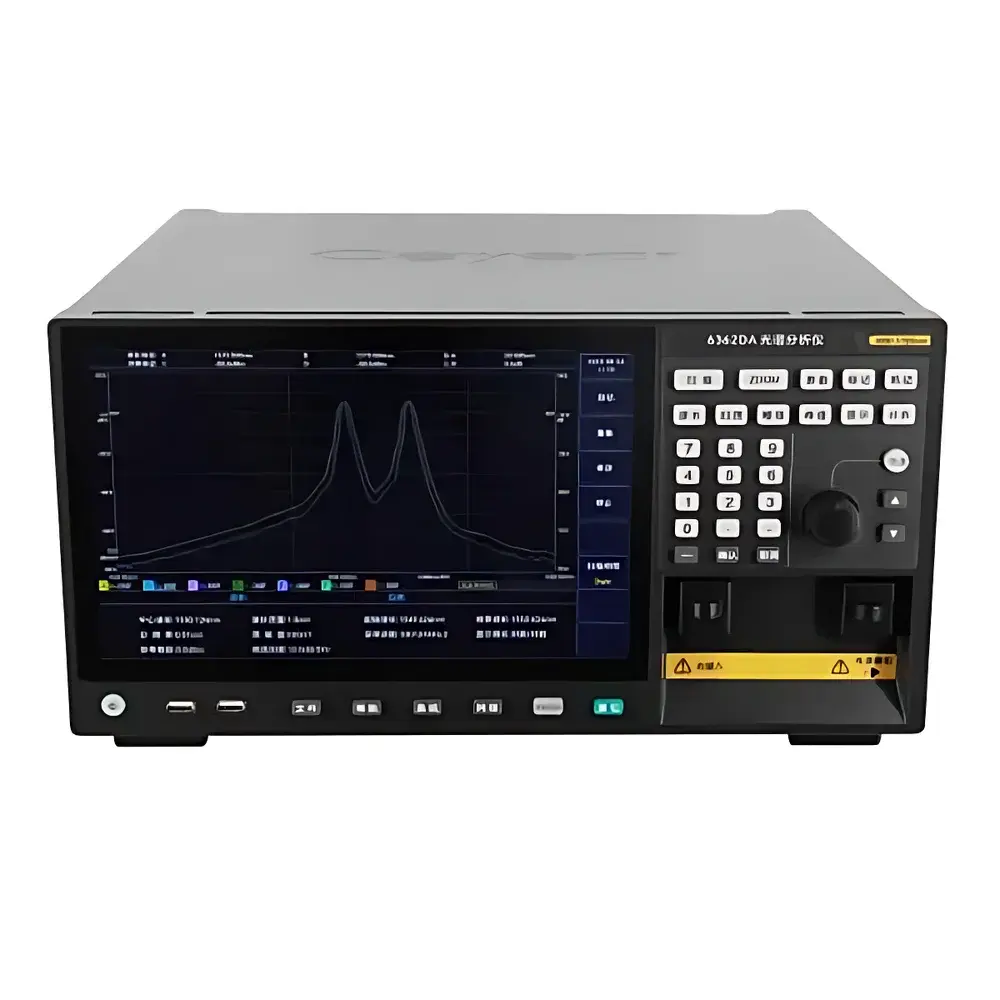
Auniontech OSA-6001700 Ultra-High-Resolution Optical Spectrum Analyzer
| Brand | Auniontech |
|---|---|
| Spectral Range | 600–1700 nm |
| Spectral Resolution | 10 pm |
| Dynamic Range | 80 dB |
| Sensitivity | –90 dBm (1300–1620 nm) |
| Wavelength Accuracy | ±0.01 nm (1520–1620 nm) |
| Input Interface | Free-space and SM/GI/large-core fiber |
| Polarization-Dependent Loss | ±0.08 dB @ 1550 nm |
| Optical Return Loss | 35 dB (with APC connector) |
| Calibration Options | Internal DFB/FP/SLED sources (1550 nm standard, customizable wavelengths) |
Overview
The Auniontech OSA-6001700 is an ultra-high-resolution optical spectrum analyzer engineered for precision spectral characterization across the full near-infrared and visible telecom bands (600–1700 nm). Based on a refined implementation of the 6362D optical architecture, it achieves true 10 pm (0.001 nm) optical resolution—enabling unambiguous discrimination of closely spaced longitudinal modes in narrow-linewidth lasers, dense DWDM channel spacing verification, and high-fidelity spectral reconstruction of complex modulated signals. Its 80 dB dynamic range and –90 dBm sensitivity at C+L bands support quantitative analysis of weak sidebands, amplified spontaneous emission (ASE), and low-power device outputs without signal averaging artifacts. The instrument employs a thermally stabilized diffraction grating monochromator with active wavelength referencing, delivering sub-5 pm short-term repeatability and traceable calibration against internal or external reference sources—including optional gas absorption cells or NIST-traceable lasers.
Key Features
- Continuous spectral coverage from 600 nm to 1700 nm—spanning visible, O-, E-, S-, C-, L-, and U-bands
- Configurable resolution settings down to 10 pm (0.001 nm), with selectable sampling intervals as fine as 0.001 nm
- 80 dB spurious-free dynamic range measured at ±1.0 nm offset from peak (0.01 nm RBW)
- Integrated 12.1-inch capacitive touch display with intuitive GUI supporting both English and Chinese language modes
- Free-space optical input port compatible with collimated beams; optional fiber-coupled variants support SMF-28, GI-50/62.5/100/200 µm fibers
- Built-in calibration light sources: standard 1550 nm DFB laser; optional FP, SLED, or multi-wavelength DFB modules
- Real-time spectral acquisition with up to 100,001 data points per scan, auto-scaling and baseline correction algorithms
- Comprehensive spectral analysis suite: peak search, FWHM measurement, SNR estimation, channel power integration, and spectral tilt calculation
Sample Compatibility & Compliance
The OSA-6001700 accommodates diverse optical sources and components common in R&D and manufacturing environments. It supports direct free-space coupling for benchtop lasers, VCSEL arrays, and tunable external cavity diodes, as well as fiber-pigtailed devices via FC/APC or SMA connectors. Input power handling is rated to +20 dBm per channel and +25 dBm total, with automatic attenuation control to prevent detector saturation. The system meets IEC 61326-1:2013 for EMC compliance and incorporates hardware-level safety interlocks for Class 1 laser operation under ANSI Z136.1 and IEC 60825-1. For regulated industries, firmware supports audit trail logging and user access control—aligning with GLP/GMP principles and enabling partial alignment with FDA 21 CFR Part 11 requirements when deployed with validated networked data management protocols.
Software & Data Management
Control and analysis are performed via embedded Linux-based firmware with a responsive web-accessible interface (HTTPS-enabled) and native Windows/Linux SDKs (C/C++, Python, LabVIEW). All spectral acquisitions include timestamped metadata: instrument ID, calibration status, environmental temperature, and user-defined tags. Raw data exports support CSV, SPC, and HDF5 formats; spectral overlays, differential comparisons, and batch processing scripts can be executed offline using the included AunionOSA Analysis Toolkit. For enterprise integration, the instrument supports SCPI over TCP/IP and provides RESTful API endpoints for remote triggering, parameter configuration, and result retrieval—facilitating automated test sequences in production line environments compliant with ISO/IEC 17025 workflows.
Applications
- Laser characterization: Linewidth validation, mode-hop detection, and side-mode suppression ratio (SMSR) measurement for DFB, DBR, and external cavity lasers
- DWDM component testing: Channel isolation, passband shape analysis, and ripple assessment for AWGs, thin-film filters, and arrayed waveguide gratings
- Optical amplifier evaluation: Gain flatness, noise figure derivation (with calibrated source), and ASE spectral density profiling in EDFA and Raman amplifiers
- Modulated signal analysis: Optical spectrum of QPSK, 16-QAM, and PAM4 signals after IQ modulation—supporting coherent transceiver development
- Photonic integrated circuit (PIC) validation: On-wafer spectral response mapping, filter roll-off characterization, and resonator Q-factor extraction
- Material and coating metrology: Thin-film interference spectra, absorption edge determination, and dispersion modeling for nonlinear crystals and anti-reflection coatings
FAQ
What wavelength calibration standards does the OSA-6001700 support?
The instrument supports internal calibration using factory-installed DFB lasers (1550 nm standard) or optional SLED/FP sources. External calibration is possible via user-provided NIST-traceable lasers or atomic/molecular absorption references (e.g., acetylene, hydrogen cyanide). No gas absorption cell is required for routine operation but may be added for enhanced long-term stability.
Can the OSA-6001700 measure polarization-dependent effects?
While not a dedicated polarimeter, the system reports polarization-dependent loss (PDL) with ±0.08 dB uncertainty at 1550 nm. For full Stokes parameter analysis, integration with an external polarization controller and rotating waveplate module is supported via GPIB or USB command interface.
Is remote operation and automation supported?
Yes—SCPI command set over TCP/IP and Ethernet is fully documented. Python and LabVIEW drivers are provided, and the instrument responds to HTTP POST requests for scan initiation and data pull. Integration with Jenkins, TestStand, or custom CI/CD pipelines is verified in multiple customer deployments.
How is thermal drift managed during extended measurements?
The optical bench features passive thermal mass stabilization and active temperature feedback control (±0.1 °C stability). Wavelength accuracy specifications assume 30-minute warm-up and ambient temperature variation < ±2 °C/hour. For ultra-stable applications, optional oven-controlled housing reduces drift to < 1 pm/hour.






