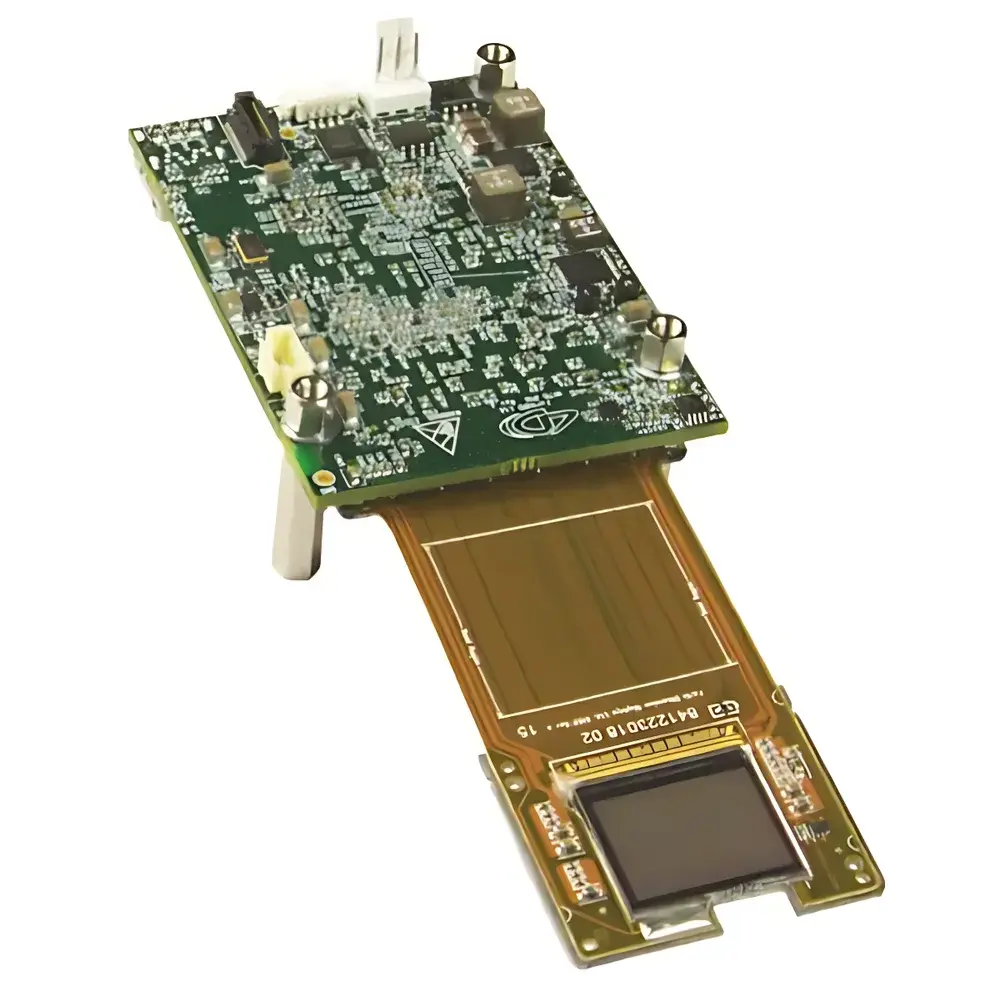
ForthDD LCOS Spatial Light Modulator for Star Simulator (2048×2048 Resolution)
| Brand | ForthDD |
|---|---|
| Resolution | 2048 × 2048 pixels |
| Pixel Pitch | 8 µm × 8 µm |
| Gap Between Pixels | 0.2 µm |
| Fill Factor | >94% |
| Reflectivity | >60% |
| Grayscale Depth | 24-bit |
| Frame Rate | >100 Hz (continuous 24-bit image loading) |
| Spectral Range | 430–700 nm |
| Technology | Reflective Silicon-Based Liquid Crystal on Silicon (LCoS) |
| Origin | United Kingdom |
| Application-Specific Design | Dedicated star simulator display engine |
Overview
The ForthDD LCOS Spatial Light Modulator (SLM) is a high-fidelity, application-optimized reflective microdisplay engineered specifically for next-generation star simulators used in the ground-based functional verification and calibration of stellar inertial attitude sensors. Unlike generic display technologies, this device operates on the principle of voltage-controlled birefringence in nematic liquid crystal layers deposited monolithically onto a CMOS backplane, enabling precise spatial phase and intensity modulation of incident visible light. Its optical architecture supports deterministic wavefront control with sub-wavelength pixel uniformity—critical for generating high-contrast, diffraction-limited point-source patterns that emulate stars across wide fields of view (FOV). Designed to meet the stringent photometric fidelity, temporal stability, and spatial repeatability requirements of aerospace-grade sensor test environments, the SLM serves as the core optical engine in closed-loop star tracker validation systems.
Key Features
- Native resolution of 2048 × 2048 pixels ensures fine-grained star field rendering, supporting simulation of dense stellar catalogs (e.g., Hipparcos, Gaia DR3) with accurate relative magnitudes and angular separations.
- Pixel pitch of 8 µm and inter-pixel gap of only 0.2 µm yield a fill factor exceeding 94%, minimizing diffraction artifacts and maximizing usable optical throughput—essential for achieving high signal-to-noise ratio (SNR) in low-light star detection scenarios.
- Reflectivity >60% across the 430–700 nm band enables efficient coupling with broadband visible illumination sources, including LED- and laser-based collimated projection optics commonly deployed in compact star projector designs.
- Real-time 24-bit grayscale loading at frame rates >100 Hz permits dynamic simulation of stellar motion, spacecraft jitter, and time-varying magnitude effects—enabling hardware-in-the-loop (HIL) testing under realistic orbital conditions.
- Monolithic silicon substrate provides exceptional thermal and mechanical stability, ensuring long-term pixel registration integrity during extended thermal cycling and vibration exposure typical of qualification-level environmental testing.
Sample Compatibility & Compliance
This LCoS SLM is fully compatible with standard F-mount and C-mount optical interfaces used in collimator-based star projector assemblies. It integrates seamlessly with industry-standard illumination subsystems operating in the visible spectrum, including broadband white-light LEDs, tunable narrowband sources, and frequency-stabilized lasers. The device complies with ISO 10110-7 (optical component surface quality), IEC 61000-4-2/4/6 (EMC immunity), and RoHS 2015/863/EU directives. While not certified per se, its design aligns with the optical performance expectations outlined in ECSS-E-ST-32-01C (Space Engineering: Optical Systems) and supports traceable calibration protocols required under ISO/IEC 17025-accredited laboratory practices.
Software & Data Management
The SLM is controlled via a PCIe-based digital interface supporting direct memory-mapped access for low-latency image streaming. Driver support includes native APIs for Windows and Linux (x86_64), with MATLAB, Python (NumPy/Cython bindings), and LabVIEW integration packages available. Firmware supports programmable gamma correction, pixel defect masking, and hardware-triggered frame synchronization—enabling precise temporal alignment with star sensor shutter signals and external motion platforms. Audit-trail-capable logging (timestamped frame load events, error codes, thermal telemetry) meets GLP-compliant data integrity requirements for qualification test reports submitted to ESA, NASA, or commercial launch providers.
Applications
- Functional validation of star tracker algorithms—including centroiding accuracy, false-alarm rate, and lost-in-space recovery—under simulated low-SNR, high-dynamic-range sky backgrounds.
- Calibration of focal plane array (FPA) non-uniformity, intra-pixel sensitivity variation, and optical distortion mapping using programmable point-spread function (PSF) generation.
- Dynamic simulation of satellite slew maneuvers, orbital precession, and apparent stellar proper motion over multi-hour test sequences.
- Development and verification of autonomous navigation software stacks in terrestrial testbeds prior to flight software upload.
- Inter-comparison studies between multiple star sensor models using identical, metrologically traceable star field stimuli.
FAQ
Is this LCoS device suitable for infrared or UV star simulation?
No. It is optimized exclusively for the 430–700 nm visible band. For NIR or UV applications, alternative SLM technologies (e.g., ferroelectric or DMD-based) with appropriate coatings and drive electronics are recommended.
Does the unit include integrated thermal management?
Yes—it features an actively monitored heatsink interface compliant with MIL-STD-810G thermal shock profiles. Optional thermoelectric cooling modules are available for extended operation at ambient temperatures up to 55°C.
Can the SLM be calibrated for absolute radiance output?
While the device itself is not a calibrated radiometric source, its linear response and stable reflectivity allow traceable calibration when paired with NIST-traceable spectroradiometers and integrating spheres—common practice in accredited test labs.
What level of synchronization precision is achievable with external trigger inputs?
Hardware-triggered frame loading achieves ≤100 ns jitter relative to TTL input edges, sufficient for sub-millisecond timing alignment with star sensor exposure windows.
Is firmware update capability supported in-field?
Yes—field-upgradable firmware is delivered via signed binary packages validated against SHA-256 checksums and authenticated using embedded secure boot keys.