
Auniontech MO-100 Series Magneto-Optical Faraday Effect Sensor
| Brand | Auniontech |
|---|---|
| Origin | Shanghai, China |
| Manufacturer Type | Authorized Distributor |
| Product Category | Domestic |
| Model | MO-100 Series |
| Pricing | Upon Request |
Overview
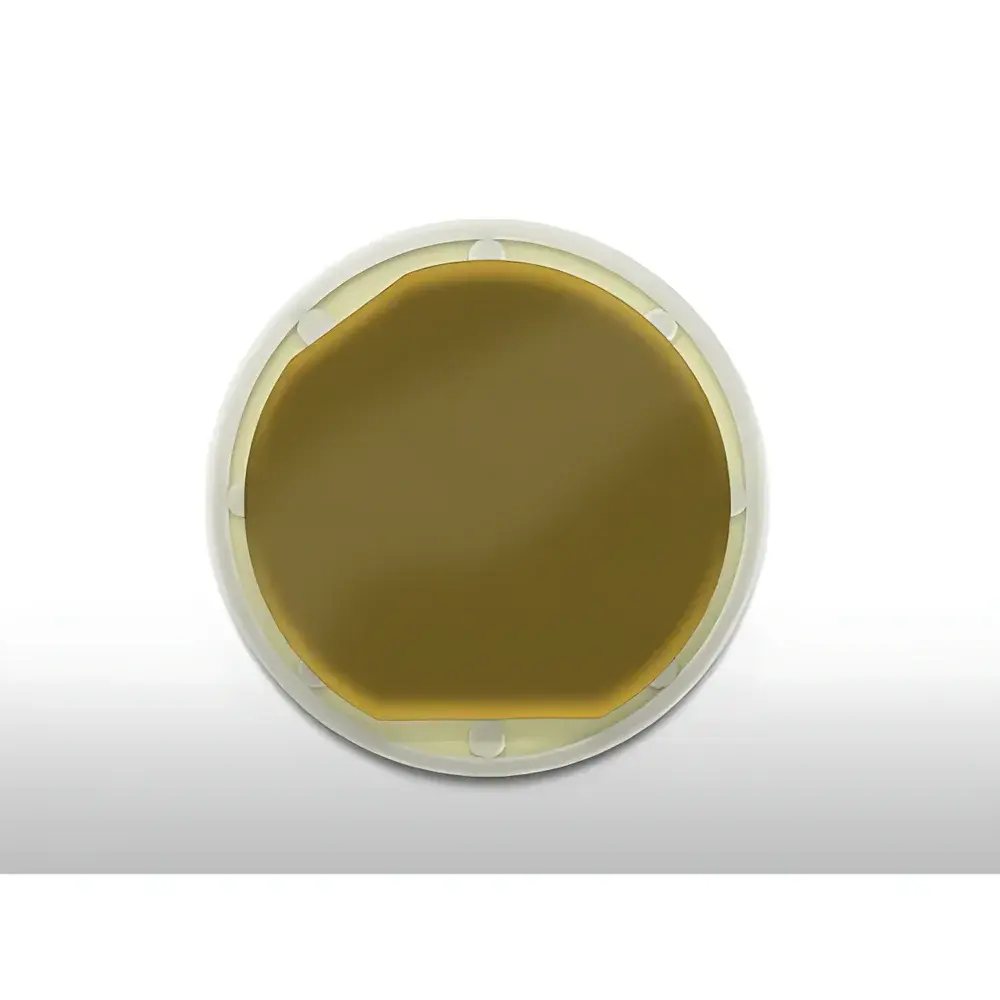
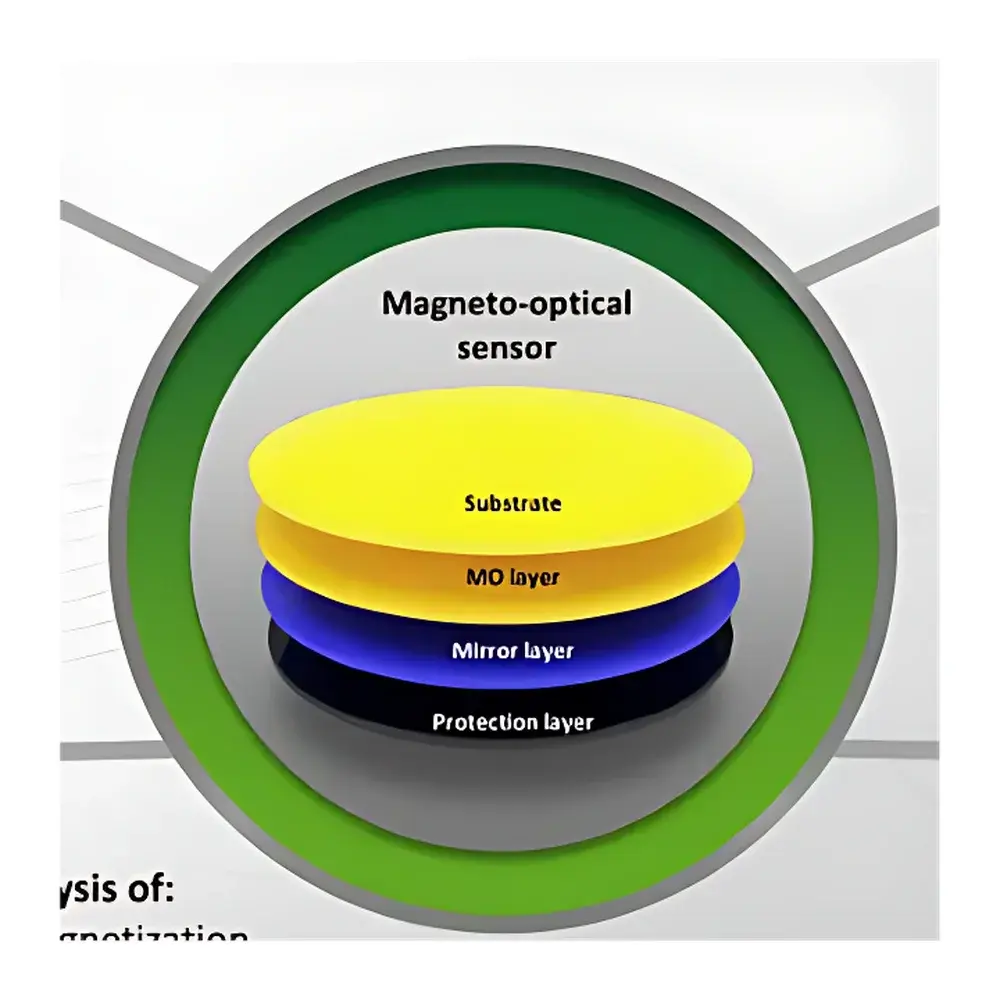
The Auniontech MO-100 Series Magneto-Optical Faraday Effect Sensor is a high-resolution, real-time 2D magnetic field visualization instrument engineered for quantitative magneto-optical imaging in research laboratories and industrial quality assurance environments. It operates on the fundamental physical principle of the Faraday effect — a magneto-optic phenomenon wherein the plane of polarization of linearly polarized light rotates proportionally to the component of magnetic flux density parallel to the direction of light propagation through a transparent magneto-optic medium. This rotation arises from differential phase velocities experienced by left- and right-circularly polarized eigenmodes in the presence of an axial magnetic field, resulting in wavelength-dependent polarization rotation (e.g., 1–10° at λ = 590 nm). The sensor core consists of a liquid-phase epitaxially grown bismuth-substituted yttrium iron garnet (Bi:YIG) thin film deposited on a non-magnetic substrate — optimized for high Verdet constant, low optical absorption, and thermal stability up to +50 °C. Unlike scanning probe or Hall-based systems, this full-field imaging approach delivers instantaneous, contactless, spatially resolved magnetic flux density mapping without mechanical rastering.
Key Features
- Real-time, wide-area 2D magnetic field visualization with optical resolution down to 1 µm
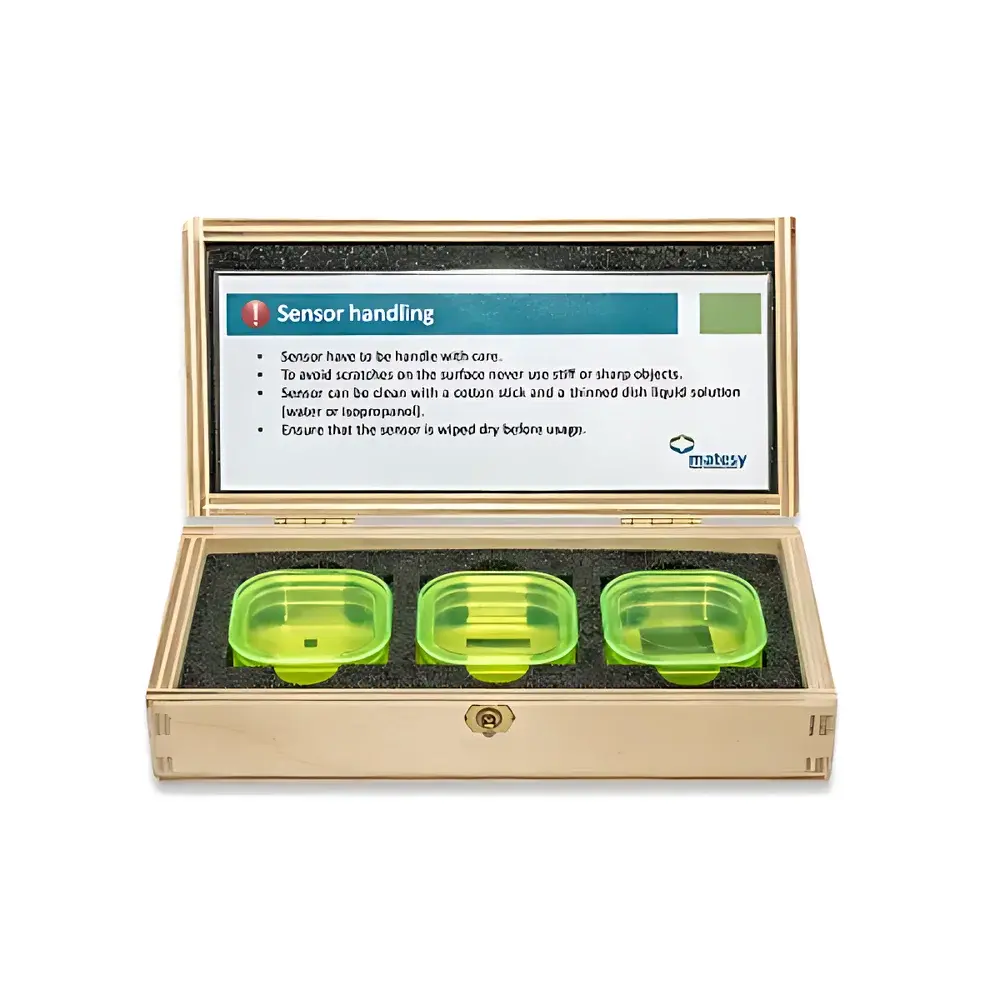
- Multiple standard active sensor formats: 8 × 8 mm, 15.5 × 20.5 mm, and 45 × 60 mm; custom geometries available up to Ø76 mm (3-inch)
- Five dedicated sensor types (A–E) optimized for distinct dynamic range and application profiles: Type A (±65 mT), Type B (±65 mT), Type C (±125 mT), Type D (low-field surface inspection), and Type E (up to 1 T for permanent magnet characterization)
- Thermally stable operation: functional within ambient temperature range of −10 °C to +35 °C; sensor layer rated up to +50 °C short-term
- Faraday rotation sensitivity calibrated at 590 nm (visible spectrum), compatible with standard LED or laser illumination sources
- Robust architecture suitable for integration into automated QA stations, R&D test benches, and failure analysis workflows
Sample Compatibility & Compliance
The MO-100 Series supports non-contact evaluation of both hard and soft magnetic materials, including sintered NdFeB and SmCo magnets, electrical steel laminations (M15–M47 grades), polymer-bonded magnets, ferritic stainless steels, magnetic inks (ISO/IEC 10536-compliant security features), and geological specimens (e.g., meteorites). It enables direct observation of domain wall motion, grain boundary effects, microcracks, residual stress-induced magnetization, and weld integrity anomalies. Sensor configurations comply with common metrological requirements for magnetic imaging under ASTM A932/A932M (standard terminology for magnetic testing) and support traceable calibration protocols aligned with ISO/IEC 17025 laboratory accreditation criteria. While not intrinsically certified for medical or aerospace-grade qualification, its output data structure is compatible with GLP/GMP documentation frameworks when integrated with validated software workflows.
Software & Data Management
The system ships with proprietary Auniontech MO-Analyzer Suite — a Windows-based application supporting live contrast-enhanced imaging, quantitative pixel-wise flux density conversion (via pre-calibrated Faraday coefficient maps), time-series acquisition, ROI-based statistical analysis, and export of TIFF/CSV/HDF5 datasets. Software features include background drift compensation, multi-frame averaging, FFT-based noise suppression, and overlay-capable annotation tools for comparative defect mapping. Audit trails, user access levels, and electronic signature functionality are implemented in accordance with FDA 21 CFR Part 11 principles for regulated environments. Raw image streams can be redirected via GigE Vision interface for integration into third-party automation platforms (e.g., LabVIEW, Python OpenCV pipelines).
Applications
- Non-destructive evaluation of weld seams and heat-affected zones in ferromagnetic structures
- Microstructural characterization of electrical steels: domain imaging, lamination insulation integrity, and core loss correlation
- Forensic verification of magnetic security features in banknotes, ID documents, and access cards
- Development and validation of magnetic encoders, position sensors, and torque transducers
- In-process quality control of bonded magnets and composite magnetic assemblies
- Research on skyrmion dynamics, spin ice analogs, and topological magnetic textures (in conjunction with external field coils)
- Residual magnetism assessment post-machining or EDM processing
FAQ
What magnetic field ranges does each sensor type support?
Type A and B: ±65 mT; Type C: ±125 mT; Type D: optimized for sub-mT fields (e.g., magnetic ink detection); Type E: up to 1 T for static permanent magnet characterization.
Is the sensor sensitive to temperature fluctuations during measurement?
The Bi:YIG film exhibits minimal thermal drift below +35 °C ambient; active thermal stabilization is recommended for measurements requiring <0.5% flux density repeatability over extended durations.
Can the system quantify absolute magnetic flux density?
Yes — when paired with factory calibration certificates referencing NIST-traceable Helmholtz coil standards, pixel-intensity values convert to Bz (mT) with typical uncertainty ≤±3% across the linear operating range.
Does the system require polarized illumination?
Yes — incident light must be linearly polarized; integrated polarizer/analyzer modules are included, but external laser diodes or broadband LEDs with external polarization optics are also supported.
Are custom sensor shapes supported for OEM integration?
Yes — Auniontech provides design consultation and fabrication of non-standard apertures, including annular, ring-shaped, or segmented layouts, subject to minimum order quantity and lead time agreement.



