
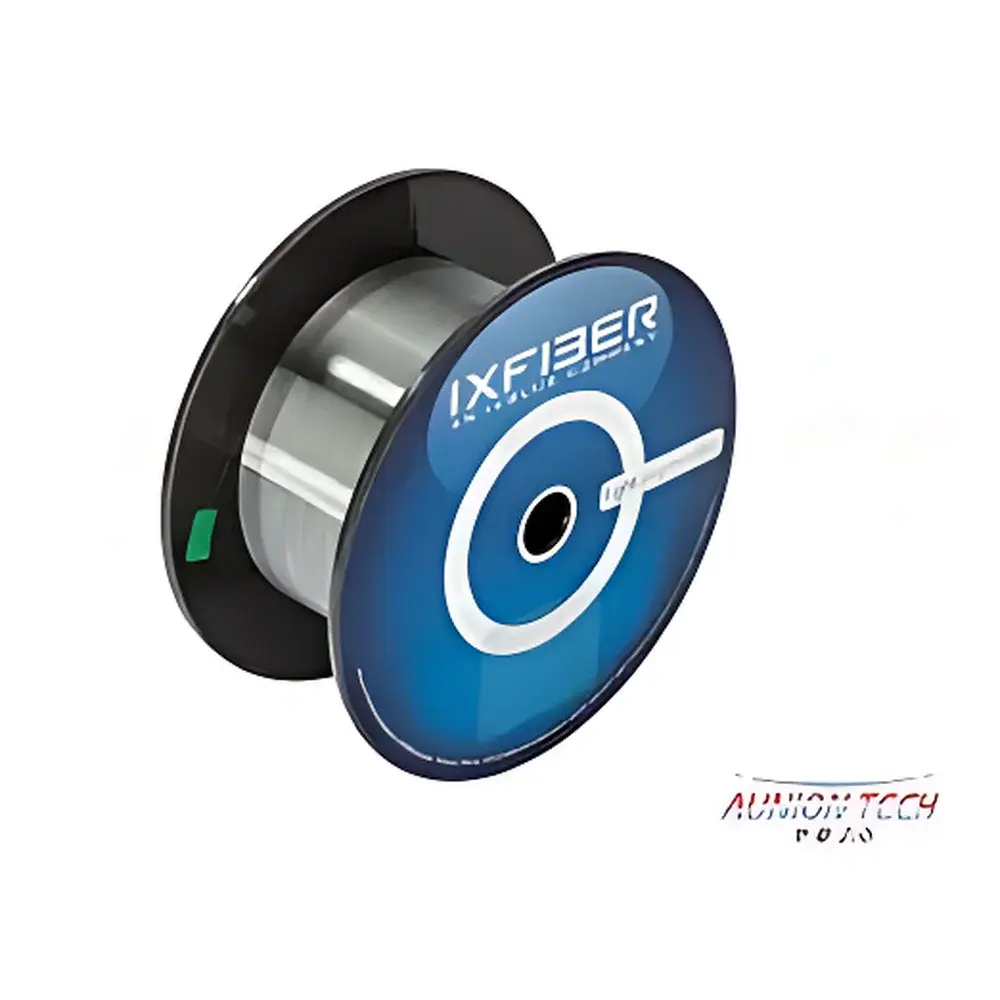
Auniontech Polarizing Fiber (PZ Fiber) – Tiger-Structure Single-Polarization Specialty Optical Fiber
| Brand | Auniontech |
|---|---|
| Origin | France |
| Manufacturer Type | Authorized Distributor |
| Import Status | Imported |
| Model | Polarizing_Fiber_and_Polarizer |
| Spectral Range | 780–1550 nm |
| Detector Type | InGaAs |
| Resolution | 7680 pixels |
| Sensitivity | High (t8-class) |
| Signal-to-Noise Ratio | High (t89-class) |
| Dynamic Range | 689 dB |
| Stray Light Suppression | d67-class |
| Extinction Ratio | >30 dB |
| Polarization Bandwidth | >100 nm |
| Design Wavelengths | 780, 840, 1060, 1310, 1550 nm |
Overview
The Auniontech Polarizing Fiber (PZ Fiber) is a high-performance, single-polarization specialty optical fiber engineered for stable, in-fiber polarization control across the near-infrared spectrum (780–1550 nm). Unlike conventional polarization-maintaining fibers that preserve an input polarization state, PZ fiber actively functions as an all-fiber polarizer—supporting only one linear polarization mode (typically aligned with the slow axis) while attenuating the orthogonal state via engineered high birefringence. Its core mechanism relies on asymmetric stress-applying structures—in this case, the proprietary “Tiger” geometry—which induces permanent, wavelength-dependent birefringence. This results in differential phase velocity and mode-dependent loss, enabling intrinsic polarization filtering without discrete bulk optics. The fiber operates on the principle of selective modal attenuation rather than interference or absorption, delivering high extinction ratio (>30 dB), low propagation loss (<0.5 dB/m typical), and excellent thermal stability (±0.01 dB/°C drift over −10 to +70 °C). Designed for integration into fiber-optic systems requiring polarization purity—such as interferometric sensors, coherent transceivers, and quantum optical setups—it eliminates alignment sensitivity and back-reflection issues common with free-space polarizers.
Key Features
- Tiger-structure stress-applying design for robust, permanent birefringence and reproducible polarization extinction
- Polarization bandwidth exceeding 100 nm—defined as the spectral window between −20 dB attenuation on the fast axis and −3 dB on the slow axis
- Extinction ratio >30 dB across multiple design wavelengths: 780 nm, 840 nm, 1060 nm, 1310 nm, and 1550 nm
- Wavelength-tunable polarization bandwidth via controlled coil diameter—reducing coil diameter narrows bandwidth and shifts it toward shorter wavelengths
- Low propagation loss (<0.5 dB/m at 1550 nm), compatible with standard fusion splicing and connectorization
- Hermetically coated acrylate or polyimide variants available for enhanced mechanical reliability and environmental resistance
Sample Compatibility & Compliance
The PZ fiber is fully compatible with standard single-mode fiber infrastructure (e.g., SMF-28, HI1060) when spliced using optimized arc parameters. It meets IEC 60793-2-50 (category B6) specifications for polarization-maintaining specialty fibers and conforms to RoHS 2011/65/EU and REACH (EC 1907/2006) directives. For applications requiring traceability and regulatory validation—including fiber-optic current sensors (IEC 61850-9-2), gyroscopic systems (MIL-STD-883H, Method 2010.10), and quantum optics labs operating under GLP guidelines—the fiber is supplied with full batch-level test reports including measured extinction ratio vs. wavelength, cutoff wavelength, and proof-test history (100 kpsi tensile strength verification). No FDA or ISO 13485 certification applies, as the product is classified as a passive optical component—not a medical device.
Software & Data Management
While the PZ fiber itself is a passive component, its performance characterization is supported by Auniontech’s optional Polarization Characterization Suite (PCS v3.2)—a LabVIEW-based application for automated measurement of extinction ratio, polarization-dependent loss (PDL), and spectral bandwidth using tunable laser sources and polarization analyzers. PCS outputs ASCII-compatible datasets compliant with ASTM E2750-21 (Standard Practice for Polarization Measurement of Optical Fibers) and supports export to MATLAB, Python (NumPy), and CSV formats. Audit trails, user access logs, and electronic signatures are implemented in accordance with FDA 21 CFR Part 11 requirements when deployed on validated Windows 10/11 platforms within GxP environments.
Applications
- Fiber optic gyroscopes (FOGs): Used as the polarization-filtering element in interferometric sensing loops to suppress polarization-induced noise and improve bias stability
- High-power fiber lasers: Integrated as intracavity polarizers to enforce unidirectional linear polarization and suppress nonlinear effects
- Coherent optical communication: Enables polarization-aligned signal injection in DP-QPSK transceivers and reduces crosstalk in polarization-division multiplexed systems
- Cold atom interferometry: Provides polarization-pure delivery of trapping and cooling beams to ultra-high-vacuum chambers with minimal wavefront distortion
- Fiber-optic current sensors (FOCS): Serves as the polarization-selective element in Faraday-effect-based current measurement systems compliant with IEC 61850-9-2
- Quantum key distribution (QKD) systems: Delivers polarization-encoded photons with high fidelity and minimal decoherence over extended fiber links
FAQ
What is the difference between PZ fiber and standard PM fiber?
PZ fiber is a polarization-filtering fiber—only one polarization state propagates with low loss; the orthogonal state is attenuated. Standard PM fiber preserves whichever polarization state is launched but does not filter out the unwanted state.
Can PZ fiber be spliced to standard SMF?
Yes—using mode-field adaptors or taper-assisted fusion splicing, insertion loss <0.3 dB and extinction ratio degradation <2 dB are routinely achieved.
How does coiling affect polarization bandwidth?
Reducing the coil diameter increases bend-induced birefringence, narrowing the polarization bandwidth and shifting its center toward shorter wavelengths—enabling fine spectral tuning.
Is temperature compensation required in precision applications?
The Tiger structure provides inherent thermal stability; drift in extinction ratio is typically <0.1 dB over −10 to +70 °C, eliminating need for active compensation in most lab and industrial deployments.
Do you offer custom cut lengths or connectorized versions?
Yes—standard lengths from 1 m to 100 m are available with FC/APC, SC/APC, or bare-fiber termination; custom polishing and hermetic packaging options are supported upon request.






