
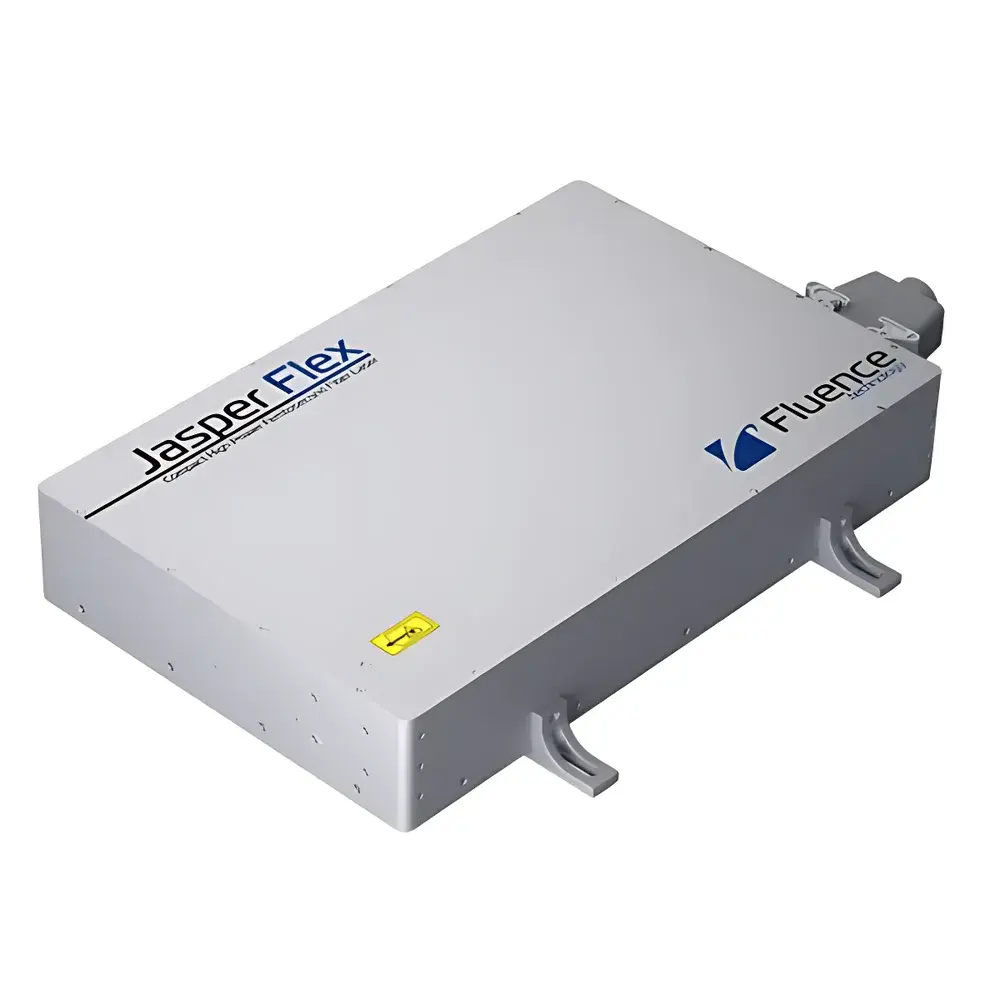
Auniontech Jasper Flex High-Power Femtosecond Fiber Laser
| Brand | Auniontech |
|---|---|
| Origin | Shanghai, China |
| Manufacturer Type | Authorized Distributor |
| Origin Category | Domestic (China) |
| Model | Jasper Flex Scientific Research Femtosecond Laser System |
| Pricing | Upon Request |
| Key Specifications | Max Avg. Power: 30 W (customizable >30 W) |
| Max Pulse Energy | 30 µJ @ ≤1 MHz |
| Max Burst Energy | 100 µJ @ 200 kHz, 1030 nm |
| Repetition Rate | 20 + 2 MHz base |
| Pulse Duration | <270 fs FWHM (typ. <250 fs) |
| Central Wavelength | 1030 ±5 nm |
| Optional Harmonics | 515 nm, 343 nm, 258 nm (with HGM) |
| Polarization | Linear, vertical |
| Beam Quality M² | <1.3 (typ. <1.15) |
| Beam Waist (1/e²) | 2.0 ±0.5 mm |
| Burst Mode | Standard |
| Cooling | 6U 19″ rack-mounted chiller included |
| External Triggering | TTL gate input included |
| Analog Power Modulation | Included |
| Control Software | Full-featured GUI included |
Overview
The Auniontech Jasper Flex is a high-repetition-rate, high-average-power femtosecond fiber laser engineered for demanding scientific and industrial applications requiring simultaneous high pulse energy, ultrashort pulse duration, and exceptional long-term stability. Based on Fluence’s proprietary all-fiber, SESAM-free oscillator architecture, the system eliminates alignment-sensitive free-space components and delivers intrinsic mechanical robustness—validated under 40 g vibration and continuous operation across ambient temperatures exceeding 50 °C. Its monolithic, polarization-maintaining fiber design ensures immunity to thermal drift and misalignment, establishing a new benchmark in reliability for turnkey ultrafast laser systems. The core oscillator is directly integrated with a high-gain fiber pre-amplifier stage, forming a compact, sealed optical path that maintains sub-270 fs pulse fidelity at average powers up to 30 W. With fundamental output at 1030 nm and optional harmonic generation modules (515 nm, 343 nm, 258 nm), the Jasper Flex serves as a versatile pump source for nonlinear optics, time-resolved spectroscopy, and precision material processing.
Key Features
- All-fiber, SESAM-free oscillator architecture ensuring >10,000 hours MTBF and zero realignment requirements
- Software-controlled pulse duration tuning from <270 fs to 8 ps (up to 20 ps optional), enabling optimization for nonlinear efficiency or thermal management
- Burst-mode operation with user-defined burst envelope (up to 100 µJ per burst at 200 kHz), critical for high-throughput micromachining of transparent and brittle materials
- Two-stage repetition rate control: fixed base rate of 22 MHz ±2 MHz, plus fine-tuning from 1–20 MHz via internal electronic modulation—no mechanical AOMs or cavity length adjustments
- Integrated pulse picker supporting true single-shot triggering with <1 ns jitter, synchronized to external TTL or analog inputs
- Real-time analog power modulation (0–100% depth, bandwidth >100 kHz) for closed-loop process control in manufacturing environments
- Industrial-grade 6U 19″ rack-mount chiller with redundant flow monitoring and temperature stabilization ±0.1 °C
Sample Compatibility & Compliance
The Jasper Flex is designed for integration into ISO Class 5–7 cleanroom-compatible tool platforms and complies with IEC 60825-1:2014 (Laser Product Safety) and EN 61000-6-3:2011 (EMC Emission Standards). Its stable beam pointing (<5 µrad/°C) and low RMS noise (<0.3% RMS, 10 Hz–10 MHz) ensure repeatable ablation thresholds across polymer, glass, sapphire, and thin-film semiconductor substrates. The system supports GLP/GMP-aligned operation through audit-trail-enabled software logging (timestamped parameter sets, interlock states, thermal sensor readings), and is compatible with FDA 21 CFR Part 11-compliant data acquisition frameworks when deployed with validated third-party DAQ hardware.
Software & Data Management
The bundled Jasper Control Suite provides deterministic, low-latency communication via Ethernet (TCP/IP) and USB 3.0. All operational parameters—including repetition rate, burst structure, pulse duration, average power, and harmonic selection—are adjustable in real time without interrupting lasing. The software implements hierarchical user access (Operator, Engineer, Administrator), automatic calibration logging, and export of metadata-embedded HDF5 files compliant with FAIR data principles. Remote monitoring APIs (RESTful JSON endpoints) enable integration into LabVIEW, Python (PyVISA), or MATLAB-based automated workflows. Firmware updates are delivered via signed package verification to ensure traceability and integrity.
Applications
- Display repair: selective ablation of OLED pixel electrodes and touch sensor layers without thermal damage to underlying TFT backplanes
- Three-photon excited fluorescence (3PEF) microscopy: high-peak-power 1030 nm pulses enabling deep-tissue imaging beyond 1.5 mm with reduced phototoxicity
- Pump-probe spectroscopy: sub-270 fs pulses provide temporal resolution sufficient for carrier dynamics studies in 2D materials and perovskites
- FIB-S sample preparation for AFM: precise, non-sputtering removal of surface oxides and contaminants prior to atomic-resolution topography
- Optical parametric amplifier (OPA) pumping: broadband IR/UV generation via collinear/noncollinear phase-matching in BBO or KTA crystals
- Surface structuring of medical implants: deterministic LIPSS (laser-induced periodic surface structures) on Ti-6Al-4V for enhanced osseointegration
FAQ
Is the Jasper Flex qualified for use in GMP-regulated environments?
Yes—the system supports configurable audit trails, electronic signatures, and parameter change history logging. When paired with validated data acquisition hardware and SOP-defined calibration protocols, it meets foundational requirements for GMP Annex 11 and ISO 13485 workflows.
Can harmonic wavelengths be switched during operation?
Harmonic modules are manually installed but support real-time power balancing and beam-pointing compensation via software-controlled motorized mirrors and waveplate drivers.
What is the maximum supported burst repetition rate?
Burst envelopes can be generated up to 200 kHz with full energy retention; higher burst rates (up to 1 MHz) are achievable with proportional pulse energy scaling.
Does the system include beam delivery optics?
Standard configuration includes collimated free-space output (2.0 ±0.5 mm 1/e² waist); optional fiber-coupled delivery (SMF-28 or PM980) and focusing objectives (f = 100–500 mm) are available as accessories.
How is long-term power stability verified?
Each unit undergoes 72-hour continuous burn-in with active thermal feedback control; typical output drift is <±0.5% over 8 hours at constant ambient conditions.





