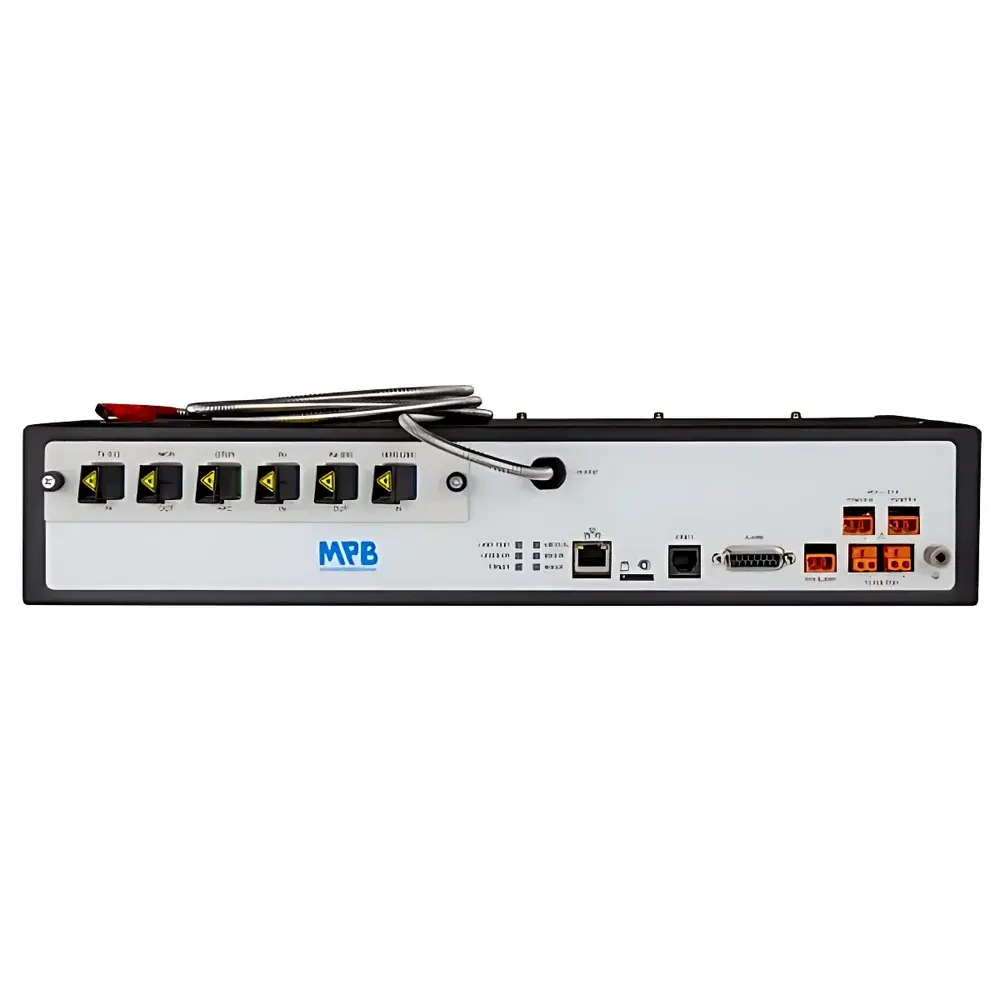
MPBC 2RU High-Power Optical Amplifier
| Brand | MPBC |
|---|---|
| Form Factor | 2RU Rack-Mount |
| Wavelength Bands | C-band (1530–1565 nm), Super C-band (1524–1572 nm), L-band (1570–1608 nm) |
| Max Output Power | up to +30 dBm |
| Gain Flatness | ≤1.5 dB (peak-to-peak) |
| OSC Wavelength | 1574/1576/1610 nm |
| OSC Reach | ≥84 dB |
| Compliance | NEBS Level 3 & GR-3108 Category 1 (with NEBS L3 Kit) |
| Control Interfaces | Web GUI, CLI, SNMP v2c/v3, NETCONF |
| Monitoring | Integrated Fiber Integrity Monitor with Auto Laser Shutdown/Restart |
| Storage | Onboard micro-SD card for configuration backup |
| Network Interface | 10/100/1000BASE-T Ethernet |
Overview
The MPBC 2RU High-Power Optical Amplifier is a carrier-grade, rack-optimized optical subsystem engineered for long-haul and ultra-long-haul fiber optic transmission systems. Based on erbium-doped fiber amplifier (EDFA) architecture, it delivers high-output power with exceptional spectral flatness across standardized ITU-T wavelength bands—including C-band (1530–1565 nm), Super C-band (1524–1572 nm), and L-band (1570–1608 nm). Designed for deployment in network-ready infrastructures, the amplifier supports both discrete channel boosting and full DWDM spectrum amplification, enabling scalable capacity expansion from single-channel operation to full-band loading without hardware replacement. Its compact 2RU form factor complies with ETSI and IEC 60297-3-100 mechanical standards, facilitating seamless integration into carrier central offices, submarine repeater huts, and harsh-environment OPGW nodes.
Key Features
- High-output power capability: configurable models delivering +24 dBm, +26 dBm, or +30 dBm maximum saturated output power
- Gain flatness ≤1.5 dB (peak-to-peak) across operational bandwidth at optimum gain settings—critical for multi-span DWDM system stability
- Negative gain tilt optimization (–6 to –16 dB over band) enables extended unregenerated reach in ultra-long-haul links without inline dispersion compensation
- Integrated Optical Supervisory Channel (OSC) at 1574 nm, 1576 nm, or 1610 nm with ≥84 dB dynamic range for end-to-end fiber health monitoring
- Fiber integrity monitoring with automatic laser shutdown upon loss-of-light detection and configurable auto-restart protocols per ITU-T G.664 and Telcordia GR-1312-CORE
- NEBS Level 3 and GR-3108 Category 1 compliance (with optional NEBS L3 kit), validated for operation in seismic zones, high humidity, and wide ambient temperature ranges (–5 °C to +55 °C)
- Secure, embedded web-based GUI with TLS 1.2 encryption, role-based access control (RBAC), and audit logging aligned with NIST SP 800-53 Rev. 4 requirements
Sample Compatibility & Compliance
The MPBC 2RU amplifier is interoperable with standard single-mode fiber (G.652.D, G.655, G.656) and supports input power ranges from –13 dBm to +11 dBm depending on model and configuration. It meets stringent regulatory and industry standards required for telecom infrastructure deployment: FCC Part 15 Subpart B (Class A), CE RED Directive 2014/53/EU, RoHS 3 (2015/863/EU), and WEEE Directive 2012/19/EU. For mission-critical applications, the unit supports GLP/GMP-aligned configuration management via signed firmware updates and immutable configuration backups stored on the onboard micro-SD card. All SNMP MIBs conform to IETF RFC 3593 and Telcordia GR-253-CORE, ensuring compatibility with major OSS/BSS platforms including Netcool, HP OpenView, and Ericsson ENMS.
Software & Data Management
Management is implemented through three concurrent, protocol-isolated interfaces: a secure HTTPS-enabled web GUI (with session timeout, password complexity enforcement, and HTTP header hardening), a standards-compliant CLI accessible via SSHv2 or serial console, and a full-featured SNMP agent supporting v2c and v3 with USM authentication and privacy (AES-128). The amplifier also implements NETCONF over SSH (RFC 6241) with YANG data models for automated provisioning in SDN-controlled environments. Configuration changes are logged with timestamps, user identifiers, and pre/post state snapshots. All logs and configurations are exportable via SFTP or HTTP POST to external syslog or SIEM systems. Firmware updates require SHA-256 signature verification and support rollback to last known good image—a requirement for ISO/IEC 27001-certified network operations centers.
Applications
- Submarine Passive Cable Networks: Deployed as Remote Optically Pumped Amplifiers (ROPA) in unrepeatered submarine branches—e.g., the 3,500 km South American coastal cable linking 12 Chilean cities—enabling 4 Tb/s DWDM transport without active repeaters
- Terrestrial Long-Haul Backbone: Integral to the 1,154 km Mackenzie Valley Fiber Link (MVFL) in Canada’s Northwest Territories, where 2RU ROPA units extend span lengths beyond 200 km while maintaining OSNR >22 dB at receiver input
- OPGW-Based Utility Networks: Qualified for operation in extreme climates—from Siberian winters (–40 °C) to Arabian deserts (+55 °C)—supporting real-time SCADA telemetry and synchrophasor data over overhead power lines
- Offshore Oil & Gas Communications: Enables low-latency, high-availability connectivity between remote offshore platforms and onshore control centers using passive underwater fiber segments augmented by online ROPA insertion points
FAQ
What wavelength bands does the MPBC 2RU amplifier support?
It supports C-band (1530–1565 nm), Super C-band (1524–1572 nm), and L-band (1570–1608 nm), with dedicated models optimized for each region per ITU-T G.694.1 grid specifications.
Is NEBS Level 3 certification included by default?
NEBS Level 3 and GR-3108 Category 1 compliance require installation of the optional NEBS L3 qualification kit; the base unit meets NEBS Level 1 mechanical and environmental specifications out of the box.
Can the amplifier operate in an unrepeatered link with no intermediate power sources?
Yes—when configured as a Remote Optically Pumped Amplifier (ROPA) with bidirectional pump delivery, it enables spans exceeding 300 km in G.652.D fiber without electrical power at the amplifier site.
Does the unit support zero-touch provisioning (ZTP) in automated networks?
Yes—via DHCP option 67 bootfile support and NETCONF-capable orchestration APIs, enabling integration with Cisco NSO, Juniper Paragon Automation, or open-source tools like Ansible and Terraform.
How is firmware integrity verified during updates?
All firmware images are cryptographically signed using ECDSA P-256 keys; the bootloader validates signatures before execution and enforces secure boot chain continuity per NIST SP 800-193 guidelines.