
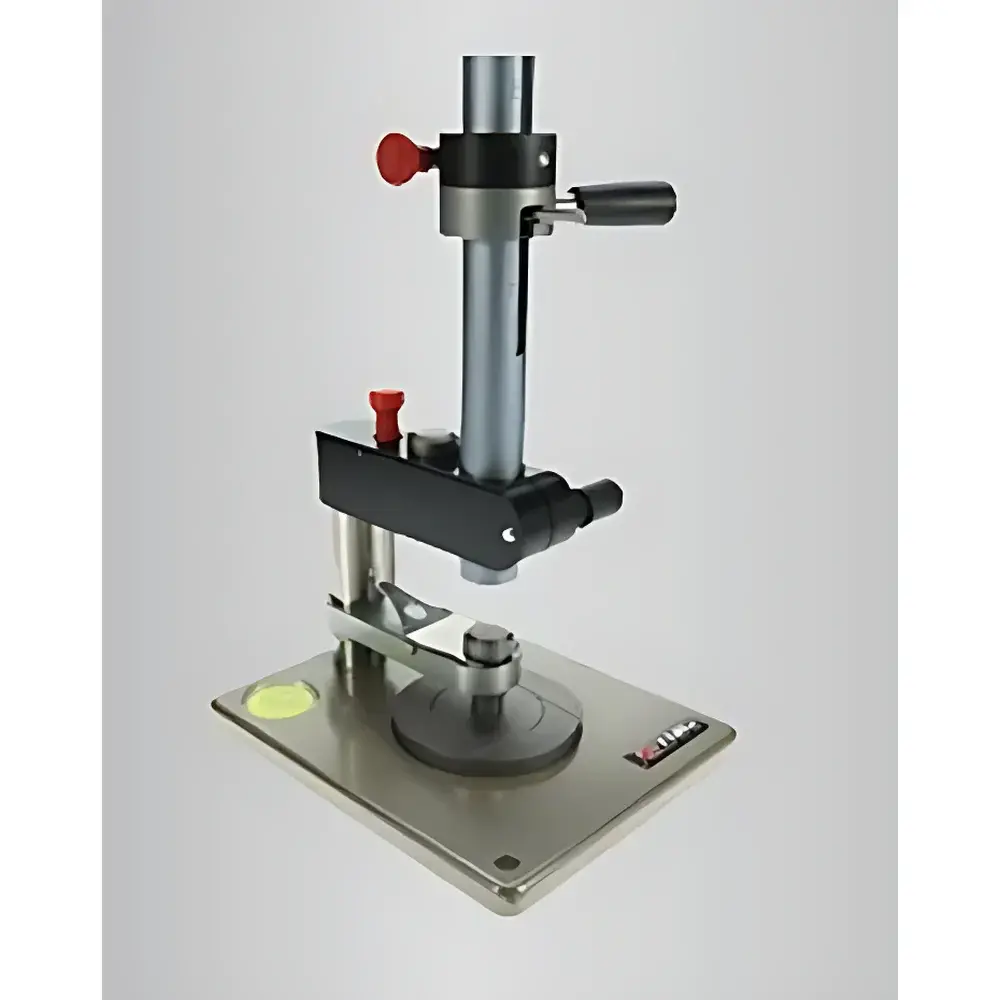
TQC SP1880/1895/1890/1891 Tube-Type Impact Tester
| Brand | TQC |
|---|---|
| Origin | Netherlands |
| Model Series | SP1880, SP1895, SP1890, SP1891 |
| Compliance | DIN EN ISO 6272, ASTM D2794, ASTM G14 |
| Certification | Qualicoat-, QIB-, and GSB-accredited |
Overview
The TQC SP1880/1895/1890/1891 Tube-Type Impact Tester is a precision-engineered mechanical testing instrument designed for standardized evaluation of coating adhesion, impact resistance, and substrate-coating system ductility under controlled dynamic loading. Operating on the principle of vertical free-fall impact, the device delivers reproducible kinetic energy to coated test panels via a calibrated weight dropped from defined heights along a rigid vertical guide tube. This methodology aligns with fundamental principles of impact mechanics used in industrial quality control laboratories, where quantifiable deformation thresholds—such as cracking, delamination, or substrate yielding—are assessed visually or microscopically against standardized pass/fail criteria. As an ISO/IEC 17025-aligned instrument, it supports traceable, auditable testing protocols required in automotive OEM supply chains, architectural aluminum finishing (Qualicoat), and high-performance coil coating environments.
Key Features
- Vertically aligned tubular guidance system ensures strict axial alignment of the falling weight, minimizing lateral deviation and enhancing test repeatability across operators and shifts.
- Dual-scale graduated impact rod (metric and imperial) enables rapid height selection per test standard—e.g., 50 cm for ISO 6272-1, 100 cm for ASTM D2794—without recalibration or conversion errors.
- Integrated spirit level and fixed reference marks guarantee horizontal positioning of the test panel within ±0.5° tolerance, critical for consistent energy transfer and inter-laboratory comparability.
- Patented alignment indicator—a spring-loaded visual marker—confirms correct positioning of the impact point relative to the panel centerline before each drop, eliminating operator-induced misalignment.
- Pre-configured drop-weight assemblies meet nominal mass requirements specified in DIN EN ISO 6272 (1.0 kg), ASTM D2794 (1.0–2.0 kg), and ASTM G14 (for abrasion-resistant coatings); weights are certified traceable to national standards.
- Robust powder-coated steel frame with anti-vibration base minimizes environmental interference during sensitive low-energy impact assessments (e.g., <1 J).
Sample Compatibility & Compliance
The tester accommodates standard flat test panels up to 150 × 100 mm (6 × 4 in) and thicknesses from 0.3 mm to 3.0 mm—including aluminum, steel, galvanized steel, and composite substrates. Panel clamping is achieved via adjustable pneumatic or manual fixtures (model-dependent), ensuring uniform surface contact without edge distortion. All SP-series units ship with full compliance documentation verifying conformance to DIN EN ISO 6272-1:2022 (paints and varnishes – impact resistance testing – Part 1: Direct impact), ASTM D2794-21 (standard test method for resistance of organic coatings to impact), and ASTM G14-22 (standard practice for calibration of impact testing apparatus). Accreditation by Qualicoat, QIB (Quality Inspectie Bouw), and GSB International confirms suitability for third-party certification audits under EN 13523-10 and ISO 20567-1.
Software & Data Management
While the core SP-series operates as a manual mechanical tester, optional digital add-ons—including USB-connected height sensors and PC-based logging modules—enable automated capture of drop height, weight mass, and timestamped test events. Data output complies with GLP/GMP documentation requirements: CSV exports include audit-trail metadata (operator ID, calibration date, environmental conditions), supporting 21 CFR Part 11 readiness when paired with validated LIMS integration. Firmware updates and calibration certificate archives are managed through TQC’s secure customer portal, accessible only to authorized laboratory personnel.
Applications
- Validation of coil-coated aluminum for façade systems per Qualicoat Technical Specification QS-2023.
- Pre-shipment testing of automotive primer-surfacer systems per OEM-specific impact specifications (e.g., Ford WSS-M2P177-A2, GMW14872).
- Batch release testing of powder coatings on architectural extrusions under EN 12206-1.
- Failure mode analysis in R&D labs investigating brittle-to-ductile transitions in UV-curable acrylates.
- Interlaboratory round-robin studies coordinated under ISO/TC 35/SC 9 working group mandates.
FAQ
What standards does the TQC SP-series impact tester formally comply with?
DIN EN ISO 6272-1:2022, ASTM D2794-21, and ASTM G14-22. Each unit includes a Declaration of Conformity and test report from an accredited body.
Is operator training required for ISO 17025 accreditation?
Yes—TQC provides documented competency assessment templates and annual refresher modules aligned with ILAC-G8:2023 guidelines for mechanical testing personnel.
Can the same unit be used for both direct and reverse impact tests?
Yes—the SP1890 and SP1891 models feature reversible panel holders enabling both configurations per ISO 6272-1 Annex A.
How often must the impact weight be recalibrated?
Annually, or after 5,000 drops—whichever occurs first—using NIST-traceable mass standards; calibration certificates are included with each shipment.
Are replacement parts available globally?
Yes—TQC maintains regional spare parts hubs in Rotterdam, Cincinnati, and Singapore, with lead times ≤5 business days for critical components including guide tubes and alignment indicators.






