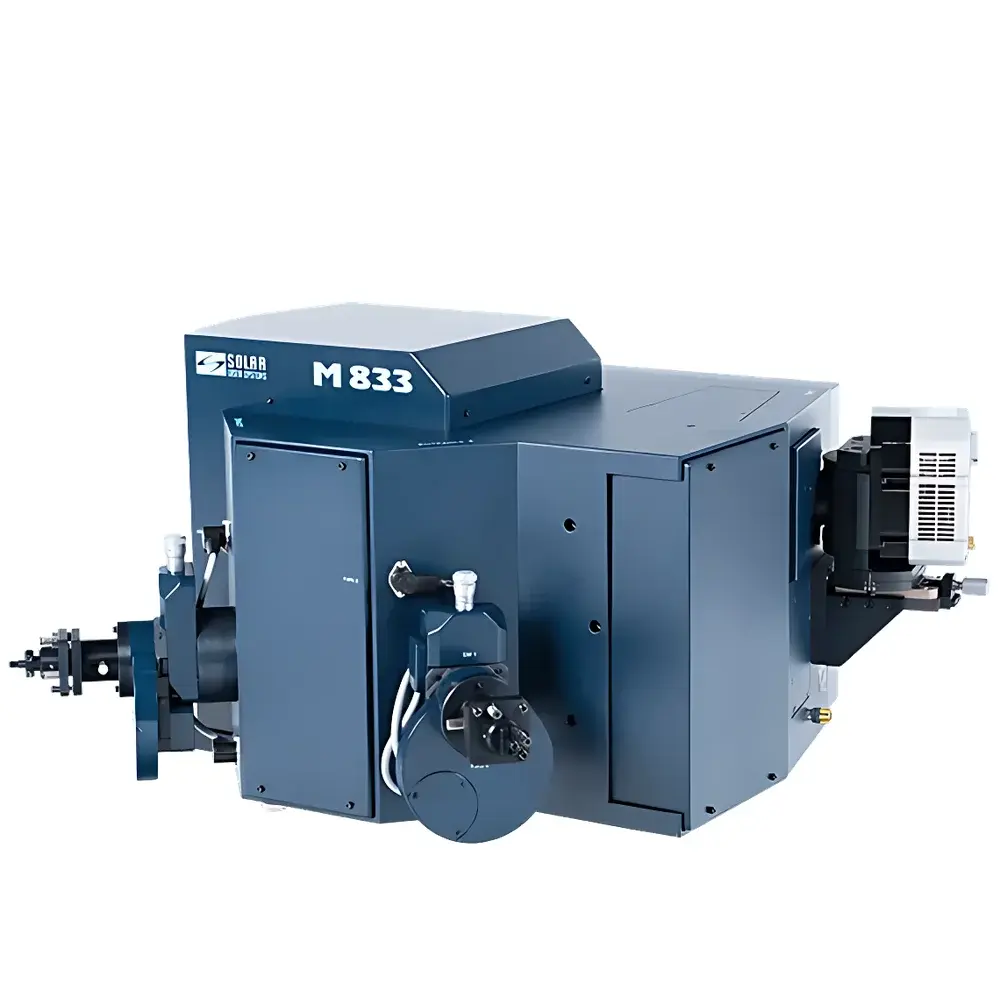
Auniontech M833 High-Resolution Monochromator
| Brand | Auniontech |
|---|---|
| Model | M833 |
| Optical Design | Dual-grating, Czerny-Turner with imaging capability |
| Focal Length | 833 mm |
| Aperture Ratio (f-number) | f/5.5 |
| Stray Light Suppression | <1×10⁻⁶ (typical) |
| Grating Options | Three interchangeable gratings |
| Input/Output Ports | Dual input and dual output slits |
| Control Interface | USB/Ethernet with full computer control |
| Software | SOLARLS.LAB (with DLL & LabVIEW VI support) |
| Spectral Range | UV to NIR (depending on grating and detector selection) |
| Resolution | ≤0.015 nm (at 500 nm, with 1200 g/mm grating and 10 µm slit) |
Overview
The Auniontech M833 High-Resolution Monochromator is a precision-engineered, long-focal-length (833 mm) dual-grating Czerny-Turner spectrometer designed for demanding spectral applications requiring exceptional resolution, low stray light, and high optical throughput. Its optical architecture integrates a large-aperture f/5.5 design with optimized mirror coatings and kinematic grating mounts to deliver stable, reproducible wavelength selection across the ultraviolet (UV), visible (VIS), and near-infrared (NIR) spectral regions. Unlike conventional monochromators, the M833 employs an imaging optical layout—enabling spatial preservation of the entrance slit at the exit plane—which significantly improves signal fidelity in multi-channel detection configurations and facilitates coupling to array detectors or fiber bundles without aberration-induced spectral distortion. The instrument’s mechanical rigidity and thermally stable aluminum alloy chassis minimize drift during extended acquisitions, making it suitable for quantitative spectroscopic measurements under laboratory or controlled industrial environments.
Key Features
- Long focal length (833 mm) combined with f/5.5 aperture for high spectral resolution and radiant throughput
- Dual-grating turret accommodating three user-selectable gratings—enabling flexible configuration for UV–NIR coverage and resolution optimization
- Imaging-mode optical design ensures point-to-point spatial mapping between entrance and exit planes, critical for CCD, CMOS, or multichannel PMT array coupling
- Dual input and dual output port configuration supports simultaneous reference–sample beam routing or multi-detector parallel acquisition
- Full computer control via USB 2.0 or Ethernet interface; integrated stepper motor drives with absolute position encoders ensure repeatable wavelength positioning (±0.002 nm typical reproducibility)
- Stray light level <1×10⁻⁶ (measured at 546 nm with 10 nm bandwidth blocking filter), meeting stringent requirements for Raman spectroscopy and weak-emission analysis
Sample Compatibility & Compliance
The M833 is compatible with standard 1/4″ and 1/2″ optical mounts, modular fiber-optic interfaces (SMA905, FC/PC), and vacuum-compatible variants (upon request). It supports integration into ISO-standard optical tables and cleanroom-rated enclosures. While the monochromator itself is not a regulated medical device, its performance characteristics align with measurement traceability frameworks required by ISO/IEC 17025-accredited laboratories. When operated with NIST-traceable calibration sources (e.g., Hg/Ar lamps), it supports compliance with ASTM E275, ISO 13406-2 (for detector linearity verification), and USP (spectrophotometric system suitability). Its low-drift thermal design and sealed optical path reduce sensitivity to ambient fluctuations—facilitating GLP-compliant data acquisition protocols when paired with audit-trail-enabled software.
Software & Data Management
The included SOLARLS.LAB software provides intuitive graphical control of wavelength scanning, slit width adjustment, grating selection, and detector synchronization. It supports real-time spectrum preview, multi-curve overlay, and export in CSV, ASCII, and HDF5 formats. For automated workflows, native DLL libraries and LabVIEW VIs are supplied—enabling seamless integration into custom-built DAQ systems compliant with FDA 21 CFR Part 11 (when deployed with electronic signature and audit trail modules). All parameter changes—including motor positions, grating IDs, and slit settings—are timestamped and logged internally, supporting full experimental traceability and retrospective validation.
Applications
- Raman spectroscopy—especially low-frequency and resonance Raman, where stray light suppression and sub-0.02 nm resolution are essential
- Photoluminescence and time-resolved fluorescence spectroscopy of quantum dots, perovskites, and single-photon emitters
- High-resolution atomic emission spectroscopy (AES) for plasma diagnostics and elemental analysis
- Calibration source characterization and spectral irradiance measurements in photometry labs
- Multichannel absorption and reflectance studies using linear or area-array detectors
- Custom optical system development requiring tunable narrowband illumination (e.g., pump-probe setups, hyperspectral imaging engines)
FAQ
What spectral range can the M833 cover?
The usable range depends on grating groove density and detector response; typical configurations span 190–1100 nm, extendable to 1600 nm with NIR-optimized optics and InGaAs detectors.
Is vacuum operation supported?
Standard units operate in air; vacuum-compatible versions (with modified seals and outgassing-controlled materials) are available as optional configurations.
Can the M833 be synchronized with pulsed lasers or gated detectors?
Yes—via TTL trigger I/O ports, enabling precise timing alignment for time-gated spectroscopy or pump–probe experiments.
How is wavelength calibration performed?
Factory calibration uses Hg/Ar spectral lines; users may perform recalibration using external reference lamps or laser lines, with polynomial or spline-based fitting algorithms embedded in SOLARLS.LAB.
Does the instrument meet CE or RoHS requirements?
Yes—the M833 complies with EU Directive 2014/30/EU (EMC) and 2011/65/EU (RoHS II); declaration of conformity is provided with shipment.