
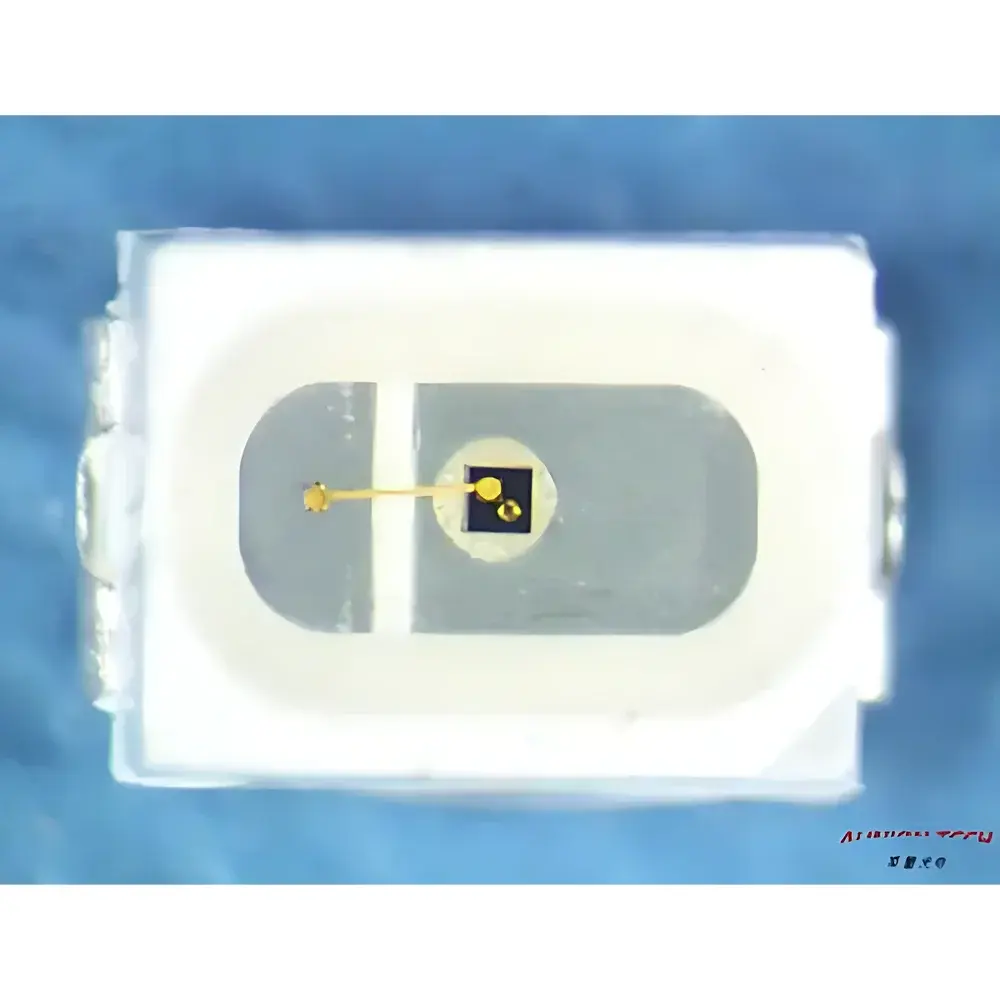
Vixar 795 nm / 895 nm High-Power Single-Mode VCSEL Chip
| Brand | Vixar |
|---|---|
| Wavelength | 794.9–795.1 nm / 894.6 nm |
| Output Power | ≥1 mW @ 3.5 mA |
| Threshold Current | 0.8–1.2 mA |
| Threshold Voltage | 1.8 V |
| Operating Voltage | 2.3 V |
| Polarization Extinction Ratio | 20–25 dB @ 3 mA |
| Side Mode Suppression Ratio | 25–30 dB @ 3 mA |
| Spectral Bandwidth (FWHM) | ≤70 MHz (unmodulated) |
| Beam Divergence (1/e²) | 10°–25° |
| Wavelength Tuning Coefficient | 0.3 nm/mA |
| Chip Substrate | GaAs |
| Temperature Range (Operating) | 30–90 °C (TEC-controlled) |
| Linewidth | <70 MHz (<±0.5 nm) |
Overview
The Vixar 795 nm / 895 nm High-Power Single-Mode VCSEL Chip is a precision semiconductor laser source engineered for atomic physics instrumentation and high-stability frequency metrology applications. As a vertical-cavity surface-emitting laser (VCSEL), it emits coherent light perpendicular to the epitaxial wafer surface—enabling compact integration, low threshold operation, and intrinsic circular beam profile with minimal astigmatism. Unlike edge-emitting lasers, this device leverages monolithic GaAs-based distributed Bragg reflector (DBR) stacks and an InGaAs quantum well active region to achieve fundamental transverse mode (TEM00) emission with exceptional spectral purity. Its narrow intrinsic linewidth (20 dB), and stable single-longitudinal-mode output make it suitable for applications demanding sub-Doppler spectroscopy, coherent population trapping (CPT), and optical pumping of alkali atoms—including 87Rb (795 nm) and 133Cs (894.6 nm).
Key Features
- Single longitudinal and transverse mode (TEM00) emission at precisely defined atomic resonance wavelengths: 794.9–795.1 nm (Rb D1 line) and 894.6 nm (Cs D1 line)
- Output power ≥1 mW under continuous-wave (CW) operation at 3.5 mA drive current, with low threshold current (0.8–1.2 mA) and voltage (1.8 V)
- High polarization extinction ratio (20–25 dB @ 3 mA), enabling robust polarization-sensitive detection schemes in magnetometers and atomic clocks
- Narrow spectral bandwidth (≤70 MHz FWHM, unmodulated), corresponding to wavelength stability within ±0.5 nm—critical for locking to atomic hyperfine transitions
- Side mode suppression ratio >25 dB, ensuring spectral purity and minimizing spurious mode competition
- GaAs-based chip architecture with integrated DBR mirrors; compatible with standard die-bonding, wire bonding, and TO-can or butterfly packaging
- Wavelength tunability of 0.3 nm/mA via injection current—facilitating fine-frequency adjustment without external cavity or temperature drift compensation
- Beam divergence of 10°–25° (1/e²), optimized for efficient coupling into single-mode fibers or vapor cell interaction zones
Sample Compatibility & Compliance
This VCSEL chip is designed for integration into ultra-high-vacuum-compatible atomic sensor platforms, including miniaturized atomic magnetometers, chip-scale atomic clocks (CSACs), and rotation-sensing interferometric systems. It operates reliably across a chip temperature range of 30–90 °C when stabilized using thermoelectric coolers (TECs), meeting thermal management requirements for field-deployable quantum sensors. The device complies with JEDEC JESD22-A108 reliability standards for operating life under accelerated stress conditions. While not certified as a medical or aerospace-grade component, its performance parameters align with typical specifications referenced in ASTM E2877 (Standard Guide for Atomic Magnetometer Performance Evaluation) and IEEE Std 1139 (Standard Definitions of Physical Quantities for Fundamental Frequency and Time Metrology). For GLP/GMP-aligned system integrators, full traceable test reports—including L-I-V curves, spectral scans, and polarization characterization—are available upon request.
Software & Data Management
As a bare-die semiconductor component, the VCSEL does not include embedded firmware or onboard control logic. However, it is fully compatible with industry-standard laser diode drivers supporting analog modulation, TTL blanking, and closed-loop TEC control (e.g., Thorlabs LDCxx, Wavelength Electronics LDTCxx, or custom FPGA-based controllers). When integrated into larger systems, its optical output can be monitored via photodiode feedback channels for real-time power stabilization. For traceable calibration and audit readiness, system-level software (e.g., LabVIEW, Python-based PyVISA instrument control frameworks) may log operational parameters—including drive current, TEC setpoint, photodiode voltage, and spectral centroid from attached wavemeters—satisfying FDA 21 CFR Part 11 requirements for electronic records and signatures where applicable.
Applications
- Atomic magnetometers and optically pumped magnetometers (OPMs) for biomagnetic imaging (e.g., fetal magnetocardiography, magnetoencephalography)
- Chip-scale atomic clocks (CSACs) and primary/secondary frequency standards based on Rb or Cs vapor cells
- Rotation sensing in interferometric or spin-exchange-relaxation-free (SERF) gyroscopes
- Quantum inertial measurement units (IMUs) requiring compact, low-power, spectrally stable pump sources
- Laser cooling and trapping setups for cold atom experiments (e.g., magneto-optical traps for alkali species)
- Gas-phase absorption spectroscopy targeting alkali metal transitions in environmental or industrial monitoring systems
FAQ
Is this VCSEL chip qualified for space or aviation environments?
No—this is a commercial-grade bare-die component intended for laboratory and industrial integration. Radiation hardness, shock/vibration qualification, and extended temperature cycling are not part of the standard specification.
Can the chip be operated in pulsed mode?
Yes—its short carrier lifetime and low capacitance enable nanosecond-scale current pulsing; however, pulse-width-dependent thermal transients must be modeled to avoid mode hopping or wavelength shift.
What packaging options are supported?
The device is supplied as a wafer-diced die on tape-and-reel. Common integration paths include TO-46/TO-56 headers, butterfly packages with integrated TEC and monitor photodiode, or direct flip-chip bonding onto silicon photonics interposers.
Does Vixar provide spectral characterization data per lot?
Yes—each production lot includes wafer-level spectral maps, L-I-V sweeps, and polarization measurements. Full traceability documentation is provided upon order fulfillment.
How is wavelength stability maintained during long-term operation?
Stability relies on active temperature control (via TEC) and constant-current driving. Drift is typically <±1 pm/°C near 795 nm and <±0.5 pm/°C near 895 nm under closed-loop thermal regulation.




