
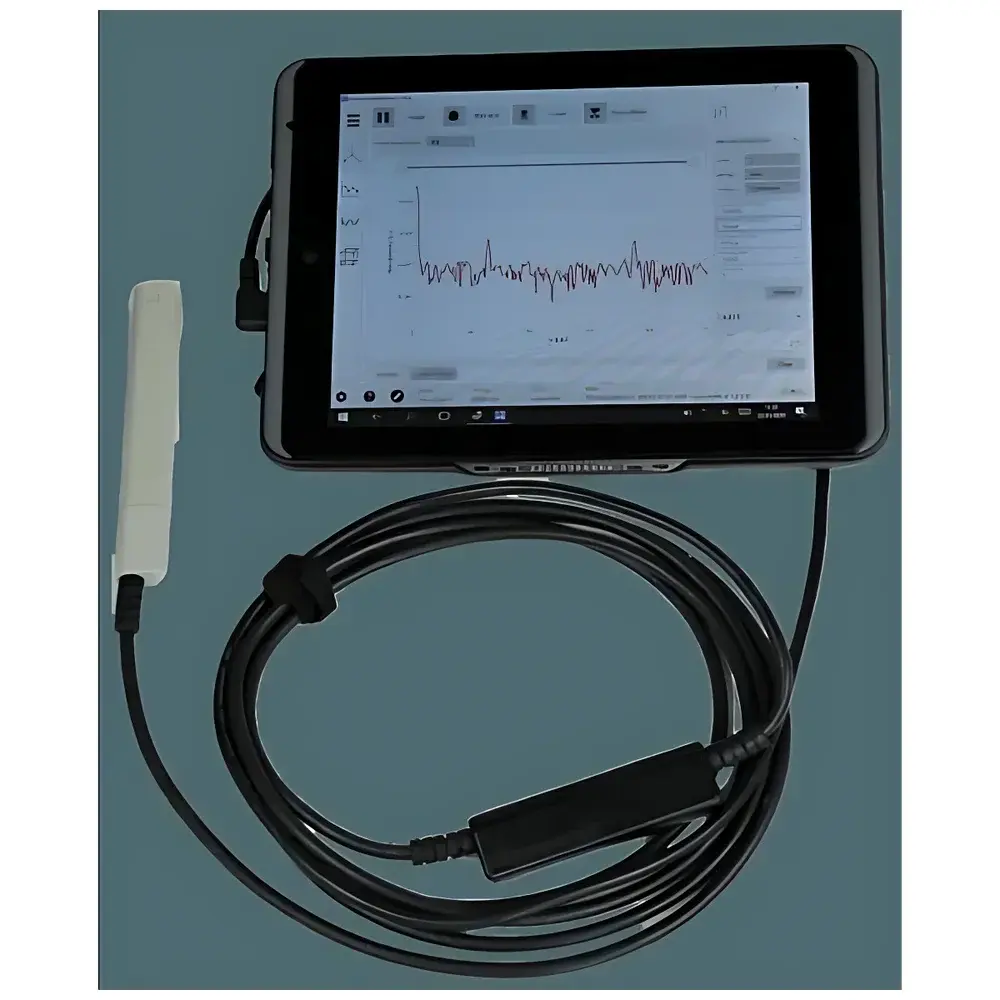
Metrolab THM1176 Triaxial Portable USB Gaussmeter
| Brand | Metrolab |
|---|---|
| Model | THM1176 |
| Sensor Type | Hall-effect triaxial probe |
| Measurement Range | 1 nT to 14 T |
| Frequency Bandwidth | DC to 1 kHz |
| Accuracy | ±1% (full-scale, isotropic total field) |
| Power Supply | USB bus-powered (5 V ±5%) |
| Output Resolution | 167 ns timestamp precision |
| Sampling Rate | 0.36 Sa/s to 6.8 kSa/s (per axis) |
| Operating Temperature | 0 °C to 40 °C |
| Compliance | CE, RoHS, USB-IF certified |
| Calibration | NIST-traceable certificate included |
| Software | EZMag3D (Windows/macOS/Linux) |
| Data Output | Bx, By, Bz, uncalibrated temperature, high-resolution timestamp |
Overview
The Metrolab THM1176 Triaxial Portable USB Gaussmeter is a precision magnetic field measurement instrument engineered for laboratory, industrial, and field applications requiring high-fidelity, vector-resolved characterization of static and time-varying magnetic fields. Based on calibrated Hall-effect sensor technology, the THM1176 integrates three orthogonal micro-Hall elements within a single compact probe head—enabling simultaneous acquisition of Bx, By, and Bz components without mechanical reorientation. Its measurement principle relies on the linear voltage response of semiconductor Hall sensors under Lorentz force, with factory-applied multi-parameter compensation for offset, gain, nonlinearity, temperature drift, and non-orthogonality—ensuring isotropic total field accuracy of ±1% across its full dynamic range (1 nT to 14 T). Unlike conventional single-axis gaussmeters, the THM1176 delivers true vector magnitude |B| = √(Bx² + By² + Bz²) independent of probe orientation, eliminating alignment uncertainty in mapping and qualification workflows.
Key Features
- Triaxial Hall probe with integrated signal conditioning and digital conversion—no external amplifier or analog cabling required
- USB 2.0 interface providing both power and bidirectional data communication; fully bus-powered, no external PSU needed
- DC to 1 kHz bandwidth supporting both steady-state magnet characterization and low-frequency AC field analysis (e.g., power-line harmonics, pulsed electromagnet decay)
- Real-time timestamp resolution of 167 nanoseconds—critical for synchronization with external triggers or timing-critical experiments
- Dynamic sampling rate configurable from 0.36 samples/s (for long-term monitoring) up to 6.8 kSa/s (for transient capture), with each sample comprising full 3-axis vector data
- NIST-traceable calibration certificate supplied with every unit, covering all three axes and total field magnitude over defined temperature and field ranges
- Ruggedized probe housing with low-magnetic-permeability materials (e.g., non-ferrous alloys, PEEK) minimizing field distortion during proximity measurements
Sample Compatibility & Compliance
The THM1176 is designed for direct contact or near-field measurement of permanent magnets, electromagnets, MRI fringe fields, magnetic shielding effectiveness, and electromagnetic compatibility (EMC) test environments. It operates reliably in ambient temperatures from 0 °C to 40 °C and exhibits immunity to fields up to 3 T at the electronics module (when used with standard cabling) and up to 1 T when connected to handheld computing platforms with integrated magnetic shielding constraints. The instrument complies with CE marking requirements under the EU Electromagnetic Compatibility Directive 2014/30/EU and the RoHS 2011/65/EU restriction on hazardous substances. Its USB interface conforms to USB-IF specifications for interoperability across host platforms. While not certified for medical device use per IEC 62304 or FDA 510(k), the THM1176 supports GLP/GMP-aligned documentation practices via its audit-ready calibration records and software metadata logging.
Software & Data Management
EZMag3D—the official cross-platform application—provides complete control and post-processing capabilities for the THM1176. Compatible with Windows, macOS, and Linux, it enables real-time visualization of vector components and scalar magnitude, spectral analysis (FFT-based frequency-domain decomposition), AC waveform reconstruction, and spatial field mapping via external positioning integration (e.g., motorized stages or manual coordinate logging). All acquired data include embedded timestamps (167 ns resolution), sensor ID, calibration epoch, and environmental metadata (uncalibrated temperature readout). Export formats include CSV (with header annotations), HDF5 (for scientific computing pipelines), and MATLAB .mat. The software supports user-defined acquisition profiles, automated batch calibration validation, and export of configuration files for traceable method replication—facilitating compliance with ISO/IEC 17025 documentation requirements.
Applications
- Characterization of permanent magnet arrays in electric motor and generator R&D
- Verification of magnetic shielding integrity in sensitive instrumentation enclosures (e.g., electron microscopes, atomic clocks)
- Mapping stray fields around MRI systems for safety zone delineation per IEC 60601-2-33
- Quality control of magnetized components in automotive and aerospace manufacturing
- Low-frequency EMI/EMC pre-compliance testing of power electronics and switching converters
- Fundamental physics experiments involving controlled DC/AC field gradients and null-field stabilization
- Educational labs demonstrating vector field superposition, dipole moments, and Ampère’s law verification
FAQ
Is the THM1176 suitable for measuring Earth’s magnetic field?
Yes—the 1 nT lower limit and sub-nT noise floor enable precise geomagnetic field monitoring, though thermal stability and vibration isolation are recommended for long-duration measurements.
Can the probe be used in cryogenic or vacuum environments?
The standard probe is rated for ambient conditions only; custom variants with cryo-compatible materials and feedthroughs are available upon request and require engineering review.
Does the software support automated compliance reporting for ISO/IEC 17025?
While EZMag3D does not generate formal accreditation reports, it exports structured, timestamped, and calibration-annotated datasets compatible with LIMS integration and internal QA workflows.
What is the maximum cable length between probe and host USB port?
Standard operation is guaranteed up to 3 m using certified USB 2.0 cables; active extension solutions (e.g., USB 2.0 repeaters) may extend reach to 15 m with verified signal integrity.
How often is recalibration recommended?
Annual recalibration is advised for metrology-critical applications; Metrolab provides return-to-factory service with updated NIST-traceable certification and performance verification across the full field range.



