
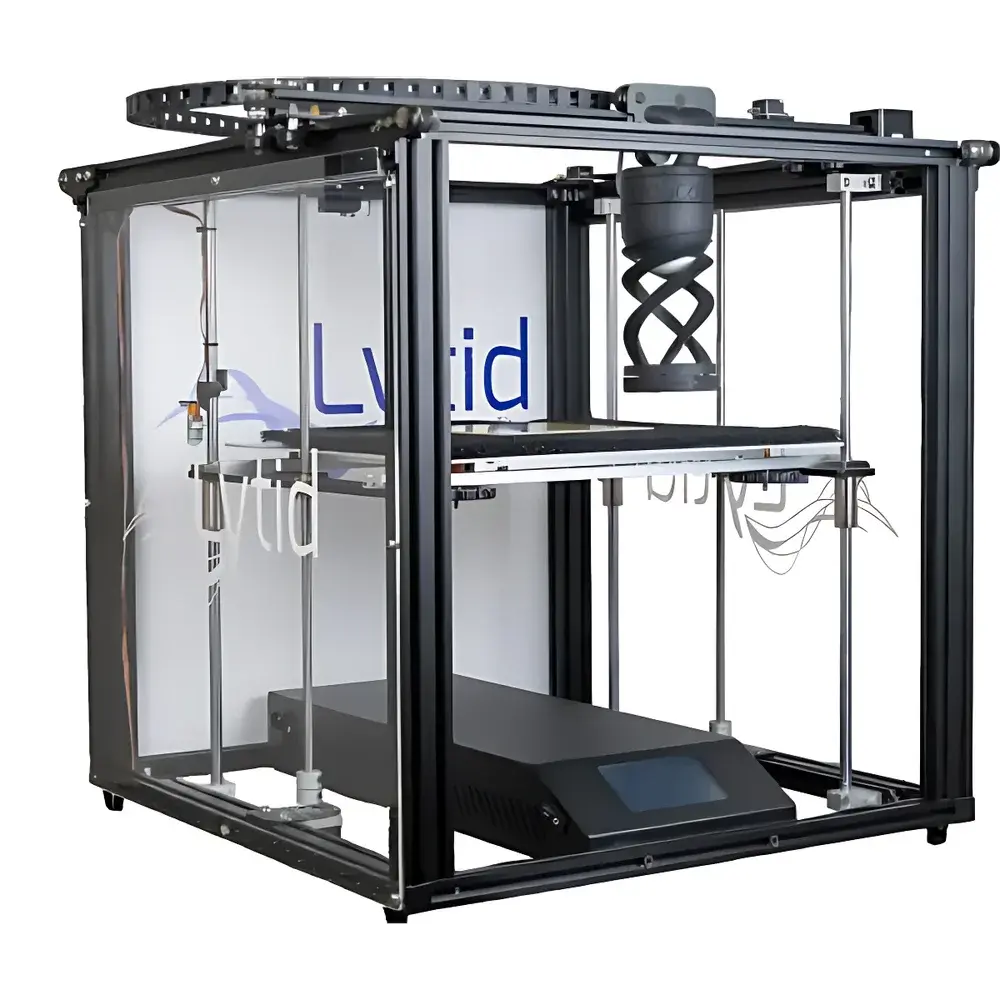
Auniontech TeraScan FMCW-Based 3D Terahertz Imaging Scanner
| Brand | Auniontech |
|---|---|
| Origin | Shanghai, China |
| Model | TeraScan Series (Frame / Arm / Long-Range Arm) |
| Frequency Bands | 120 GHz / 240 GHz / 300 GHz |
| Scanning Modes | Contactless, Non-Destructive 3D Tomographic Imaging |
| Software Platform | TeraVisio 3D |
| Compliance | Designed for ISO/IEC 17025-aligned NDT workflows, supports audit-ready data logging per GLP/GMP principles |
| Sample Handling | Modular X-Y-Z translation stage or 6-axis collaborative robot (COBOT)-integrated motion control |
| Optical Interface | Interchangeable THz emitter/detector modules and quasi-optical components |
| Data Output | Raw time-domain waveforms, A-scan/B-scan/C-scan volumes, depth-resolved 3D voxel maps |
Overview
The Auniontech TeraScan FMCW-Based 3D Terahertz Imaging Scanner is a precision-engineered system for non-contact, non-destructive volumetric inspection of dielectric and semi-conductive materials. Leveraging frequency-modulated continuous-wave (FMCW) terahertz radar architecture, the system achieves coherent heterodyne detection with high signal-to-noise ratio and sub-millimeter depth resolution. Unlike pulsed THz time-domain spectroscopy (TDS), the FMCW approach enables robust phase-sensitive ranging without requiring ultrafast lasers or cryogenic components—making it suitable for factory-floor integration and long-term operational stability. The scanner operates across three selectable frequency bands (120 GHz, 240 GHz, and 300 GHz), allowing users to optimize penetration depth versus lateral resolution based on material composition and defect morphology. Its core function is to reconstruct 3D internal structures—including delaminations, voids, porosity, corrosion under coatings, and interfacial degradation—in composites, polymers, ceramics, battery electrode stacks, and fiber-reinforced laminates.
Key Features
- FMCW-based coherent detection architecture for high-depth accuracy and phase-stable ranging
- Triple-band frequency agility: switch between 120 GHz (deep penetration in low-loss media), 240 GHz (balanced resolution/depth), and 300 GHz (high-resolution near-surface imaging)
- Modular mechanical platform options: TeraScan Frame (precision X-Y-Z linear stages), TeraScan Arm (6-axis COBOT-integrated manipulator), and TeraScan Arm Long Range (extended working distance up to 1.5 m)
- Interchangeable THz optics and sensor modules—enabling rapid reconfiguration for varying standoff distances, field-of-view requirements, and polarization sensitivity
- Real-time 3D volumetric reconstruction with sub-100 µm axial resolution and ≤ 500 µm lateral resolution (at 300 GHz, λ ≈ 1 mm)
- Integrated thermal stabilization and environmental drift compensation for repeatable measurements across ambient temperature fluctuations
Sample Compatibility & Compliance
The TeraScan system is optimized for non-metallic and weakly conductive materials where conventional X-ray or ultrasound face limitations—such as carbon-fiber-reinforced polymer (CFRP) laminates, polymer-coated metal substrates, lithium-ion battery pouch cells, ceramic matrix composites (CMCs), and pharmaceutical tablet coatings. It is insensitive to ionizing radiation hazards and requires no shielding infrastructure. The system complies with electromagnetic compatibility (EMC) Class B standards per CISPR 32 and meets CE marking requirements for industrial instrumentation. While not certified for medical use, its measurement traceability aligns with ISO 12718 (NDT — Terminology — Ultrasonic, Eddy Current, Radiographic, and Terahertz Testing) and supports documentation frameworks required for ISO/IEC 17025-accredited laboratories. Audit trails, user-access controls, and raw waveform export ensure compatibility with GLP and GMP data integrity expectations.
Software & Data Management
TeraVisio 3D software provides a unified interface for acquisition, visualization, and post-processing. Core capabilities include synchronized A-scan (time-domain waveform), B-scan (cross-sectional slice), and C-scan (planar projection at selected depth layers). The Depth Browser slider enables interactive navigation through reconstructed 3D volumes; voxel intensity thresholds, color mapping, and iso-surface rendering allow quantitative defect sizing. All raw time-domain data are stored in HDF5 format with embedded metadata (timestamp, frequency band, position coordinates, calibration flags). Batch processing pipelines support automated defect detection using configurable amplitude/phase deviation criteria. Software architecture permits integration with third-party analysis tools via Python API and supports DICOM-like export for cross-platform compatibility. Custom UI layouts can be defined for production-line operators, including pass/fail overlays and real-time SPC charting.
Applications
- Aerospace: Detection of disbonds, water ingress, and impact damage in CFRP fuselage panels and wing skins
- Automotive: Inspection of adhesive bond integrity in multi-material EV battery enclosures and structural adhesives in aluminum-composite joints
- Energy Storage: In-line characterization of electrode calendering uniformity, separator wrinkling, and dry-out zones in prismatic and pouch cells
- Electronics: Subsurface imaging of embedded traces, voids in molded interconnect devices (MIDs), and delamination in fan-out wafer-level packaging
- Cultural Heritage: Stratigraphic analysis of paint layers and underdrawings in historical artifacts without sampling
- Pharmaceuticals: Coating thickness mapping and blister-pack seal integrity verification
FAQ
What is the maximum achievable depth penetration in common composite materials?
Penetration depth depends on material loss tangent and operating frequency—for example, ~8–12 mm in GFRP at 120 GHz, ~3–5 mm in CFRP at 240 GHz, and ~1–2 mm in polyimide films at 300 GHz.
Does the system require external vibration isolation or climate-controlled environments?
No active vibration isolation is needed due to built-in motion compensation algorithms; however, stable ambient temperature (±2°C) is recommended for optimal long-term repeatability.
Can TeraVisio 3D export data compatible with CAD-based defect localization workflows?
Yes—coordinate-aligned point clouds and STL surface meshes can be exported with calibrated spatial referencing for overlay onto engineering drawings or finite element models.
Is remote operation supported for integration into Industry 4.0 platforms?
The system includes Ethernet/IP and OPC UA interfaces for PLC synchronization, MES data exchange, and cloud-based fleet monitoring via secure TLS-encrypted connections.
How does the system handle highly reflective substrates such as aluminum or copper?
Through advanced time-gated reflection suppression and dual-polarization mode acquisition, enabling reliable subsurface imaging beneath metallic paint layers or thin metallized films.







