
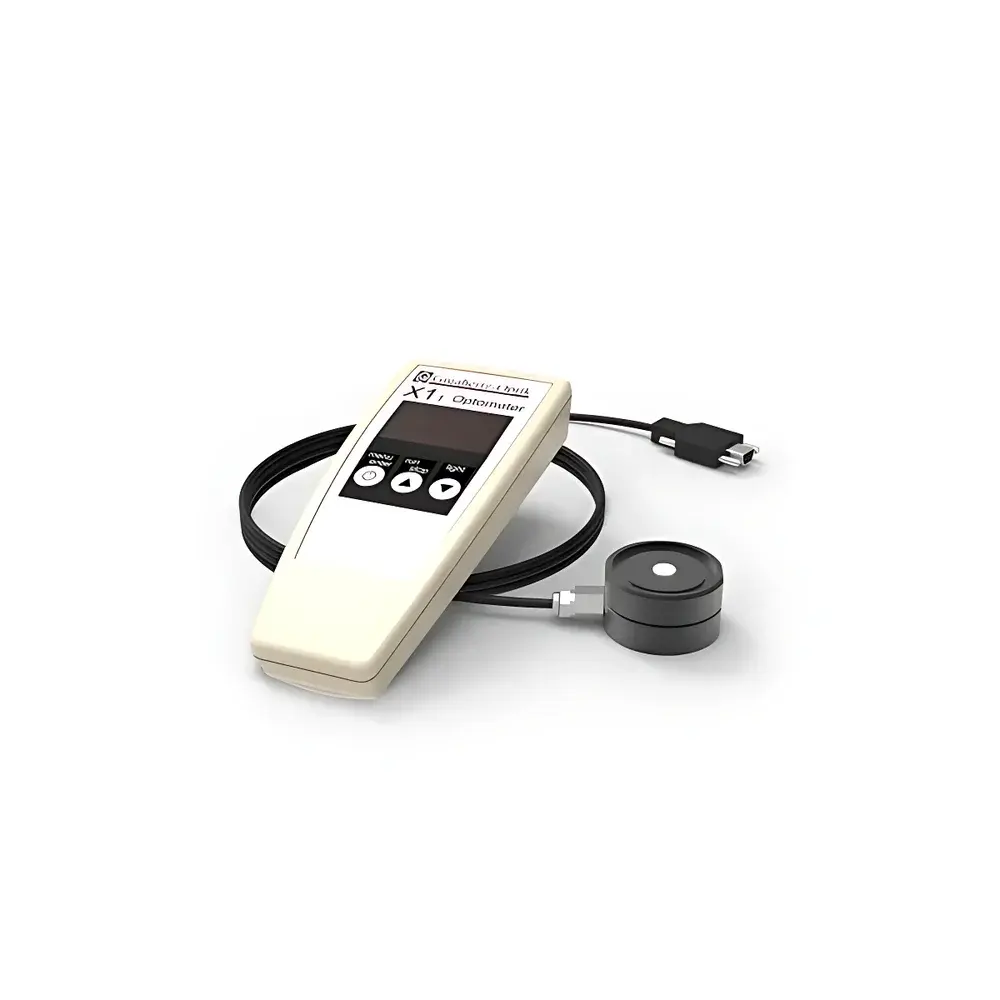
Gigahertz Optik X1-Series Multi-Channel UV-VIS-NIR LED Illuminance and Radiance Meter
| Brand | Gigahertz Optik |
|---|---|
| Model Series | X1-Series (with interchangeable detectors: X1-1-RCH-116-4, X1+VL-3701, X1+RW-3703, X1+RW-3704, PLL-1701+VL-3701) |
| Detector Type | Calibrated Silicon Photodiode (UV-enhanced, VIS-optimized, NIR-sensitive) |
| Spectral Range | 350–1000 nm (configurable per channel) |
| Optical Aperture | 7–11 mm diameter diffuser |
| Irradiance Range | 1 µW/cm² to 400 W/cm² (dependent on detector head) |
| Photometric Matching | f₁′ ≤ 3% (CIE V(λ) compliant) |
| Integration Time | 100 ms to 10 s |
| Output Interface | USB 2.0 (virtual COM port), analog voltage (0–10 V), optional oscilloscope sync |
| Calibration | NIST-traceable, individual detector certificate included |
| Compliance | ISO/IEC 17025 accredited calibration, CE, RoHS, GLP-ready data logging |
Overview
The Gigahertz Optik X1-Series is a modular, four-channel USB photometer system engineered for high-fidelity photometric, radiometric, and flicker analysis of ultraviolet (UV), visible (VIS), and near-infrared (NIR) light-emitting diodes (LEDs). Unlike conventional single-spectrum illuminance meters, the X1-Series employs spectrally optimized, individually calibrated detector heads—each designed to match specific emission bands of modern solid-state lighting sources. Its core measurement principle relies on precision-calibrated silicon photodiodes with tailored spectral responsivity curves, coupled with temperature-stabilized analog front-end electronics and real-time digital signal processing. This architecture ensures accurate irradiance (W/m²), illuminance (lux), and radiant exposure (J/m²) quantification across dynamic LED output profiles—including pulsed, modulated, and high-intensity UV curing sources. The system is purpose-built for applications demanding traceable, repeatable, and standards-compliant optical metrology in R&D labs, LED manufacturing QA, photopolymerization process validation, and lighting product certification.
Key Features
- Modular four-channel architecture supporting simultaneous multi-spectral acquisition via hot-swappable detector heads (X1-1-RCH-116-4 for UV curing LEDs; X1+VL-3701 for photopic luminance; X1+RW-3703 for broadband visible radiometry; X1+RW-3704 for NIR radiometry; PLL-1701+VL-3701 for flicker analysis)
- NIST-traceable calibration with individual certificate per detector head, covering full operational wavelength range and irradiance span
- Optimized diffuser optics (7–11 mm Ø) enabling cosine-corrected angular response (f₂ ≤ 2%) per CIE S 023/E:2013
- Temperature-compensated analog circuitry ensuring stability under sustained UV exposure (>1000 h at 365 nm, 50 mW/cm²) and ambient temperatures up to 50 °C
- Configurable integration time (100 ms – 10 s) and programmable auto-ranging to maintain SNR ≥ 50 across six decades of irradiance (1 µW/cm² to 400 W/cm²)
- USB 2.0 interface with virtual COM port protocol compatible with LabVIEW, Python (PySerial), MATLAB, and custom SCADA systems
Sample Compatibility & Compliance
The X1-Series accommodates diverse LED geometries—from surface-mount chips and COB arrays to high-power collimated modules—via standardized mounting fixtures and optional beam-shaping adapters. Each detector head meets CIE Publication No. 193:2010 requirements for LED measurement geometry and field-of-view definition. Photometric channels (e.g., X1+VL-3701) comply with CIE 1931 V(λ) spectral luminous efficiency function (f₁′ ≤ 3%). Radiometric configurations adhere to ISO 13406-2 for display backlight characterization and ASTM E308-22 for colorimetric computation. For UV curing validation, the X1-1-RCH-116-4 head satisfies ISO 11531:2022 (UV-LED source characterization) and is routinely deployed in FDA-regulated medical device manufacturing environments where process reproducibility must meet 21 CFR Part 11 audit trail requirements.
Software & Data Management
The included X1-Control software provides real-time visualization, multi-channel synchronization, and automated report generation in PDF or CSV format. Raw analog outputs support external oscilloscope integration for time-resolved flicker waveform capture (e.g., percent flicker, flicker index per IEEE 1789-2015). All measurements include embedded metadata: timestamp (UTC), detector serial number, calibration expiry date, integration time, and environmental temperature. Audit logs record user actions, configuration changes, and calibration events—enabling full GLP/GMP compliance. Data export supports IEC 61215-2 (PV module testing) and ISO/IEC 17025 laboratory accreditation documentation workflows.
Applications
- UV-LED curing process validation in adhesive, ink, and coating manufacturing
- Photobiomodulation (PBM) device dosimetry for clinical and preclinical research
- White LED binning and chromaticity verification during production
- Flicker assessment of architectural and automotive LED lighting per ENERGY STAR Lamps V2.1
- Radiometric qualification of NIR emitters used in machine vision illumination and driver monitoring systems
- Calibration transfer between primary standards laboratories and industrial metrology labs
FAQ
Can the X1-Series measure pulsed or PWM-driven LEDs?
Yes—the system supports configurable integration windows down to 100 ms and offers trigger-synchronized acquisition for precise duty-cycle-resolved irradiance averaging.
Is recalibration required after each detector head swap?
No—each detector head ships with its own NIST-traceable calibration file; the X1-Control software auto-loads correction coefficients upon USB enumeration.
Does the system support compliance reporting for ISO/IEC 17025 accredited labs?
Yes—audit logs, calibration certificates, uncertainty budgets, and raw data timestamps are all exportable in formats accepted by accreditation bodies.
What is the maximum continuous operating temperature for the X1-1-RCH-116-4 UV detector?
The detector maintains specification compliance at ambient temperatures up to 50 °C and withstands cumulative UV exposure equivalent to >5,000 hours at 365 nm, 100 mW/cm².
Can I integrate this meter into an automated production line?
Yes—USB HID and Modbus RTU over USB protocols are supported, enabling direct integration with PLCs, MES platforms, and robotic handling systems.





