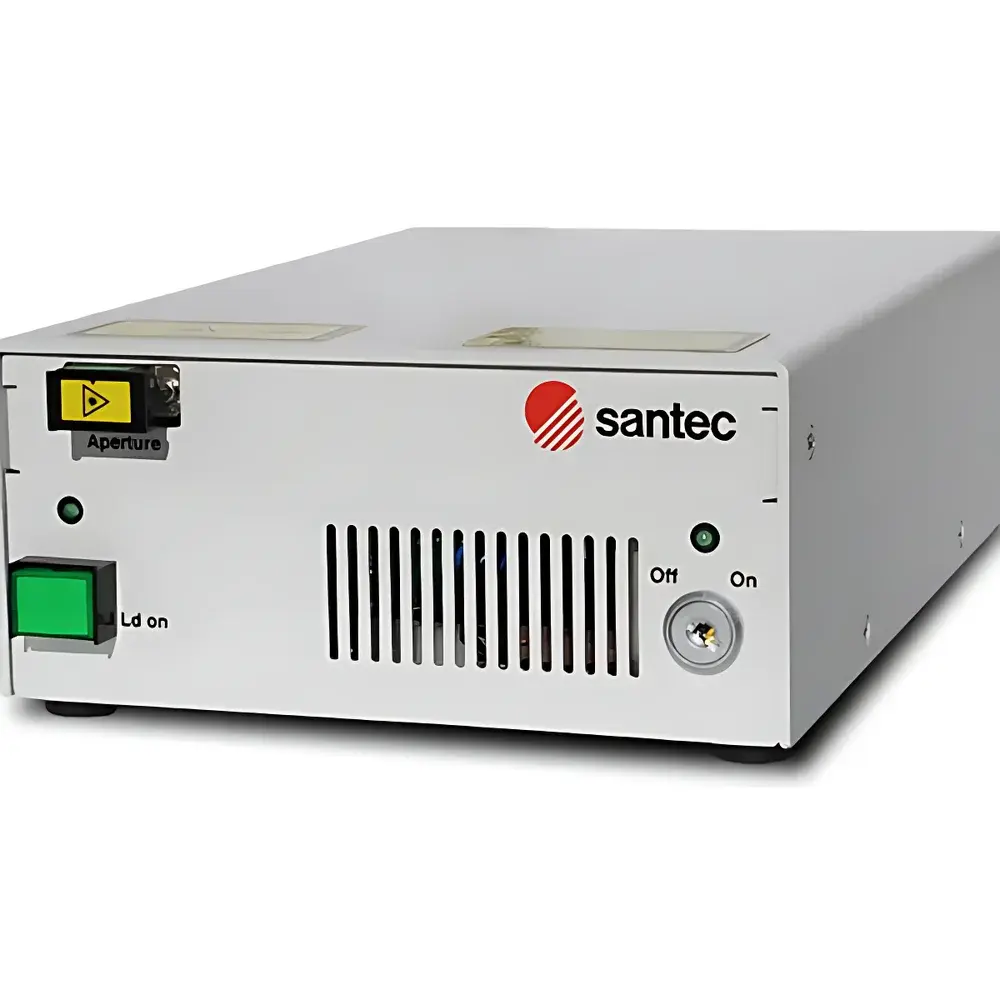
Santec HSL Series High-Speed Swept-Source Laser for SS-OCT
| Brand | Santec |
|---|---|
| Model | HSL-1 / HSL-10 / HSL-20 / HSL-2100 |
| Wavelength | 1060 nm (HSL-1, HSL-10), 1310 nm (HSL-20, HSL-2100) |
| Output Power | ≥40 mW (HSL-1/10/20), >20 mW (HSL-2100) |
| Sweep Range | ≥75 nm (HSL-1), ≥90 nm (HSL-10), ≥105 nm (HSL-20), ≥170 nm (HSL-2100) |
| Sweep Rate | 10–400 kHz (HSL-1), 100 kHz (HSL-10 & HSL-20), 20 kHz (HSL-2100) |
| Coherence Length | >100 mm (theoretical, HSL-1), ≥10 mm (HSL-10), ≥16–20 mm (HSL-20), ≥6 mm (HSL-2100) |
| Tuning Technology | MEMS-based VCSEL (HSL-1), MEMS-scanned external cavity (HSL-10/20), Polygon-based scanning (HSL-2100) |
| Compliance | IEC 60601-1, CE Marked (Medical Use) |
| Interface | USB 2.0 |
| OEM Support | Yes |
| Application Domain | Ophthalmic OCT, Dental OCT, Endoscopic OCT, Industrial Metrology, Fiber Optic Sensing, Spectral Domain Interferometry |
Overview
The Santec HSL Series High-Speed Swept-Source Lasers are engineered for precision optical coherence tomography (OCT) systems requiring high-speed, long-coherence, and spectrally stable wavelength scanning. Based on fundamental swept-source interferometry principles, these lasers generate a continuously tunable narrow-linewidth output across defined spectral bands—1060 nm for aqueous-tissue penetration (e.g., retinal imaging) and 1310 nm for deeper tissue penetration with reduced water absorption (e.g., dental, cardiovascular, and industrial inspection). Each model employs a distinct optomechanical architecture: the HSL-1 integrates a proprietary MEMS-actuated vertical-cavity surface-emitting laser (VCSEL), delivering single longitudinal mode operation with inherently low relative intensity noise (RIN) and extended coherence length; the HSL-10 and HSL-20 utilize MEMS-driven external cavity designs optimized for stability and compactness; and the HSL-2100 implements polygon-mirror-based scanning to achieve ultra-wide tuning ranges (>170 nm) with exceptional linearity and repeatability—eliminating the need for K-trigger synchronization in data acquisition. All units are manufactured under controlled semiconductor fabrication processes, ensuring batch-to-batch consistency and long-term reliability in both laboratory and GMP-aligned production environments.
Key Features
- High-speed wavelength tuning: Selectable sweep rates from 10 kHz up to 400 kHz (HSL-1), enabling real-time volumetric OCT acquisition at clinically relevant frame rates.
- Extended coherence length: Ranging from ≥6 mm (HSL-2100) to theoretical >100 mm (HSL-1), supporting deep-tissue imaging and long-path interferometric measurements without signal decorrelation.
- Single-mode emission with low mode-partition noise: Critical for maintaining axial resolution and minimizing speckle noise in high-dynamic-range OCT reconstructions.
- Wide, user-selectable tuning bandwidth: Up to 170 nm centered at 1310 nm (HSL-2100), directly translating into axial resolution below 6 µm in air (≈4.5 µm in tissue).
- Integrated synchronization interfaces: Built-in K-trigger and start-trigger outputs (HSL-10/HSL-20) ensure deterministic timing alignment with camera exposure, galvo scanning, or data acquisition hardware.
- OEM-ready design: Compact form factor, USB 2.0 control interface, and configurable firmware support seamless integration into third-party OCT platforms and industrial inline metrology systems.
Sample Compatibility & Compliance
The HSL Series is validated for use with biological tissues exhibiting high water content—including ocular, dental, and vascular structures—as well as non-biological materials such as silicon wafers, polymer films, and composite laminates. Its 1060 nm variants minimize scattering and absorption in vitreous humor and corneal stroma, while the 1310 nm models provide optimal penetration depth in gingival tissue, arterial walls, and opaque industrial substrates. All medical-grade configurations comply with IEC 60601-1 (Safety of Medical Electrical Equipment) and carry CE marking under the EU Medical Device Regulation (MDR 2017/745). For non-medical applications, the lasers meet IEC 61340-5-1 (ESD control) and RoHS 2011/65/EU directives. Traceable calibration reports and GLP-compliant documentation packages are available upon request for regulated QC/QA deployments.
Software & Data Management
Santec provides a Windows-compatible SDK (C/C++, .NET, LabVIEW) enabling full control over sweep parameters—including center wavelength, scan range, repetition rate, and trigger polarity—via USB 2.0. The SDK supports real-time parameter adjustment during acquisition, facilitating adaptive scanning protocols and multi-rate interleaving. All models log internal temperature, drive current, and sweep linearity metrics with timestamped metadata, compatible with HDF5 and MATLAB .mat export formats. Audit trails—including user login, parameter changes, and firmware updates—are retained in non-volatile memory to satisfy FDA 21 CFR Part 11 requirements for electronic records and signatures when deployed in regulated manufacturing or clinical research settings.
Applications
- Ophthalmology: Retinal layer segmentation, choroidal thickness mapping, and glaucoma progression monitoring using 1060 nm SS-OCT systems.
- Dentistry & Oral Surgery: In vivo imaging of enamel-dentin junctions, caries detection, and peri-implantitis assessment.
- Cardiovascular Endoscopy: Intravascular OCT (IV-OCT) catheter-based imaging of plaque morphology and stent apposition.
- Industrial Metrology: Real-time thickness measurement of transparent coatings on silicon wafers, defect detection in multilayer packaging films, and dimensional verification of microfluidic channels.
- Fiber Optic Sensing: Distributed strain and temperature monitoring in FBG and interferometric sensor arrays.
- Research OCT Platforms: Development of functional extensions including Doppler OCT, polarization-sensitive OCT (PS-OCT), and angiography algorithms.
FAQ
What distinguishes the HSL-1 from other swept-source lasers in terms of coherence performance?
The HSL-1’s monolithic VCSEL-MEMS architecture yields intrinsically narrow instantaneous linewidth (<0.1 nm) and minimal mode-hopping, resulting in a theoretical coherence length exceeding 100 mm—critical for high-resolution, long-depth-range OCT without phase unwrapping artifacts.
Can the HSL-2100 operate without external triggering hardware?
Yes. Its polygon-based scanning mechanism delivers highly linear and repeatable wavelength sweeps, allowing direct synchronization with standard PCIe DAQ cards via software-defined timing—no K-trigger circuitry required.
Is firmware upgrade support available for field-deployed units?
Yes. Firmware updates are delivered via signed binary packages through Santec’s secure customer portal, with version rollback capability and integrity verification to maintain system validation status in regulated environments.
Do you provide application-specific optical coupling solutions?
Yes. Santec offers fiber-pigtailed versions with FC/APC or custom connectors, collimated free-space outputs, and OEM-integrated thermal management modules—including TEC-controlled housings rated for continuous operation at ambient temperatures up to 45°C.
Are calibration certificates traceable to NIST or PTB standards?
Calibration data for center wavelength, sweep range, and output power are traceable to NMI-Japan (AIST) reference spectrometers and power meters; NIST-traceable equivalents are available upon request with additional lead time.