
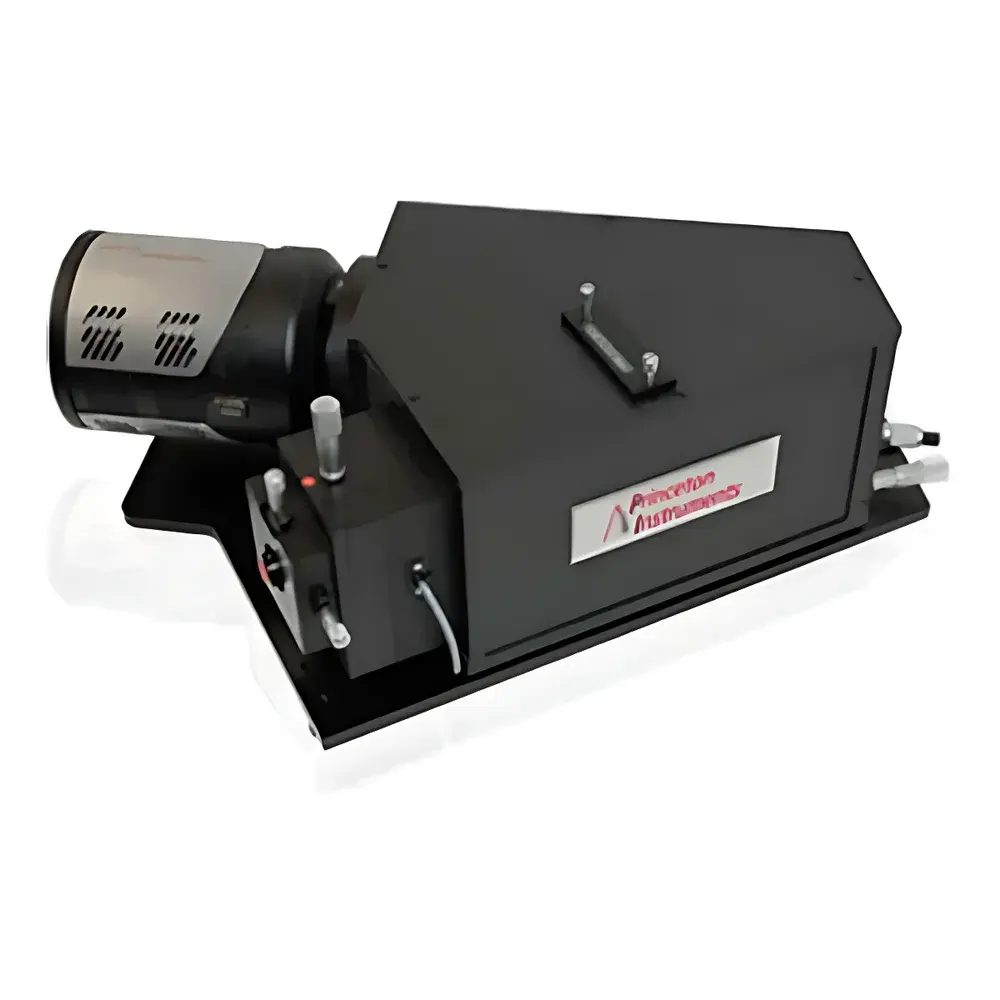
Teledyne Princeton Instruments Acton LS Series Spectrograph
| Brand | Teledyne Princeton Instruments |
|---|---|
| Origin | Shanghai, China |
| Manufacturer Type | Authorized Distributor |
| Product Origin | Domestic (China) |
| Model | Acton LS Series |
| Pricing | Available Upon Request |
Overview
The Teledyne Princeton Instruments Acton LS Series Spectrograph is a high-throughput, f/2 reflective imaging spectrograph engineered for demanding near-infrared (NIR) spectral applications—particularly 785 nm excitation Raman spectroscopy. Built upon the legacy of Acton Optics & Coatings (founded in the early 1960s), the LS platform integrates precision-machined optical mounts, gold-coated diffraction gratings, and broadband anti-reflection (AR)-coated mirrors to maximize photon collection efficiency across 750–1100 nm. Its compact 85 mm focal length design leverages aberration-corrected off-axis parabolic optics to deliver spatially resolved, low-stray-light spectra with minimal distortion—critical for fiber-coupled Raman systems requiring high signal-to-noise ratio (SNR) and reproducible spectral fidelity. Unlike scanning monochromators, the LS Series operates as a fixed-grating, multi-channel detection platform, enabling simultaneous acquisition across its full spectral range when paired with a scientific-grade CCD or sCMOS detector.
Key Features
- f/2 reflective optical architecture optimized for 750–1100 nm, delivering high étendue and throughput for NIR Raman applications
- Gold-coated 1200 grooves/mm diffraction grating with high diffraction efficiency in the NIR band
- Micrometer-actuated grating rotation and focus adjustment for precise wavelength alignment and spatial optimization
- Integrated kinematic mounting for stable, repeatable coupling with 25 µm core optical fibers (e.g., for remote Raman probes)
- Compatible with Teledyne PI’s deep-cooled PIXIS and PyLoN CCD detectors—enabling sub-2 e⁻ RMS read noise and >90% quantum efficiency at 785–900 nm
- Robust aluminum housing with thermal stabilization provisions to minimize drift during extended acquisitions
Sample Compatibility & Compliance
The LS Series supports direct fiber-optic input (SMA 905), free-space collimated beams, and custom slit configurations. It is routinely deployed in GLP-compliant Raman laboratories for pharmaceutical raw material identification (per USP and ASTM E1840), polymer characterization (ASTM D7513), and biological tissue analysis. All optical components meet ISO 10110 surface quality standards; the instrument itself is manufactured under ISO 9001:2015 certified processes. While not FDA 21 CFR Part 11–validated out-of-the-box, its integration with LightField software enables audit-trail-enabled data capture, user-access controls, and electronic signature support—facilitating compliance-ready workflows in regulated environments.
Software & Data Management
Controlled exclusively via LightField software—a modular, driver-level application developed by Teledyne PI—users achieve synchronized hardware configuration, real-time spectral preview, and quantitative intensity calibration. LightField embeds a native mathematical engine supporting on-the-fly baseline correction, peak integration, spectral subtraction, and multivariate analysis (e.g., PCA). It provides native LabVIEW® and MATLAB® instrument drivers (NI-VISA and MathWorks Instrument Control Toolbox compatible), enabling seamless integration into automated test benches or custom acquisition pipelines. IntelliCal—a hardware-assisted calibration module—automatically performs wavelength and pixel-response uniformity correction using built-in LED references, reducing setup time and improving inter-system comparability.
Applications
- NIR Raman spectroscopy: High-speed acquisition of pharmaceutical actives, excipients, and counterfeit detection in solid dosage forms
- CARS (Coherent Anti-Stokes Raman Scattering) hyperspectral imaging: Subcellular lipid/protein mapping in live cells using 785 nm pump sources
- Process analytical technology (PAT): In-line monitoring of chemical reactions and crystallization kinetics in bioreactors
- Materials science: Defect analysis in SiC, GaN, and 2D materials via strain-sensitive Raman shifts
- Environmental sensing: Quantitative detection of hydrocarbons and organic pollutants in aqueous matrices using fiber-probe–coupled configurations
FAQ
Is the LS-785 compatible with non-Princeton Instruments detectors?
Yes—via standard USB 3.0 or Camera Link interfaces, provided the detector supports programmable ROI readout and trigger synchronization.
What is the typical spectral resolution achievable with a 25 µm fiber input?
Approximately 5 cm⁻¹ (FWHM) at 900 nm when used with a 1024×1024 CCD pixel array and optimal slit matching.
Does the LS Series support vacuum or purged operation?
Not natively—but optional N₂ purge ports and O-ring sealed housings are available upon request for moisture-sensitive NIR measurements.
Can LightField perform real-time spectral library matching?
Yes—via optional Chemometrix add-on module, supporting NIST SRD, commercial Raman libraries, and user-defined spectral databases with cosine similarity scoring.
Is mechanical shutter control integrated into LightField?
Yes—LightField directly commands external shutters (e.g., Uniblitz VS series) via TTL output, enabling gated acquisition synchronized to laser pulses.





