
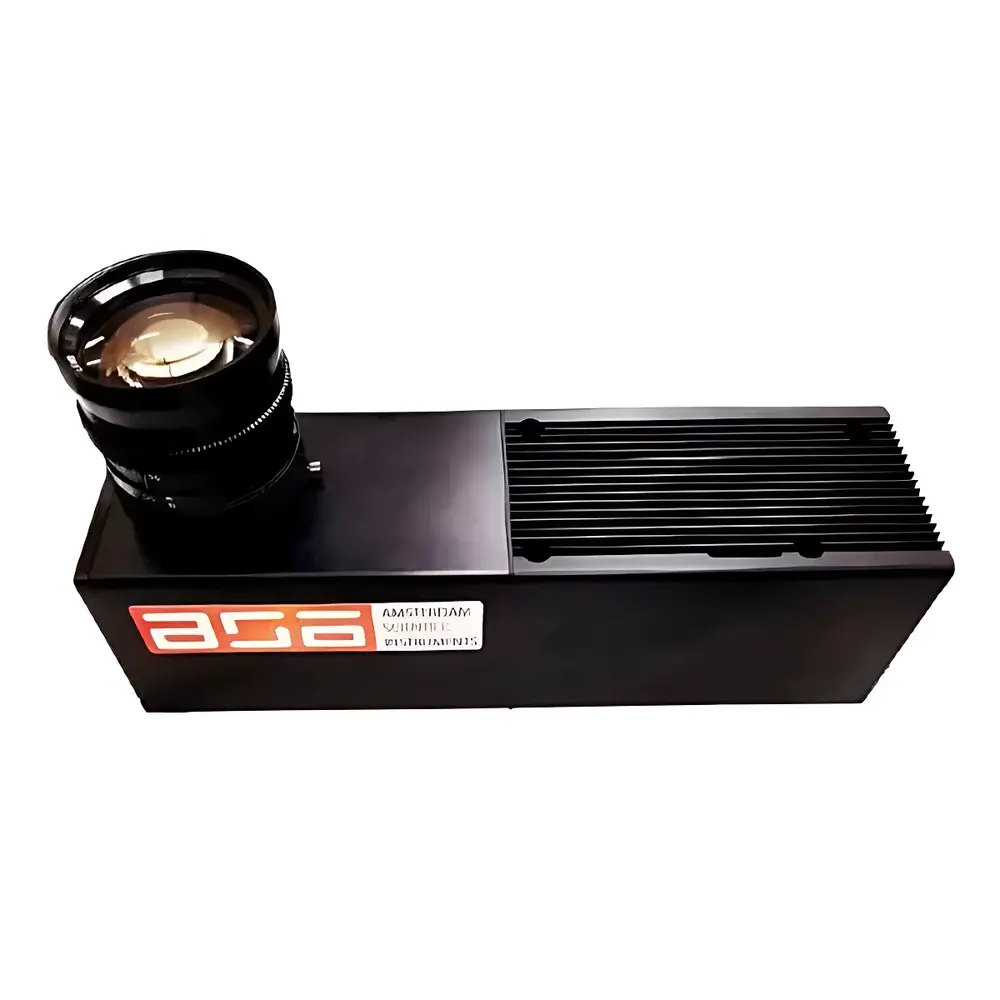
Auniontech TPX3CAM High-Speed Time-Resolved CMOS Camera (1.6 ns Timing Resolution)
| Brand | Auniontech |
|---|---|
| Origin | Shanghai, China |
| Model | TPX3CAM |
| Sensor Material | Radiation-Hardened Silicon with Enhanced QE |
| Wavelength Range | 400–1000 nm |
| Pixel Array | 256 × 256 |
| Pixel Pitch | 55 µm |
| Active Area | 14.1 × 14.1 mm² |
| Timing Resolution | 1.6 ns |
| Effective Frame Rate | > 500 MHz |
| Data Throughput | Up to 80 Mhits/s @ 10 Gb/s |
| Readout Architecture | Event-Driven, Zero Dead-Time |
| Optical Interface | C-mount |
| Cooling | Air-Cooled |
| Weight | 2.2 kg |
| Dimensions (L×W×H) | 28.8 × 8 × 9 cm |
| OS Support | Windows, Linux, macOS |
| Software | GUI-based Acquisition & Analysis Suite |
Overview
The Auniontech TPX3CAM is a high-speed, time-resolved CMOS camera engineered for ultrafast optical event detection and nanosecond-scale temporal imaging. Built around the Timepix3 hybrid pixel detector architecture, it integrates a radiation-hardened silicon sensor with a custom ASIC readout chip to deliver simultaneous spatial localization and precise timestamping of individual photon, electron, or ion events. Unlike conventional frame-based cameras, the TPX3CAM operates in an event-driven mode: each of its 65,536 pixels functions as an independent time-to-digital converter (TDC), recording both Time-of-Arrival (ToA) and Time-over-Threshold (ToT) for every detected hit. This architecture enables true time-stamped imaging with 1.6 ns timing resolution—making it suitable for applications requiring sub-nanosecond synchronization with pulsed light sources, particle beams, or laser excitation triggers. Its quantum efficiency exceeds 40% across the visible to near-infrared spectrum (400–1000 nm), and its zero-dead-time readout supports sustained data rates up to 80 million hits per second at 10 Gb/s throughput.
Key Features
- 1.6 ns timing resolution per pixel, enabling femtosecond-level jitter characterization in pump-probe experiments
- Simultaneous acquisition of ToA and ToT for each detected event—supporting intensity calibration and pulse shape analysis
- Event-driven, noiseless readout with zero readout dead time; no frame-skipping or data loss during high-flux illumination
- Scalable data throughput: 15 Mhits/s over 1 GbE, 80 Mhits/s over 10 GbE interface
- C-mount optical interface for flexible integration into microscopes, vacuum chambers, or beamlines
- Air-cooled thermal management ensures stable operation without cryogenic infrastructure
- Cross-platform software support (Windows, Linux, macOS) with real-time visualization, histogramming, and time-slice reconstruction tools
Sample Compatibility & Compliance
The TPX3CAM is compatible with direct detection of photons (400–1000 nm), electrons (keV range), and ions (with appropriate conversion layers). When coupled to image intensifiers, it achieves single-photon sensitivity for time-correlated single-photon counting (TCSPC) applications. Its design conforms to standard laboratory safety and electromagnetic compatibility requirements (IEC 61326-1). While not certified for medical use, the system supports audit-ready data logging and metadata embedding—facilitating GLP/GMP-aligned workflows where traceability of acquisition parameters (e.g., exposure timestamp, threshold settings, gain configuration) is required. All firmware and acquisition software are version-controlled and support reproducible experimental setups across multiple instruments.
Software & Data Management
The TPX3CAM ships with a modular, open-API software suite that provides both graphical user interface (GUI) control and programmatic access via Python bindings (PyTimepix3). Raw event streams are stored in HDF5 format, preserving full ToA/ToT metadata alongside spatial coordinates. The software includes built-in tools for time-slice binning, time-of-flight (TOF) spectrum generation, covariance mapping, and coincidence filtering. For regulated environments, optional add-ons provide FDA 21 CFR Part 11-compliant electronic signatures, audit trails, and role-based user permissions. Data export supports CSV, TIFF (time-integrated), and custom binary formats for integration with MATLAB, Origin, or custom analysis pipelines.
Applications
- Ultrafast laser spectroscopy: mapping carrier dynamics in semiconductors and 2D materials using time-resolved photoluminescence
- Time-of-flight mass spectrometry (TOF-MS): ion imaging and covariance analysis in strong-field ionization experiments
- Widefield TCSPC: phosphorescence lifetime imaging (PLIM) and fluorescence lifetime imaging (FLIM) in biological tissues
- Beam diagnostics: single-shot characterization of electron bunch profiles in accelerator facilities
- Plasma diagnostics: spatiotemporal mapping of emission transients in laser-induced plasmas
- Quantum optics: coincidence detection in entangled photon pair experiments with <2 ps synchronization uncertainty
FAQ
What is the minimum detectable signal level?
The TPX3CAM is single-event sensitive—capable of detecting individual photons when used with an image intensifier. Without intensification, its native threshold is ~1 keV equivalent for electrons or ~10 keV for heavy ions, depending on sensor bias and pixel configuration.
Can the camera be synchronized with external lasers or RF triggers?
Yes—the device features a dedicated TTL-compatible input for external trigger synchronization with sub-260 ps timestamp jitter. It also supports output signals for gating auxiliary equipment such as Pockels cells or delay generators.
Is cooling required for long-exposure measurements?
No active cooling is needed. Air-cooling maintains sensor temperature within ±1°C over continuous operation, minimizing dark count drift and ensuring stable ToA calibration over multi-hour acquisitions.
How is calibration performed for time-resolved measurements?
Factory calibration includes per-pixel TDC offset correction and ToT linearity characterization. Users can perform in-situ calibration using pulsed LED references or synchrotron X-ray pulses, with software tools supporting iterative refinement of timing maps.
Does the system support real-time processing?
Yes—onboard FPGA resources enable real-time histogram accumulation, time-slice projection, and basic coincidence logic. Full event streaming to host memory allows post-acquisition reconstruction of arbitrary time windows down to 1.6 ns resolution.




