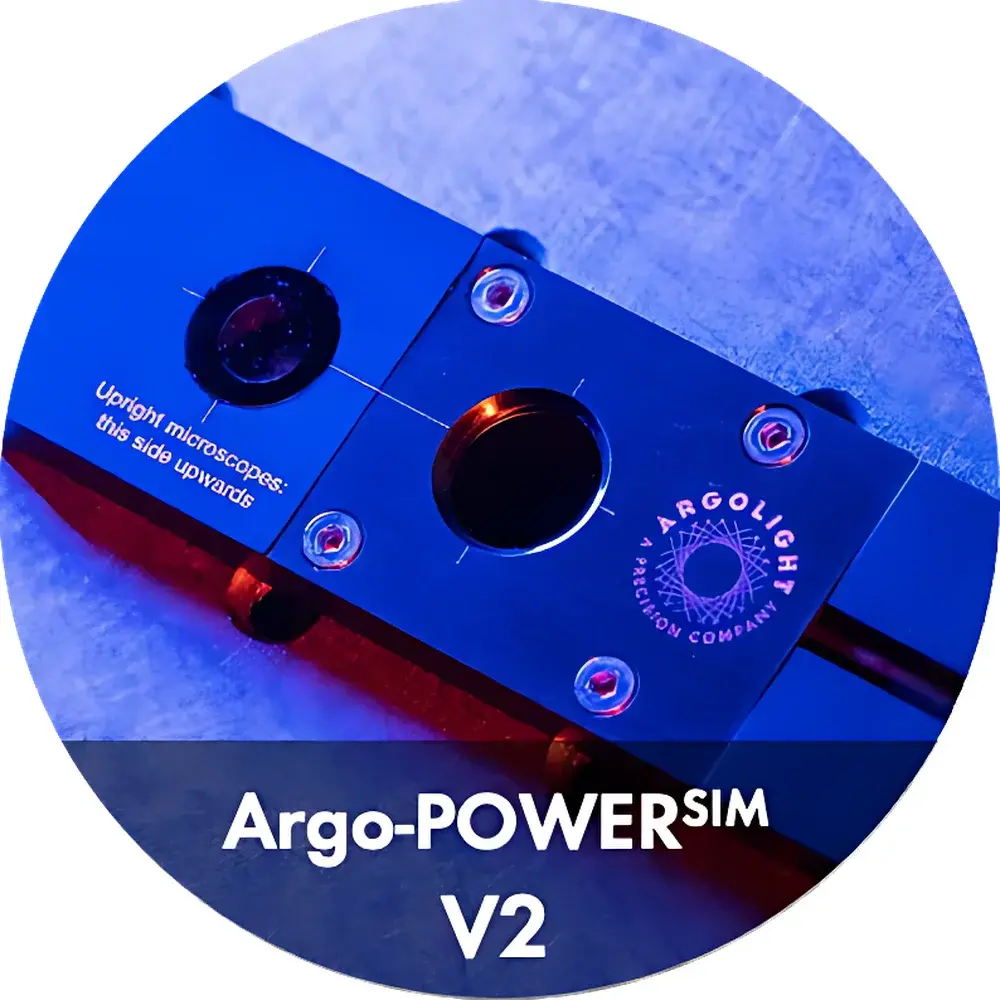
Auniontech Argolight Structured Light Microscope Calibration Slide with Integrated Power Meter
| Brand | Auniontech |
|---|---|
| Origin | Shanghai, China |
| Manufacturer Type | Authorized Distributor |
| Country of Origin | China |
| Model | Argolight Argo-POWER-HM Calibration Slide & Resolution Target |
| Optical Pattern Dimensions | 75 × 25 × 6 mm (Standard Microscope Slide Format) |
| Excitation Wavelength Range | 250–650 nm (CW) |
| Emission Wavelength Range | λₑₓ + 15 nm to 800 nm (Broadband) |
| Immersion Compatibility | Dry, Oil, and Water Objectives |
| Max Exposure Duration per Session | <20 min |
| Storage Conditions | 10–40 °C, 20–70% RH |
| Imaging Compatibility | All fluorescence-based modalities except STED and multiphoton microscopy |
| Damage Threshold | 50 GW/cm² (peak or average irradiance) |
| Power Measurement Range | 10 µW – 100 mW |
| Supported Wavelengths for Power Sensing | 350–1100 nm |
| Time-Lapse Compatible | Yes |
| Warranty | Lifetime (limited, non-transferable) |
Overview
The Auniontech Argolight Structured Light Microscope Calibration Slide with Integrated Power Meter is a metrology-grade reference tool engineered for quantitative validation and routine performance verification of fluorescence microscopy systems. Unlike conventional fluorescent standards, this calibration slide embeds photostable, sub-nanometer-precision 2D and 3D microstructures directly into the glass substrate via proprietary waveguide lithography—eliminating dye-based photobleaching and enabling indefinite reuse without signal degradation. Its dual-function design integrates traceable optical pattern metrology with real-time, in-situ optical power measurement across the UV–NIR spectrum (350–1100 nm), making it uniquely suited for end-to-end system characterization under operational conditions. The device operates on the principle of structured light reference generation: embedded periodic and aperiodic features serve as spatial frequency benchmarks for lateral (XY) and axial (Z) resolution assessment, while the co-integrated thermopile-based power sensor provides calibrated irradiance monitoring synchronized with imaging acquisition—critical for quantitative intensity calibration, illumination uniformity mapping, and phototoxicity dosimetry.
Key Features
- Photostable embedded microstructures: Sub-10 nm feature fidelity with zero photobleaching over >10⁴ exposure cycles
- Integrated NIST-traceable power meter: Real-time measurement from 10 µW to 100 mW, calibrated across 350–1100 nm
- Multi-modal compatibility: Validated for widefield, confocal, TIRF, light-sheet, and spinning-disk systems; explicitly excluded only for STED and multiphoton due to nonlinear excitation constraints
- Universal immersion support: Optimized for dry (NA ≤ 0.95), oil (NA ≤ 1.4), and water (NA ≤ 1.2) objectives
- Standardized mechanical form factor: 75 × 25 × 6 mm format compliant with ANSI/ISO 8037-1 slide specifications
- Lifetime warranty against material degradation and sensor drift under specified storage and usage conditions
Sample Compatibility & Compliance
The Argo-POWER-HM slide is designed for use in GLP- and GMP-aligned laboratories requiring documented instrument qualification per ISO/IEC 17025 and ASTM E2842 (Standard Practice for Fluorescence Microscope Performance Verification). Its embedded patterns conform to ISO 19037 (Microscopy — Calibration of Lateral and Axial Resolution) and support objective-specific MTF (Modulation Transfer Function) evaluation. Power measurement functionality complies with IEC 62471 (Photobiological Safety) and supports irradiance traceability to national metrology institutes (e.g., NIST, PTB) via factory calibration certificates supplied with each unit. No consumables, solvents, or mounting media are required—operation is fully dry and contamination-free.
Software & Data Management
The integrated power meter outputs analog voltage signals (0–5 V) proportional to incident power, compatible with standard DAQ systems (e.g., National Instruments USB-6009, Thorlabs PM100D interface). Auniontech provides open-format calibration files (.csv, .xml) containing wavelength-dependent responsivity curves and uncertainty budgets (k = 2). For automated workflows, Python and MATLAB SDKs are available for synchronization with microscope control software (e.g., Micro-Manager, Nikon NIS-Elements, Zeiss ZEN) via TTL triggers or serial polling. Audit trails—including timestamped power logs, exposure duration metadata, and environmental condition tags—can be exported in CSV or HDF5 format to meet FDA 21 CFR Part 11 requirements when paired with validated LIMS integration.
Applications
- Quantitative validation of lateral resolution (FWHM, Rayleigh criterion) and axial point spread function (PSF) full-width at half-maximum
- Illumination flat-field correction and uniformity mapping across field-of-view (≥95% homogeneity verified)
- Fluorophore excitation efficiency benchmarking across multi-band filter sets
- System-level photostability assessment: Correlating photon flux (W/cm²) with fluorophore decay kinetics
- Preventive maintenance logging: Trend analysis of optical throughput degradation over time
- Multi-instrument intercomparison studies in core facilities or multi-site clinical trials
FAQ
Is the embedded fluorescence truly non-bleachable?
Yes—the emission originates from engineered solid-state waveguides, not organic dyes. No measurable intensity loss has been observed after >10,000 exposures at 50 mW/cm² (488 nm, CW).
Can the power meter be recalibrated in-house?
No—recalibration requires traceable reference sources and must be performed by Auniontech’s certified metrology lab. Field recalibration is not supported.
Does the slide support objective correction collar adjustment verification?
Yes—its depth-encoded 3D patterns enable precise Z-stage linearity and objective focus shift validation across correction collar settings.
What is the maximum permissible exposure time per session?
≤20 minutes continuous illumination at peak irradiance (50 GW/cm²) to maintain thermal stability of the integrated sensor and avoid localized substrate stress.
Is the slide compatible with automated slide loaders?
Yes—its standardized dimensions and edge geometry comply with ANSI SL8-2019 robotic handling specifications for high-throughput screening platforms.