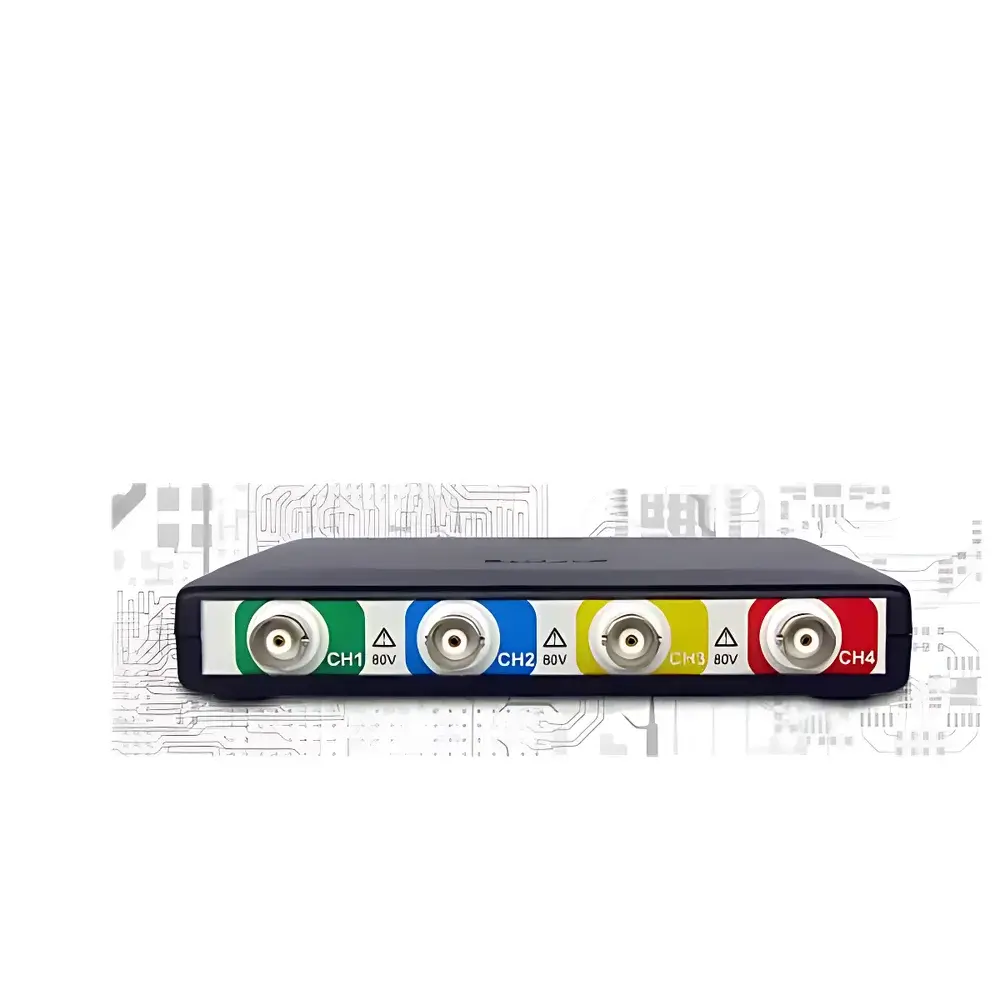
Auniontech Handyscope HS6 DIFF High-Resolution USB 3.0 Oscilloscope with Differential Inputs
| Brand | Auniontech |
|---|---|
| Origin | Shanghai, China |
| Type | USB 3.0 Digital Oscilloscope |
| Channels | 4 differential inputs |
| Resolution | 8/12/14/16-bit selectable per channel |
| Sampling Rate | up to 1 GSa/s (real-time), up to 200 MSa/s continuous streaming |
| Bandwidth | up to 250 MHz |
| Memory Depth | up to 256 MSamples per channel (with XM option) |
| DC Vertical Accuracy | ±0.25 % (typ. ±0.1 %) |
| Timebase Stability | 1 ppm |
| Interface | USB 3.0, CMI synchronization port, optional Ethernet/WiFi via TPISS server |
| Compliance | CE, RoHS, FCC Class B |
Overview
The Auniontech Handyscope HS6 DIFF is a high-fidelity, PC-based USB 3.0 oscilloscope engineered for precision signal acquisition in R&D, education, and industrial test environments where resolution, timing integrity, and input safety are critical. Unlike conventional 8-bit oscilloscopes, the HS6 DIFF employs oversampling-capable ADC architecture supporting configurable vertical resolution from 8 to 16 bits — enabling true high-dynamic-range measurement of low-amplitude signals superimposed on large DC offsets or noisy backgrounds. Its differential input topology eliminates common-mode interference, making it suitable for floating measurements in power electronics, motor drives, sensor interfaces, and isolated communication lines. The instrument operates on a deterministic real-time sampling engine synchronized via a dedicated CMI (Common Measurement Interface) bus, allowing precise multi-unit timebase alignment for scalable channel expansion beyond four inputs. All firmware and hardware design comply with IEC 61000-4-3 (radiated immunity) and IEC 61000-4-6 (conducted immunity) standards, ensuring robust operation in electromagnetically complex laboratories.
Key Features
- Four fully isolated differential analog inputs with user-selectable resolution (8/12/14/16 bit) and programmable input ranges (±50 mV to ±20 V)
- Real-time sampling up to 1 GSa/s at full resolution; sustained streaming at 200 MSa/s over USB 3.0 without gap or drop
- 250 MHz analog bandwidth with <0.3 dB flatness across full range and <1.5% harmonic distortion at 100 MHz
- Integrated SureConnect diagnostics: automated continuity verification and channel impedance measurement prior to acquisition
- SafeGround module (G-option): enables conversion of differential inputs to protected single-ended mode with galvanic isolation and short-circuit current limiting
- CMI interface standard: supports hardware-synchronized daisy-chaining of up to four HS6 units for 16-channel coherent acquisition
- EMI measurement capability (E-option): includes TP-EMI-HS6 near-field probe set and CISPR-compliant weighting filters for pre-compliance radiated emissions screening
Sample Compatibility & Compliance
The HS6 DIFF is designed for direct interfacing with a wide range of signal sources without external signal conditioning in most cases: differential sensors (e.g., LVDTs, strain gauges with bridge outputs), isolated gate drivers, CAN/LIN transceivers, isolated ADC reference outputs, and high-side current sense amplifiers. Its input protection circuitry meets IEC 61000-4-5 Level 3 surge immunity (2 kV line-to-ground, 1 kV line-to-line). For regulatory testing workflows, the EMI option enables compliance with CISPR 16-1-1 and MIL-STD-461G RS103 when used with calibrated near-field probes. All models ship with traceable factory calibration certificates aligned to ISO/IEC 17025 requirements. Firmware implements audit-trail logging for GLP/GMP environments, recording user actions, calibration events, and configuration changes with timestamps and operator IDs.
Software & Data Management
The multi-channel oscilloscope software (v5.8+) runs natively on Windows 10/11 and supports six concurrent instrument modes: oscilloscope, spectrum analyzer, data logger, digital multimeter, arbitrary waveform generator (AWG), and protocol analyzer. It features native support for IEEE 1588 PTP synchronization when deployed with TPISS network server — transforming the HS6 DIFF into a remotely accessible, time-coordinated node in distributed test systems. All acquired data is stored in HDF5 format with embedded metadata (channel settings, trigger conditions, calibration coefficients), ensuring FAIR (Findable, Accessible, Interoperable, Reusable) data principles. Export options include CSV, MATLAB .mat, TDMS, and ASCII with customizable delimiter and timestamp formats. Software modules comply with FDA 21 CFR Part 11 requirements when configured with electronic signature and role-based access control (RBAC) policies.
Applications
- Power electronics validation: switching loss analysis, gate drive waveform fidelity, inverter harmonic content assessment
- Automotive ECU development: crank/cam sensor signal simulation, CAN FD bus decoding, J1939 message timing verification
- Acoustic and vibration sensing: high-resolution piezoelectric transducer readout with >100 dB dynamic range
- Medical device testing: low-noise biopotential signal capture (ECG, EEG) under IEC 60601-2-27 safety constraints
- Education labs: hands-on instruction in Fourier analysis, aliasing effects, Nyquist theorem demonstration, and mixed-signal debugging
- EMI pre-scanning: near-field magnetic/electric field mapping of PCBs and enclosures using TP-EMI-HS6 probe kit
FAQ
Does the HS6 DIFF support FFT-based spectral analysis with windowing and overlap processing?
Yes — the built-in spectrum analyzer offers 16 configurable window types (Hanning, Flat Top, Kaiser-Bessel, etc.), adjustable overlap (0–90%), and real-time RMS averaging across up to 1024 traces.
Can the SafeGround module be retrofitted to an existing HS6 DIFF unit?
Yes — the G-option is field-upgradeable via firmware update and physical installation of the SafeGround daughterboard; contact Auniontech technical support for procedure documentation.
Is remote control via Python or MATLAB supported?
Yes — comprehensive API bindings are provided for both environments, including full SCPI command set emulation and native object-oriented wrappers for acquisition, triggering, and math operations.
What is the maximum sustainable streaming duration at 200 MSa/s across all four channels?
With 256 MSamples/channel memory (XM option), continuous streaming is limited only by host system disk I/O throughput; typical sustained recording exceeds 10 minutes onto NVMe SSD storage.
Does the instrument meet EMC requirements for use in certified test laboratories?
All HS6 DIFF units are CE-marked and tested to EN 61326-1:2013 (industrial environment) and EN 55011:2016 Class B limits; full test reports available upon request for accredited lab integration.