
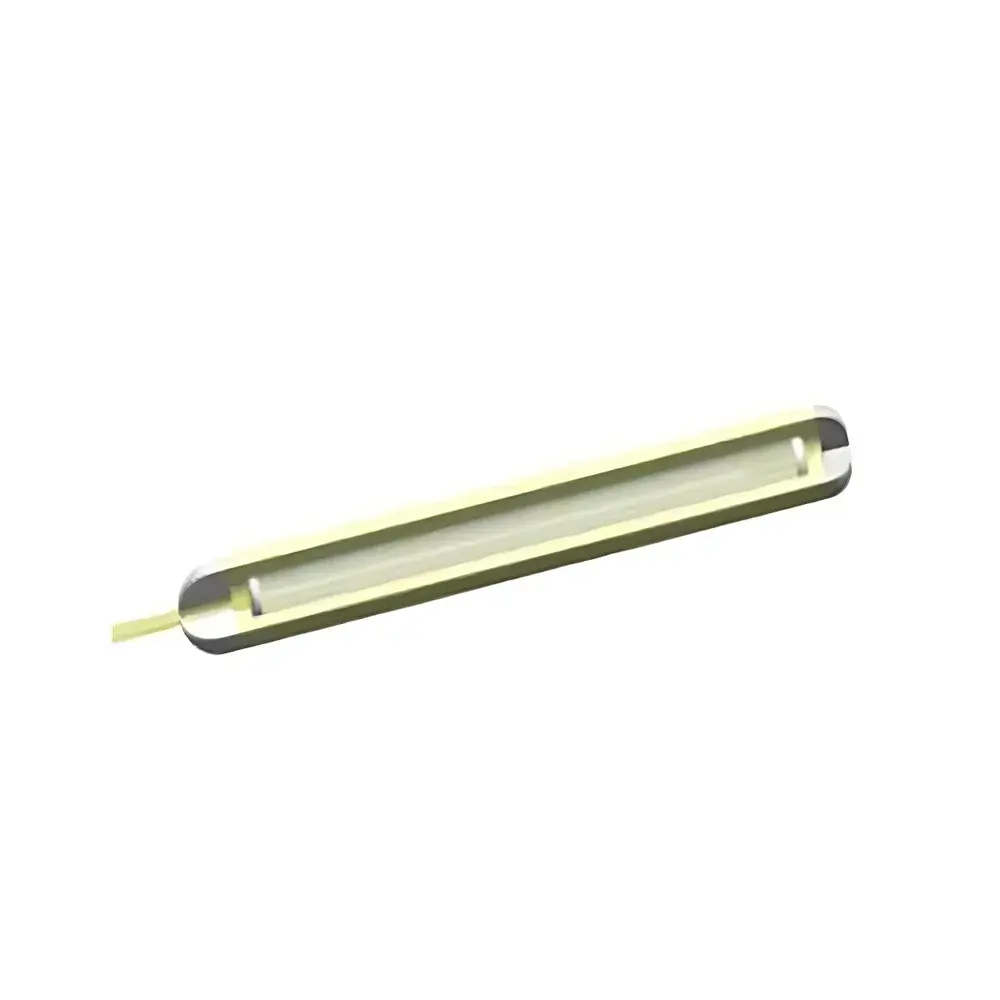
Auniontech AUT-S900 Fabry–Perot Fiber-Optic Temperature Sensor
| Brand | Auniontech |
|---|---|
| Origin | Shanghai, China |
| Model | AUT-S900 Series |
| Temperature Range (customizable) | –20 to 100 °C |
| Accuracy | ±0.1 °C |
| Thermal Response Rate | ≥40 °C/s |
| Displacement Resolution (with compatible interrogator) | 0.1% FS |
| Bare Sensor Dimensions | Ø340 µm × 10 mm |
| Fiber Connector | SC/PC |
| Packaging | Ceramic (Ø1 mm × 15 mm) + PVC tubing (Ø2 mm, customizable length) |
Overview
The Auniontech AUT-S900 is a high-precision, miniature fiber-optic temperature sensor engineered on the principle of extrinsic Fabry–Perot interferometry (EFPI). Unlike conventional electronic thermistors or thermocouples, the AUT-S900 relies on optical path-length modulation within a microfabricated air-gap cavity formed between two parallel reflective surfaces—typically a cleaved fiber end and a diaphragm or substrate interface. As temperature changes induce thermal expansion or contraction of the cavity spacer material, the interference fringe pattern shifts in wavelength; this spectral shift is quantified using a broadband light source and an optical spectrum analyzer or dedicated EFPI interrogator. The resulting measurement is intrinsically immune to electromagnetic interference (EMI), radio-frequency noise, and high-voltage environments—making it uniquely suited for operation inside MRI bores, intraoperative catheters, and minimally invasive surgical tools where metallic sensors would distort imaging or compromise safety.
Key Features
- EMI-immune operation: No metallic conductive elements; fully dielectric sensing architecture ensures compatibility with MRI, electrosurgical units, and high-field RF environments.
- Miniaturized form factor: Bare sensor diameter of only 340 µm enables integration into narrow lumens (e.g., guidewires, biopsy needles, endoscopic channels) without compromising mechanical integrity or fluid dynamics.
- High thermal fidelity: ±0.1 °C absolute accuracy over the standard –20 °C to +100 °C range, traceable to NIST-traceable calibration protocols; optional extended-range configurations available upon request.
- Rapid thermal response: ≥40 °C/s rise time under convective conditions, validated per IEC 60751 Annex D methodology using calibrated hot-air pulses.
- Stress-compensated packaging: Monolithic ceramic housing (Ø1 mm × 15 mm) combined with flexible PVC overbraid eliminates residual thermal stress at the fiber–package interface—critical for long-term zero-drift stability in cyclic thermal environments.
- Interrogation-flexible design: Compatible with standard SC/PC-terminated broadband sources (e.g., ASE, SLED) and commercial EFPI demodulation platforms supporting wavelength-shift tracking at sub-pm resolution.
Sample Compatibility & Compliance
The AUT-S900 exhibits broad biocompatibility when encapsulated per ISO 10993-5 (cytotoxicity) and ISO 10993-10 (irritation/sensitization) guidelines. Its all-glass/ceramic/PVC construction resists degradation in saline, ethanol, and common sterilants (e.g., ethylene oxide, low-temperature hydrogen peroxide plasma). While not pre-certified as a Class II medical device under FDA 21 CFR Part 820, the sensor meets essential design controls for incorporation into OEM diagnostic or therapeutic systems subject to IEC 62304 (software lifecycle) and ISO 13485 (quality management). For clinical deployment, final system-level validation—including electromagnetic compatibility per IEC 60601-1-2 and MRI safety per ASTM F2503—is the responsibility of the integrating manufacturer.
Software & Data Management
The AUT-S900 does not include embedded firmware or onboard processing. It functions as a passive transducer requiring external interrogation hardware (e.g., Micron Optics sm130, Luna ODiSI-B, or custom FPGA-based spectrometers). Auniontech provides SDKs and LabVIEW/Python API libraries supporting real-time wavelength-to-temperature conversion using third-order polynomial calibration coefficients. All delivered calibration reports include uncertainty budgets compliant with GUM (JCGM 100:2008) and support audit-ready documentation for GLP/GMP-regulated workflows. Interrogator software may be configured to log timestamped temperature traces with configurable sampling rates up to 1 kHz, exportable in CSV, HDF5, or TDMS formats for downstream analysis in MATLAB, Python (SciPy), or JMP.
Applications
- MRI-guided thermal ablation monitoring: Real-time core temperature feedback during focused ultrasound (FUS) or laser interstitial thermal therapy (LITT), eliminating RF-induced artifacts.
- Intravascular thermometry: Integration into balloon catheters or intracardiac electrodes for mapping regional myocardial temperature gradients during arrhythmia ablation procedures.
- Preclinical neurophysiology: Chronic implantation in rodent brain tissue or spinal cord for longitudinal thermal profiling during optogenetic stimulation or pharmacological challenge studies.
- Bioreactor and microfluidic process control: Distributed sensing in stainless-steel or glass reactors where EMI from stirrer motors or heating elements prohibits conventional probes.
- Material science testing: In-situ temperature monitoring during laser welding, additive manufacturing, or dynamic mechanical analysis (DMA) where spatial resolution and field immunity are critical.
FAQ
Is the AUT-S900 suitable for sterile, single-use medical devices?
Yes—when packaged with medical-grade PVC and sealed using gamma-compatible adhesives, the sensor can be validated for terminal sterilization. Auniontech provides material declarations (IMDS, REACH, RoHS) and supports bioburden testing coordination.
Can multiple AUT-S900 sensors be multiplexed on a single fiber?
No—each EFPI cavity requires discrete wavelength allocation. However, up to 8 sensors can be serially multiplexed using wavelength-division techniques if their free spectral ranges (FSRs) are non-overlapping and interrogator resolution supports <10 pm discrimination.
What calibration documentation is provided?
Each unit ships with a certificate of conformance including full-range calibration data (at least 5 points from –20 °C to 100 °C), expanded uncertainty (k=2), reference standard traceability, and environmental test records (thermal cycling, humidity soak).
Does Auniontech offer OEM integration support?
Yes—engineering teams provide mechanical mounting drawings, optical coupling specifications, interrogator interface schematics, and application-specific validation templates aligned with ISO 14971 risk management requirements.





