
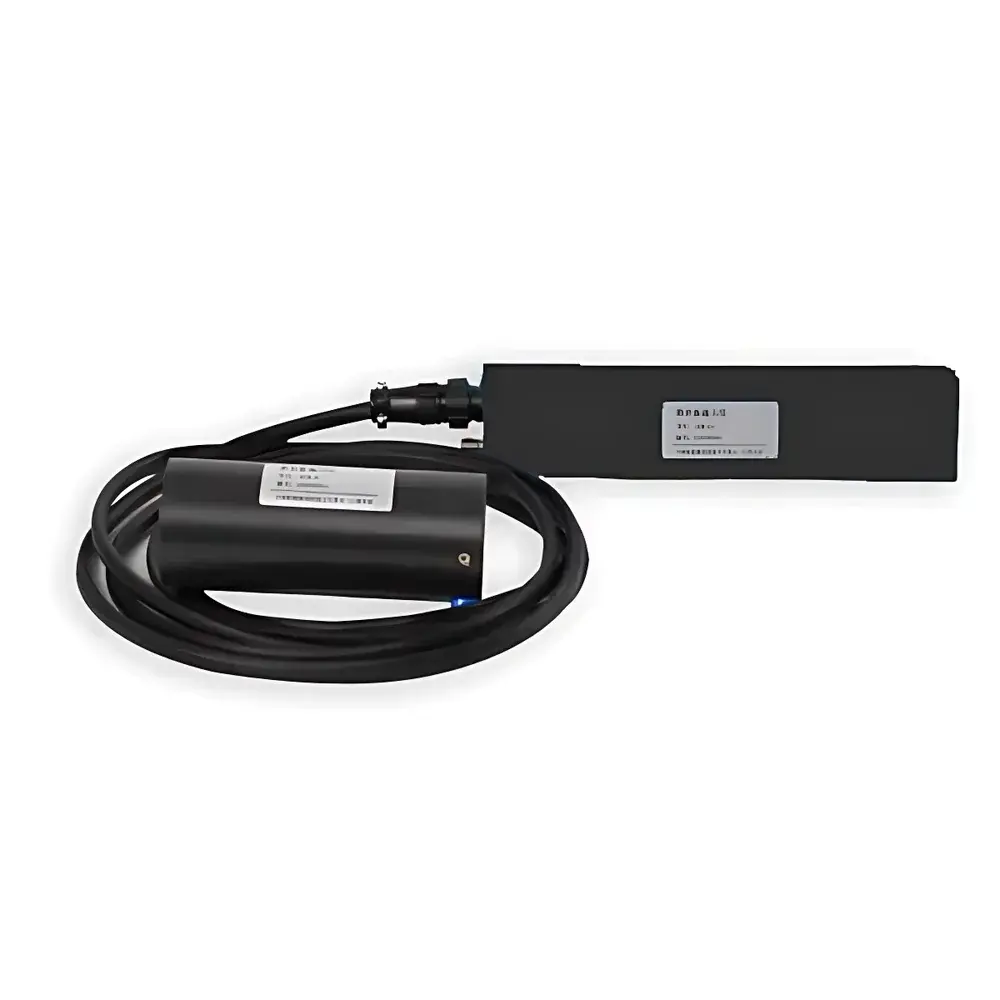
Auniontech AUT-CAM-01 Cesium Vapor Pump Magnetometer
| Brand | Auniontech |
|---|---|
| Origin | Shanghai, China |
| Manufacturer Type | Authorized Distributor |
| Product Category | Domestic |
| Model | AUT-CAM-01 |
| Pricing | Upon Request |
| Operating Principle | Self-Oscillating Cesium Atomic Magnetometer |
| Measurement Range | 10,000–100,000 nT |
| Angular Acceptance | 15°–75° & 105°–165° (Hemispherical) |
| Sensitivity | 0.5 pT/Hz¹ᐟ² |
| Larmor Frequency Scaling Factor | 3.498577 Hz/nT |
| Output Signal | TTL-compatible square wave (0–5 V), frequency-encoded Larmor resonance |
| Power Supply | 24–36 V DC (nominal 28 V) |
| Power Consumption | ~18 W (steady-state) |
| Total Mass | ~1.25 kg |
| Probe Dimensions | Ø60 mm × 146 mm (L) |
| Electronics Unit Dimensions | 266 mm × 54 mm × 42 mm |
| Probe–Electronics Pairing | Serialized and non-interchangeable |
Overview
The Auniontech AUT-CAM-01 Cesium Vapor Pump Magnetometer is a high-sensitivity, scalar total-field magnetometer engineered for precise geomagnetic field measurement and magnetic anomaly detection. It operates on the physical principle of optically pumped nuclear magnetic resonance (OPNMR) in cesium vapor, utilizing self-oscillating circuitry to sustain continuous atomic precession. When exposed to an external magnetic field B, cesium-133 nuclei precess at the Larmor frequency fL, governed by the fundamental relation fL = γCs·B, where γCs = 3.498577 Hz/nT is the cesium gyromagnetic ratio. The instrument directly outputs this frequency as a digital-ready square wave (0–5 V TTL), enabling traceable, absolute magnetic field determination without calibration drift. Designed for stable operation across mid-latitude geomagnetic conditions (typically 25,000–65,000 nT), the AUT-CAM-01 delivers sub-picotesla sensitivity in 1 Hz bandwidth and maintains hemispherical angular tolerance—ensuring reliable performance in both horizontal and near-vertical field orientations.
Key Features
- Scalar measurement architecture eliminates orientation-dependent errors common in vector magnetometers
- Self-oscillating design ensures autonomous resonance lock-in without external RF excitation or feedback loops
- Frequency-encoded analog output provides direct, linear, and inherently stable field quantification
- Serialized probe–electronics pairing guarantees factory-matched optical pumping efficiency and resonance phase coherence
- Compact, lightweight form factor (probe: Ø60 × 146 mm; electronics: 266 × 54 × 42 mm) supports portable survey platforms, UAV integration, and borehole deployment
- Robust power architecture accepts wide-input DC (24–36 V) with integrated power-line frequency coupling and on-board decoupling for clean signal extraction
- LED status indicator provides real-time operational diagnostics: red = cesium lamp warm-up or failure; green = stable atomic vapor excitation and resonance lock
Sample Compatibility & Compliance
The AUT-CAM-01 is optimized for ambient terrestrial magnetic field environments and does not require sample contact or material interaction—it measures the vector magnitude of the local static or quasi-static magnetic field. Its cesium vapor cell is hermetically sealed and insensitive to non-magnetic environmental variables such as temperature gradients (within specified operating range), humidity, or atmospheric pressure. While not certified to ISO/IEC 17025 for metrological calibration, the instrument’s Larmor-based physics foundation ensures intrinsic traceability to the SI definition of the tesla via the cesium gyromagnetic ratio—a constant recognized by the International Committee for Weights and Measures (CIPM). For field survey applications, it complies with standard geophysical data acquisition protocols used in ASTM D6429 (Standard Guide for Geophysical Methods for Near-Surface Environmental and Geotechnical Investigations) and supports GLP-aligned logging when paired with timestamped frequency counters meeting NIST-traceable timing standards.
Software & Data Management
The AUT-CAM-01 operates as a hardware-level frequency source and requires no proprietary firmware or embedded software. Its 0–5 V square-wave output is compatible with industry-standard frequency measurement devices—including benchtop frequency counters (e.g., Keysight 53230A), data acquisition systems (e.g., National Instruments PXIe-6363), and FPGA-based edge processors. Users may implement custom LabVIEW, Python (via PyVISA or GPIO-timed counting), or MATLAB scripts to convert measured frequency fL into magnetic flux density using B = fL / 3.498577 (nT). Audit-ready data streams can be generated with full time-stamping, metadata tagging (e.g., GPS position, temperature, battery voltage), and CSV/Binary export—enabling compliance with FDA 21 CFR Part 11 requirements when deployed in regulated geophysical monitoring workflows requiring electronic records and signature integrity.
Applications
- High-resolution aeromagnetic and ground-based magnetic surveys for mineral exploration and geological mapping
- UXO (unexploded ordnance) detection and archaeological prospection in low-noise environments
- Geomagnetic observatory backup instrumentation and space weather monitoring networks
- Magnetic signature characterization of naval vessels, infrastructure, and shielded enclosures
- Calibration reference for fluxgate and proton precession magnetometers in field laboratories
- Research-grade measurements in rock magnetism, paleomagnetism, and laboratory-based magnetic anomaly simulation
FAQ
Can the probe and electronics unit be interchanged between different AUT-CAM-01 units?
No. Each probe and electronics unit are serialized and factory-paired to ensure optimal optical pumping alignment and resonance phase matching. Cross-use will result in unstable oscillation or failure to lock.
What happens if power is applied before connecting the probe to the electronics unit?
Applying power without the probe connected may damage the oscillator circuitry and void warranty. Always establish mechanical and electrical connection prior to power-up.
Is the 3.498577 Hz/nT scaling factor valid across the full 10,000–100,000 nT range?
Yes—the scaling factor is derived from the fundamental nuclear magnetic moment of 133Cs and remains invariant over the specified dynamic range. No linearity correction is required.
Does the instrument require periodic recalibration?
No. As a quantum-based scalar sensor, its accuracy depends solely on the stability of the cesium gyromagnetic ratio and frequency measurement precision—not on component aging or analog gain drift.
Can the output be interfaced directly with a microcontroller?
Yes—provided the microcontroller features a hardware timer/counter peripheral capable of measuring frequencies up to ~350 kHz (corresponding to 100,000 nT) with ±1 Hz resolution or better.



