
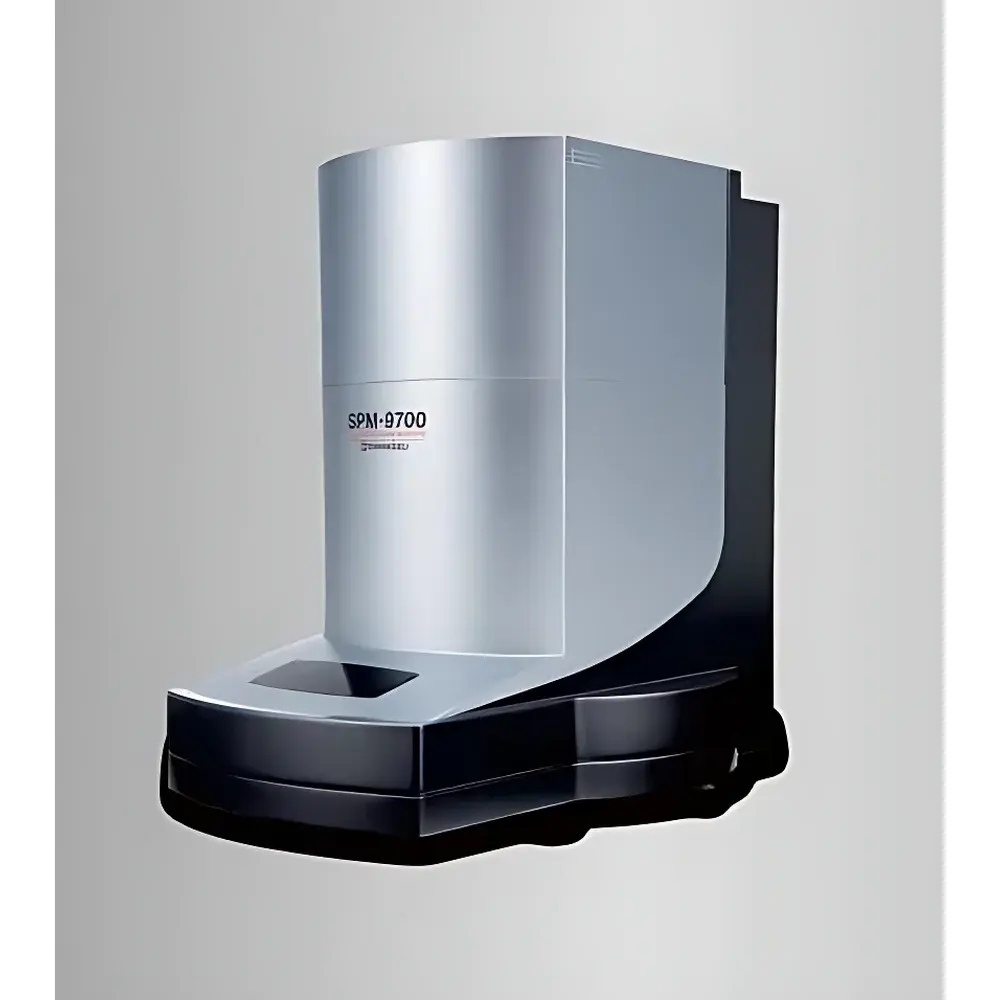
Shimadzu SPM-9700HT High-Performance Atomic Force Microscope
| Brand | Shimadzu |
|---|---|
| Origin | Japan |
| Model | SPM-9700HT |
| Instrument Type | Atomic Force Microscope (AFM) |
| Horizontal Position Detection Noise | 0.1–0.2 nm |
| Vertical Position Detection Noise | 0.03–0.05 nm |
| Sample Size | Ø24 mm × 8 mm |
| Sample Stage Travel Range | ±6 mm |
| Height Measurement Range | 1 μm (optional ranges: 0.3, 5, 7, or 13 μm) |
Overview
The Shimadzu SPM-9700HT is a high-stability, high-sensitivity atomic force microscope engineered for quantitative nanoscale surface characterization under ambient conditions. Utilizing dynamic mode (tapping mode) and contact mode scanning principles, the system detects minute cantilever deflections via optical beam deflection (OBD) with sub-nanometer resolution in both lateral and vertical axes. Its robust mechanical design minimizes thermal drift and acoustic interference, enabling reliable topographic imaging and property mapping of non-conductive, soft, or heterogeneous samples without metal coating—critical for polymer science, biological membranes, thin-film coatings, and functional materials research. The instrument operates natively in air, eliminating the need for vacuum infrastructure while maintaining measurement fidelity comparable to controlled-environment systems.
Key Features
- Sub-angstrom vertical noise floor (0.03–0.05 nm RMS) and low horizontal noise (0.1–0.2 nm RMS), achieved through optimized photodetector electronics, low-vibration granite base, and active feedback loop stabilization.
- Wide-range Z-scanner with 1 µm standard travel (expandable to 13 µm via optional piezoelectric modules), supporting high-aspect-ratio feature analysis and multi-layer thickness profiling.
- Integrated XYZ sample stage with ±6 mm linear travel range, enabling precise region-of-interest navigation and large-area stitching without manual repositioning.
- Modular environmental enclosure compatibility: Optional sealed atmosphere chamber supports inert gas (N₂, Ar), humidity-controlled, or reactive gas environments—enabling in situ electrochemical AFM, hydration-dependent mechanics, or catalytic surface studies.
- Intuitive operator interface with guided workflow menus, real-time parameter optimization suggestions, and one-click mode switching between topography, phase, amplitude, and force-volume acquisition.
Sample Compatibility & Compliance
The SPM-9700HT accommodates standard disk-shaped specimens up to Ø24 mm × 8 mm thickness, compatible with common wafer carriers, TEM grids, and custom substrate holders. Its non-destructive, label-free operation complies with ISO/IEC 17025 requirements for calibration traceability when used with NIST-traceable height standards. Routine verification follows ASTM E2539-21 (Standard Guide for AFM Performance Verification) and ISO 25178-602 (Surface texture — Areal – Part 602: Calibration and measurement standards for scanning probe microscopes). Data integrity meets GLP and GMP-aligned documentation practices, with optional audit trail logging per FDA 21 CFR Part 11 when paired with Shimadzu’s certified LabSolutions SPM software suite.
Software & Data Management
Acquisition and analysis are fully integrated within Shimadzu LabSolutions SPM v5.x, a Windows-based platform supporting automated tip qualification, multi-channel synchronized imaging (topography + phase + adhesion + dissipation), and batch-mode processing. Raw data is stored in vendor-neutral .spm binary format with embedded metadata (scan parameters, calibration constants, timestamp, user ID), ensuring long-term archival compliance. Advanced analysis modules include power spectral density (PSD) calculation, grain size distribution (via watershed segmentation), roughness parameter extraction (Sa, Sq, Sz per ISO 25178-2), and nanomechanical property quantification (Young’s modulus mapping via Hertzian contact modeling). Export options include TIFF, CSV, and HDF5 for third-party interoperability with MATLAB, Python (scikit-image, PySPM), or commercial metrology platforms.
Applications
- Surface metrology of semiconductor wafers, photomasks, and EUV resists—quantifying line-edge roughness (LER), sidewall angle, and defect morphology.
- Mechanical property mapping of biomaterials: collagen fibril stiffness gradients, hydrogel swelling kinetics, and cell-substrate interaction forces.
- Thin-film characterization in OLED and perovskite solar cell R&D—phase separation analysis, domain size distribution, and interfacial delamination detection.
- Quality control of coated pharmaceutical tablets—film uniformity, pore structure, and API crystallinity assessment at sub-micron resolution.
- In situ nanotribology: wear track depth profiling, coefficient of friction mapping, and lubricant film thickness monitoring under controlled load and velocity.
FAQ
Does the SPM-9700HT require ultra-high vacuum or cryogenic cooling for standard operation?
No. The system is designed for ambient-air operation with optional environmental enclosures; vacuum or low-temperature stages are available as separate accessories.
Can it image insulating samples such as polymers or ceramics without conductive coating?
Yes. As an AFM, it does not rely on electron conduction; surface topography and local mechanical properties are measured via physical probe–sample interaction.
What is the typical tip lifetime and how is tip wear monitored during extended scans?
Tip lifetime varies by scan mode and sample hardness; automated tip qualification routines assess sharpness and consistency before each session using reference grating standards.
Is remote operation supported for shared facility or multi-user lab environments?
Yes—LabSolutions SPM supports secure network deployment with role-based access control, enabling remote acquisition, queue management, and real-time collaboration across institutional networks.
How is calibration traceability maintained for quantitative height measurements?
Through periodic verification using NIST-traceable step-height standards (e.g., VLSI Standards VS-1 series) and built-in laser interferometer-assisted Z-calibration routines compliant with ISO 16014-3.




