
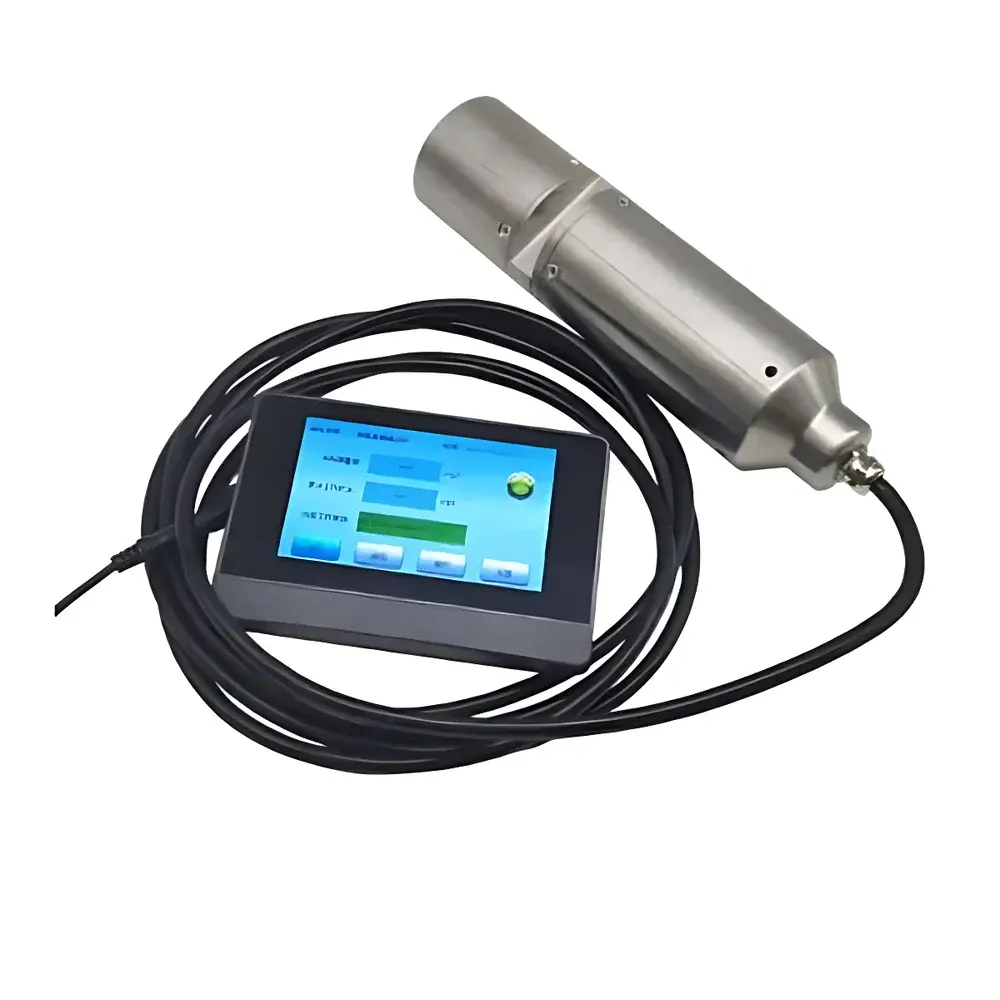
Auniontech AUT-iSpecWQ-UV/VIS Fiber Optic Spectrometer Module for Multi-Parameter Water Quality Monitoring
| Brand | Auniontech |
|---|---|
| Origin | Shanghai, China |
| Model | AUT-iSpecWQ-UV/VIS |
| Spectral Range | 190–840 nm |
| Spectral Resolution | 0.5–1 nm (selectable) |
| Light Source | Pulsed Xenon Lamp (10⁹ pulses lifetime) |
| Optical Path Design | Dual-path Differential Absorption Probe |
| Pathlength | 2–35 mm (configurable) |
| Detector Interface | Modular Fiber-Coupled Spectrometer |
| Data Interface | Modbus/RS485 |
| Operating Temperature | 0–60 °C |
| IP Rating | IPX8 |
| Dimensions | Ø91 mm × 396 mm |
| Weight | 5 kg |
| Integrated Sensors | Dual Temperature (0–45 °C, 0.1 °C res.), Dual Humidity (0–100 %RH) |
| Minimum Measurement Interval | 15 s |
| Compliance | Designed for EPA Method 410.4, ISO 7027, ISO 8467, ASTM D1253/D512/D5391/D6508 |
Overview
The Auniontech AUT-iSpecWQ-UV/VIS Fiber Optic Spectrometer Module is an OEM-grade, multi-parameter water quality sensing platform engineered for continuous, in-situ absorption spectroscopy in environmental monitoring applications. It operates on the principle of ultraviolet–visible (UV-VIS) differential absorption spectroscopy, leveraging high-stability pulsed xenon illumination and dual-path optical geometry to quantify multiple water quality indicators simultaneously—without reagents or consumables. The module integrates a calibrated light source, temperature- and humidity-compensated optical path, and synchronized spectral acquisition electronics into a single ruggedized housing. Its core architecture supports real-time, drift-resistant measurement of chemical oxygen demand (CODCr), total organic carbon (TOCeq), turbidity (NTU), nitrate-nitrogen (NO3-N), total chlorine, color, and biochemical oxygen demand (BOD5) via multivariate calibration models trained against reference wet-chemistry methods. Designed explicitly for integration into third-party analyzers, wastewater SCADA systems, or portable field instruments, the module complies with foundational metrological requirements for environmental instrumentation under ISO/IEC 17025-aligned development practices.
Key Features
- Dual-path differential absorption probe minimizes interference from ambient light, fouling, and refractive index fluctuations—enabling stable operation in turbid, variable-temperature, or biofouling-prone environments
- Pulsed xenon lamp with ≥10⁹ operational cycles ensures long-term photometric stability and eliminates thermal drift associated with continuous arc or LED sources
- Modular spectrometer interface supports interchangeable fiber-coupled detectors (e.g., back-thinned CCD or CMOS arrays) across selectable resolutions (0.5 nm or 1.0 nm FWHM) and spectral ranges (190–840 nm)
- Onboard dual temperature and dual humidity sensors provide real-time environmental compensation for absorbance-to-concentration conversion algorithms
- RS485/Modbus RTU protocol enables seamless integration with PLCs, RTUs, and industrial IoT gateways—fully compatible with IEC 61131-3 control environments
- IPX8-rated stainless-steel housing withstands submersion up to 3 m depth; optimized for permanent installation in manholes, influent channels, and raw water intakes
- Configurable optical pathlength (2–35 mm) allows application-specific optimization: short paths for high-concentration wastewater, longer paths for low-absorbance surface water or drinking water matrices
Sample Compatibility & Compliance
The AUT-iSpecWQ-UV/VIS module is validated for direct immersion or flow-cell coupling in untreated wastewater, stormwater, river/lake water, reservoir effluents, and potable distribution systems. Its UV-VIS absorption methodology aligns with internationally recognized standard methods including ISO 7027 (turbidity), ISO 8467 (COD by UV absorbance), ASTM D5391 (conductivity-corrected UV absorbance for TOC estimation), and EPA Method 410.4 (spectrophotometric nitrate analysis). While not a standalone certified analyzer, the module satisfies critical performance criteria required for use in GLP-compliant monitoring networks and serves as the optical engine in Type-Approved analyzers meeting EN 14181 QAL1/QAL2 requirements. All firmware and calibration data structures support audit-ready logging per FDA 21 CFR Part 11 principles when deployed with compliant host software.
Software & Data Management
The module operates autonomously but exposes full spectral raw data (intensity vs. wavelength, 0.5 nm sampling interval) alongside processed parameter outputs via Modbus register mapping. Host systems may implement proprietary chemometric models (e.g., PLS regression, PCA-based outlier detection) using factory-provided wavelength-specific extinction coefficients and validation datasets. Auniontech supplies SDKs for Windows/Linux (C/C++, Python bindings) enabling OEMs to embed spectral preprocessing, dynamic baseline correction, and drift-compensation routines directly into their firmware. Internal non-volatile memory retains >30 days of time-stamped spectral snapshots at 15-second intervals—accessible via diagnostic polling commands. No cloud dependency; all data handling occurs locally unless explicitly routed through user-defined edge computing layers.
Applications
- Real-time COD and TOC surrogate monitoring at WWTP influent and secondary clarifier outlets
- Nitrate-N trending in agricultural runoff and groundwater abstraction wells
- Turbidity and color profiling in drinking water treatment plants (coagulation optimization, filter breakthrough detection)
- Combined sewer overflow (CSO) event characterization using multi-wavelength absorption fingerprints
- Mobile water quality survey platforms integrating GPS-synchronized spectral logging
- OEM integration into compact, battery-powered field kits for regulatory compliance spot-checking (e.g., EPA NPDES reporting)
FAQ
Does this module require daily manual calibration?
No. It supports automated zero-point referencing via internal dark-current measurement and optional external reference cuvette triggers. Field recalibration intervals are typically 30–90 days depending on matrix fouling rate.
Can it distinguish between nitrate and nitrite absorption bands?
Yes—its 190–840 nm coverage resolves characteristic peaks at 201 nm (NO2−) and 220/275 nm (NO3−), enabling speciation when combined with pH and redox-compensated multivariate models.
Is spectral data export supported in vendor-neutral formats?
Yes—raw spectra are output as ASCII-delimited wavelength/intensity pairs; processed parameters follow Modbus standard register conventions for interoperability with SCADA historians (e.g., Ignition, Siemens Desigo, Wonderware).
What maintenance is required for submerged deployment?
Annual cleaning of quartz windows and verification of O-ring integrity; xenon lamp replacement is not field-serviceable but rated for >10 years at 1 Hz measurement frequency.
Does it meet cybersecurity requirements for utility SCADA integration?
The module itself contains no IP stack or wireless interface. When connected via isolated RS485, it introduces no network attack surface—compliant with NIST SP 800-82 and IEC 62443-3-3 Level 1 assumptions.




