Cinogy CinCam CMOS Series Low-Cost Beam Profiler
| Brand | Cinogy |
|---|---|
| Origin | Germany |
| Model | CinCam CMOS |
| Sensor | 1288 × 1032 pixel high-sensitivity CMOS |
| Dynamic Range | 2500:1 |
| Interface | USB 2.0 |
| Power | USB bus-powered |
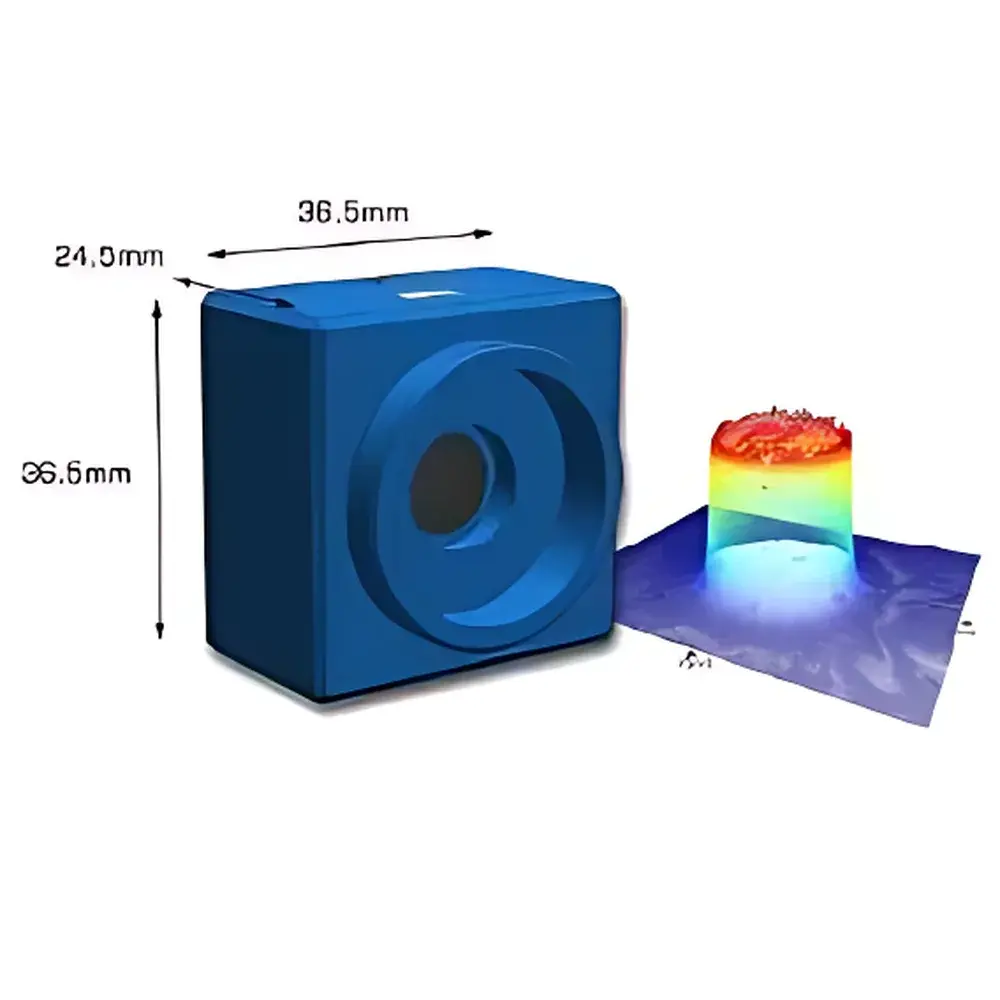
| Dimensions | 36 mm × 36 mm × 24 mm |
| Weight | 45 g |
| Mount | Standard C-Mount |
| Software Options | RayCi-Standard (full-featured) / RayCi-Lite (essential analysis) |
| UV Converter Support | 100–320 nm |
| IR Converter Support | 1495–1595 nm |
Overview
The Cinogy CinCam CMOS Series Low-Cost Beam Profiler is a precision-engineered optical measurement instrument designed for quantitative spatial characterization of continuous-wave (CW) and pulsed laser beams. Based on the principle of direct imaging via high-resolution CMOS sensor technology, it captures two-dimensional intensity distributions in the near-field (plane perpendicular to propagation) and supports far-field evaluation through optional Fourier-transform optics or scanning configurations. Unlike legacy beam profilers relying on scanning slits or pyroelectric arrays, the CinCam CMOS employs a monolithic 1288 × 1032 pixel active area with >60 dB dynamic range (2500:1), enabling simultaneous acquisition of beam centroid, width (D4σ, knife-edge, 1/e²), ellipticity, peak intensity, flatness, and beam propagation parameters—without sacrificing speed or sensitivity. Its compact form factor (36 × 36 × 24 mm), USB 2.0 interface, and bus-powered operation eliminate external power supplies and simplify integration into benchtop labs, production lines, and embedded optical systems.
Key Features
- High-fidelity CMOS imaging core with 1288 × 1032 effective pixels and global shutter architecture for accurate pulse capture (down to µs-duration pulses with appropriate triggering)
- Native 12-bit ADC resolution with hardware-level noise suppression, delivering reproducible measurements across intensity ranges from sub-mW/cm² to multi-W/cm² (with calibrated neutral density filters)
- C-Mount mechanical interface ensures compatibility with industry-standard UV/IR wavelength converters—including UV-Converter (100–320 nm) and IR-Converter (1495–1595 nm)—enabling spectral extension beyond native silicon response (350–1100 nm)
- USB 2.0 plug-and-play connectivity with real-time frame rates up to 30 fps at full resolution; no proprietary frame grabbers or PCIe cards required
- Dual-software strategy: RayCi-Lite (entry-level) provides ISO 11146-compliant beam width, divergence, and centroid calculation; RayCi-Standard adds M² measurement per ISO 11146-2, beam propagation modeling, temporal gating, and batch analysis scripting
- Robust aluminum housing with thermal stabilization design, minimizing drift during extended acquisition sessions
Sample Compatibility & Compliance
The CinCam CMOS accommodates free-space collimated or focused beams from solid-state, diode, fiber, and ultrafast lasers. It supports both TEM₀₀ and higher-order mode analysis, including multimode fiber output and LED spatial emission profiling. When used with optional M² measurement rail kits, the system complies with ISO 11146-1 (determination of beam widths) and ISO 11146-2 (M² calculation methodology). All software versions implement audit-trail logging and user-access controls compatible with GLP/GMP environments. RayCi-Standard includes optional FDA 21 CFR Part 11 compliance modules (electronic signatures, change history, locked datasets) for regulated QC laboratories. Calibration certificates traceable to PTB (Physikalisch-Technische Bundesanstalt) are available upon request.
Software & Data Management
RayCi software operates natively on Windows 10/11 (64-bit) and supports direct export of beam parameter time-series, image stacks (TIFF, BMP, HDF5), and metadata-rich CSV reports. Both RayCi-Lite and RayCi-Standard feature real-time histogram overlays, cross-sectional line profiles, and customizable pass/fail thresholds for automated QA workflows. RayCi-Standard extends functionality with Python API access (via COM interface), allowing integration into LabVIEW, MATLAB, or custom CI/CD pipelines. Raw image data retains full bit-depth prior to processing; all calculations adhere strictly to ISO 11146 definitions—no proprietary normalization or heuristic smoothing applied by default. Data retention policies, folder-based project organization, and version-stamped export logs ensure full traceability.
Applications
- Real-time alignment verification and mode monitoring during laser cavity optimization and fiber coupling
- Production-line QC of diode bars, VCSEL arrays, and pump modules in photonic packaging facilities
- Far-field pattern analysis of VCSELs, edge-emitting lasers, and micro-LED arrays using optional collimating optics
- M² and BPP (beam parameter product) validation for medical, industrial, and defense-grade laser systems
- Near-field characterization of ultrafast amplifier outputs prior to compressor staging
- Integration as an embedded diagnostic module in adaptive optics systems and laser material processing heads
FAQ
What wavelength ranges does the base CinCam CMOS sensor cover without converters?
The standard CMOS sensor is sensitive from 350 nm to 1100 nm, optimized for visible and NIR lasers (e.g., 405 nm, 532 nm, 780 nm, 808 nm, 980 nm, 1064 nm).
Can the CinCam CMOS be used for pulsed lasers with nanosecond pulse widths?
Yes—when synchronized via external TTL trigger input and configured with appropriate exposure/gating settings, it resolves single pulses down to ~10 ns duration.
Is M² measurement supported out-of-the-box?
M² requires the optional motorized translation stage kit and RayCi-Standard software; the base unit alone performs near-field analysis only.
Does the system support calibration traceability to national standards?
Yes—NIST-traceable or PTB-traceable calibration reports are available as optional add-ons, including spatial uniformity and responsivity mapping.
How is thermal stability managed during long-duration acquisitions?
The aluminum housing incorporates passive thermal mass and low-power electronics; internal temperature is monitored and logged, with automatic gain compensation activated above ±2°C deviation.