
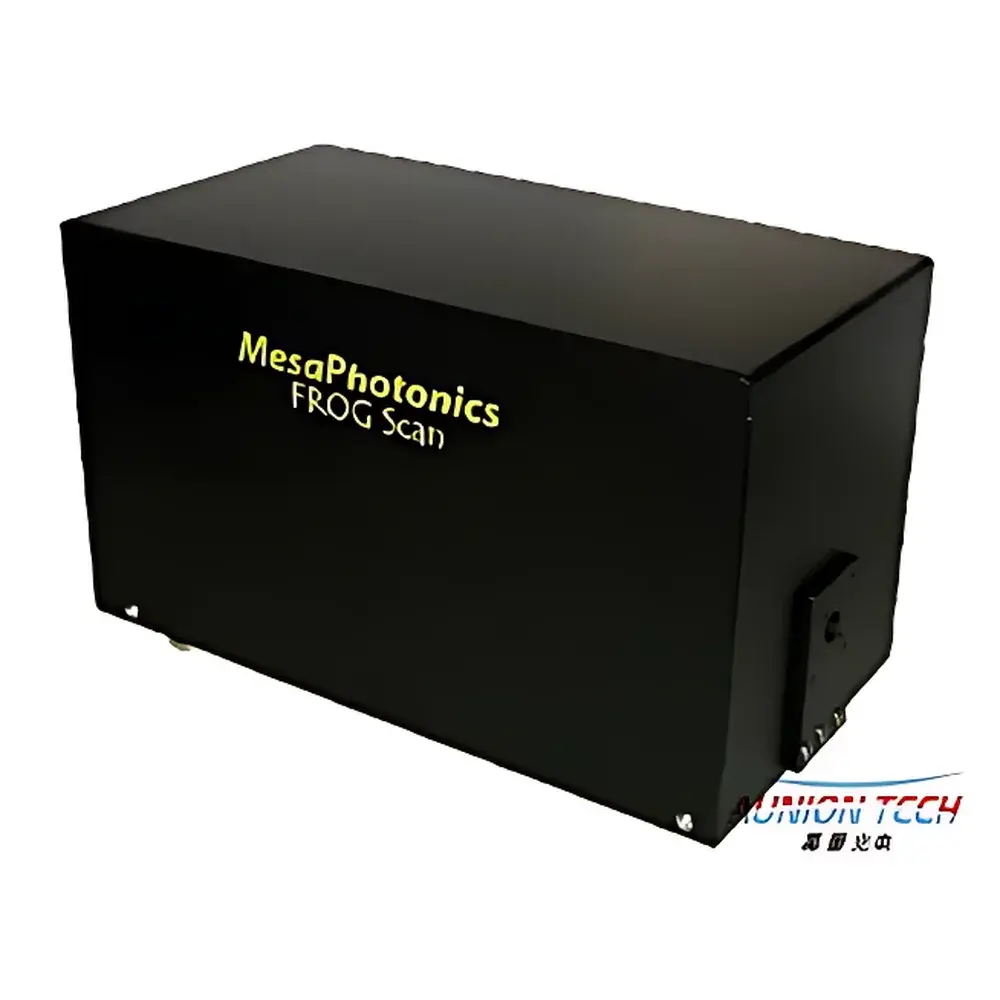
Auniontech Mid-IR FROG Ultrafast Pulse Characterization System
| Brand | Auniontech |
|---|---|
| Origin | Germany |
| Manufacturer Type | Authorized Distributor |
| Product Category | Imported Instrument |
| Model | Mid-IR FROG Pulse Analyzer |
| Price | Upon Request |
| Wavelength Range | 2000–3400 nm |
| Minimum Measurable Pulse Duration | 12 fs |
| Dynamic Range | 75 dB |
| Detection Method | Second-Harmonic Generation (SHG) Frequency-Resolved Optical Gating |
| Compatible Spectrometers | Ocean Insight USB4000 / USB2000+ |
| Data Acquisition | 16-bit ADC |
| Reconstruction Algorithm | PCGP (Principal Component Generalized Projections) |
Overview
The Auniontech Mid-IR FROG Ultrafast Pulse Characterization System is a precision optical metrology instrument engineered for complete temporal and spectral phase reconstruction of ultrashort laser pulses in the mid-infrared spectral region (2000–3400 nm). Unlike conventional SHG-FROG systems limited to visible and near-IR wavelengths, this system extends full-field pulse measurement capability into an under-served spectral band critical for molecular fingerprinting, ultrafast spectroscopy, and high-field physics. It operates on the principle of frequency-resolved optical gating (FROG), wherein a test pulse is split into signal and gate arms; the gate arm is delayed via a high-speed mechanical optical delay line, and both arms are spatially and temporally overlapped in a non-linear SHG crystal. The resulting second-harmonic intensity as a function of delay τ and frequency ω—termed the FROG trace—is captured by a calibrated CCD-coupled spectrometer. A robust iterative phase retrieval algorithm (PCGP) then reconstructs both amplitude and phase of the electric field E(t) with high fidelity and convergence stability.
Key Features
- Native mid-IR coverage from 2000 nm to 3400 nm—enabling characterization of OPOs, QCLs, and DFG sources previously inaccessible to standard FROG platforms
- Sub-15 fs temporal resolution, validated down to 12 fs minimum measurable pulse duration under optimal SNR conditions
- 75 dB dynamic range achieved through integrated 16-bit analog-to-digital conversion and low-noise optical path design
- Modular SHG crystal exchange architecture: supports BBO, AgGaS₂, GaSe, and ZnGeP₂ crystals for optimized phase-matching across broad IR bands
- High-speed mechanical delay stage with sub-100 fs step resolution and ≤50 ms full-range scan time (−10 ps to +10 ps), exceeding typical piezo-driven stages by >10× in speed
- Real-time acquisition and reconstruction: capable of streaming FROG traces at up to 5 Hz frame rate with live phase retrieval and display
Sample Compatibility & Compliance
The system accommodates free-space collimated beams with diameters from 2 mm to 8 mm and divergence < 1 mrad. Input polarization must be linear and aligned to the crystal’s phase-matching axis; optional half-wave plates and broadband polarizers are available for polarization management. All optical mounts comply with ISO 9001-certified manufacturing standards. The hardware and software architecture support GLP-compliant operation: audit trails, user access levels, electronic signatures, and data integrity logs are implemented per FDA 21 CFR Part 11 requirements when deployed in regulated environments. Traceability to NIST-traceable spectral calibration sources is maintained via factory-certified spectrometer alignment protocols.
Software & Data Management
VideoFROG Scan v4.x is the proprietary, Windows-based control and analysis suite developed exclusively for Auniontech FROG platforms. It provides synchronized hardware control, real-time FROG trace acquisition, PCGP-based pulse reconstruction, and comprehensive post-processing tools. The GUI features modular dockable panels—including time-domain pulse profile, spectral intensity/phase, spectrogram view, FROG trace heatmap, and residual error map—each fully scalable and repositionable. All datasets are saved in HDF5 format with embedded metadata (wavelength calibration, delay calibration, crystal type, temperature, ambient humidity). Export options include ASCII, MATLAB .mat, and CSV for third-party analysis. Batch processing mode enables automated analysis of multi-pulse sequences, supporting statistical evaluation (e.g., RMS pulse duration jitter, phase drift over time) required for laser stability qualification per ISO 13694 and IEC 60825-1.
Applications
- Characterization and optimization of mid-IR ultrafast oscillators and amplifiers (e.g., Cr:ZnS, Fe:ZnSe, OP-GaAs-based systems)
- Quantitative dispersion measurement and compensation validation in hollow-core fibers and chirped mirrors
- Real-time monitoring of pulse evolution in nonlinear compression stages (e.g., gas-filled capillaries, filamentation)
- Phase-sensitive diagnostics of complex pulses exhibiting higher-order chirp, satellite pulses, or coherent artifact structures
- Time-resolved mid-IR pump-probe experiments requiring precise knowledge of pump/probe temporal overlap and phase coherence
- Validation of pulse synthesis schemes in multi-octave IR comb generation setups
FAQ
What is the minimum pulse energy required for reliable measurement?
Typical threshold is 10 nJ for 12-fs pulses at 2500 nm using AgGaS₂; energy sensitivity scales inversely with pulse duration and crystal nonlinear coefficient.
Can the system measure pulses with arbitrary carrier-envelope phase (CEP)?
Yes—FROG is insensitive to CEP; it retrieves the full complex electric field E(t), including absolute phase, without requiring stabilization or interferometric referencing.
Is calibration traceable to national standards?
Spectral calibration uses NIST-traceable Hg/Ar emission lines; temporal calibration is performed via known reference pulses (e.g., autocorrelation of Ti:sapphire oscillator) and verified against certified delay-stage encoder resolution.
Does the software support automated pass/fail criteria for production-line testing?
Yes—customizable tolerance masks can be defined for pulse duration, bandwidth, time-bandwidth product, and phase error; results are logged with timestamp and operator ID for SPC integration.
Are OEM integration options available for embedding into larger laser systems?
SDK (C++/Python APIs) and LabVIEW VIs are provided for seamless integration with motion controllers, power meters, and beam diagnostics in turnkey ultrafast laboratories.



