
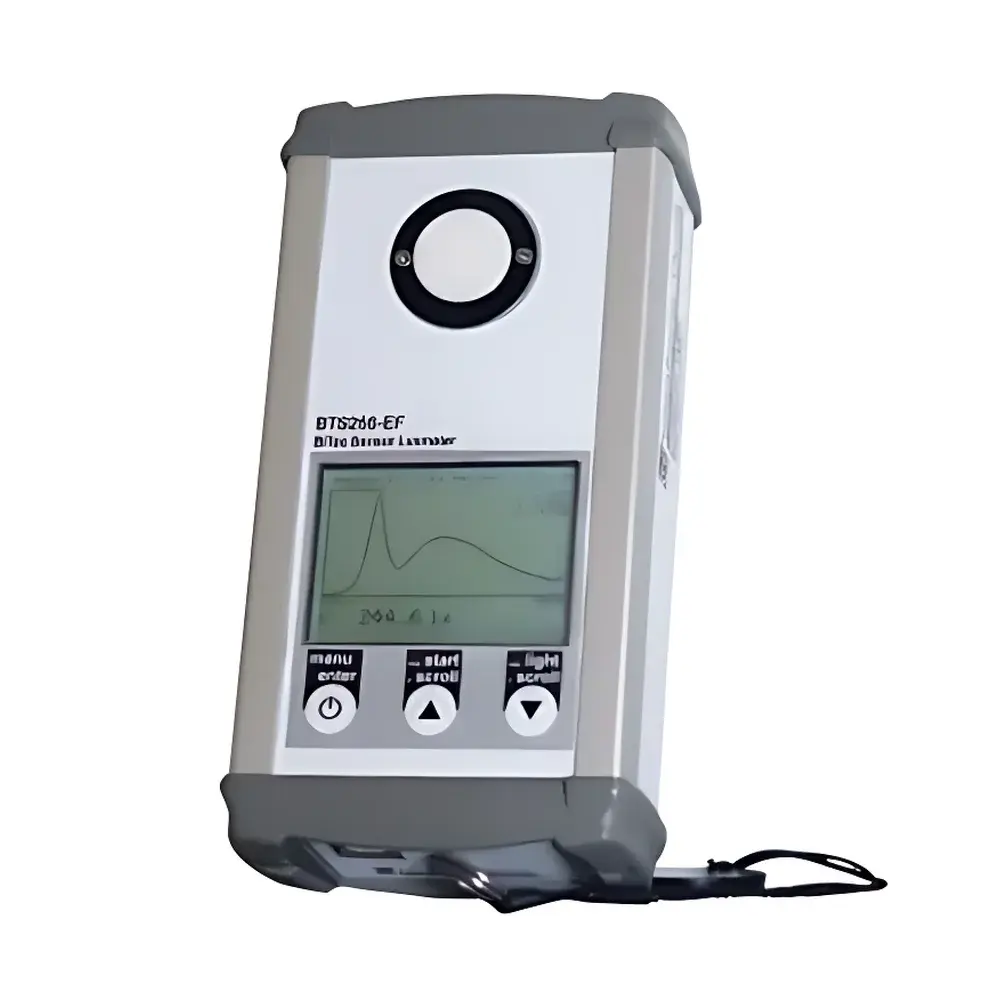
Gigahertz Optik BTS256-EF Handheld Spectroradiometer and Photometer
| Brand | Gigahertz Optik |
|---|---|
| Origin | Germany |
| Model | BTS256-EF |
| Spectral Range | 360–830 nm |
| FWHM Bandwidth | 10 nm (CIE 214-compliant spectral bandwidth correction) |
| Illuminance Range | 1–199,999 lx |
| Chromaticity Repeatability | ±0.0001 (Standard Illuminant A), ±0.0002 (LED) |
| Chromaticity Uncertainty (Δx, Δy) | ±0.002 (A), ±0.005 (LED) |
| CCT Range | 1700–17000 K |
| CRI | Ra and R1–R15 |
| Stray Light | ≤6×10⁻⁴ (colored LEDs), ≤1×10⁻³ (white LED, measured 100 nm left of peak) |
| Cosine Error (f₂) | ≤3% |
| Integration Time | 5.2–30,000 ms |
| Measurement Speed | ≤5 ms at 199,999 lx (white light), ≤1 s at 100 lx |
| ADC Resolution | 12-bit |
| Power | 5 V DC / 450 mA via USB |
Overview
The Gigahertz Optik BTS256-EF is a high-precision handheld spectroradiometer and photometer engineered for metrologically traceable optical measurements in lighting R&D, quality assurance, and regulatory compliance testing. Unlike conventional illuminance meters based on filtered photodiodes, the BTS256-EF employs a dual-sensor BiTec architecture—integrating a V(λ)-corrected silicon photodiode with a high-resolution CCD-based spectroradiometer—to deliver simultaneous, co-registered photometric, radiometric, colorimetric, and temporal measurements. Its core measurement principle relies on calibrated spectral sampling across 360–830 nm with 1 nm data resolution and automatic CIE 214-compliant bandwidth correction, enabling accurate derivation of photopic, scotopic, melanopic illuminance (Ep, Es, Em), photosynthetically active radiation (PAR), correlated color temperature (CCT), and full CRI evaluation (Ra + R1–R15). The instrument is specifically designed to address dynamic lighting challenges—including PWM-driven sources, thermal transients, and flicker analysis up to 200 kHz—making it suitable for IEC TR 61547-1, IEEE 1789, and ENERGY STAR SSL verification protocols.
Key Features
- BiTec dual-sensor system: Independent yet mutually referenced photodiode and spectroradiometer channels ensure superior linearity, stability, and measurement speed without trade-offs in accuracy.
- Cosine-corrected 20 mm input aperture with f₂ error ≤3%, optimized for field use under non-uniform or off-axis illumination conditions.
- Flicker analysis capability: Full waveform capture and calculation of percent flicker, flicker index, SVM (stroboscopic visibility measure), and frequency-domain spectral content from 0.25 Hz to 200 kHz.
- Real-time spectral bandwidth correction per CIE Publication 214, minimizing spectral mismatch uncertainty (f₁′ ≤3% with correction vs. ≤6% uncorrected).
- Thermal drift compensation: Onboard temperature sensor actively corrects diode responsivity across operational ambient range (10–40 °C).
- USB-powered operation (5 V DC / 450 mA) enables battery-independent field deployment with no external power supply required.
- 12-bit ADC with configurable integration time (5.2–30,000 ms) supports both high-speed transient capture and low-light precision measurement.
Sample Compatibility & Compliance
The BTS256-EF is validated for measurement of all common light source types—including incandescent, halogen, fluorescent, HID, OLED, and multi-channel LED modules—with documented performance under pulsed, modulated, and thermally unstable operating conditions. Its stray light rejection (≤6×10⁻⁴ for monochromatic LEDs; ≤1×10⁻³ for white LEDs at 100 nm spectral offset) meets requirements for high-dynamic-range spectral characterization per CIE S 023/E:2019. Calibration is performed traceably to PTB (Physikalisch-Technische Bundesanstalt) standards, with stated uncertainties of ±2.2% for luminance and ±0.002 in chromaticity coordinates (Illuminant A). The device complies with EMC immunity requirements per EN 61326-1 for industrial environments and supports GLP/GMP-aligned audit trails when used with Gigahertz Optik’s BTS-Control software (21 CFR Part 11 optional configuration available).
Software & Data Management
BTS-Control v4.x provides full instrument control, real-time spectral visualization, automated report generation (PDF/CSV), and batch processing for production QA. Raw spectral data (1 nm steps) is stored in industry-standard JDX format, supporting post-acquisition re-evaluation of metrics—including custom weighting functions, TM-30-15 Rf/Rg, and melanopic EDI calculations. The software includes built-in flicker test templates aligned with IEC TR 61547-1 Annex D and allows synchronized triggering with programmable AC power supplies (e.g., California Instruments iX Series) for end-to-end lamp stress testing. All measurement metadata—including timestamp, GPS coordinates (via optional Bluetooth module), operator ID, and calibration certificate ID—is embedded in exported files to satisfy ISO/IEC 17025 documentation requirements.
Applications
- LED driver validation and PWM dimming performance assessment
- Thermal transient analysis of luminaires during burn-in and thermal cycling
- Regulatory testing for ENERGY STAR, DesignLights Consortium (DLC), and EU Ecodesign Lot 10
- Human-centric lighting (HCL) design: melanopic EDI, circadian stimulus (CS), and scotopic/photopic ratio mapping
- Photobiological safety screening per IEC 62471 (limited to hazard group classification support)
- Manufacturing process control for backlight units, automotive lighting, and horticultural LED systems
- Field verification of lighting installations against IES LM-79-19 and CIE S 025/E:2015 protocols
FAQ
Is the BTS256-EF calibrated traceably to national standards?
Yes—each unit ships with a factory calibration certificate traceable to PTB (Germany) and includes spectral irradiance, illuminance, and chromaticity reference points across the full 360–830 nm range.
Can it measure flicker for high-frequency PWM drivers above 20 kHz?
Yes—the instrument supports full waveform acquisition up to 200 kHz, with anti-aliasing filtering and sample rates exceeding 1 MS/s to resolve fast-switching LED drivers compliant with JEDEC JESD78.
Does it support TM-30-15 color fidelity analysis?
Yes—raw spectral data export enables post-processing using NIST-developed TM-30-15 calculators or integrated analysis within BTS-Control v4.3+.
What is the recommended recalibration interval?
Gigahertz Optik recommends annual recalibration for laboratory-grade applications; biannual intervals are acceptable for production floor use under stable environmental conditions.
Is firmware upgrade supported in the field?
Yes—firmware updates are delivered via USB through BTS-Control software and include enhancements to spectral interpolation algorithms, flicker metric definitions, and USB enumeration robustness.





