
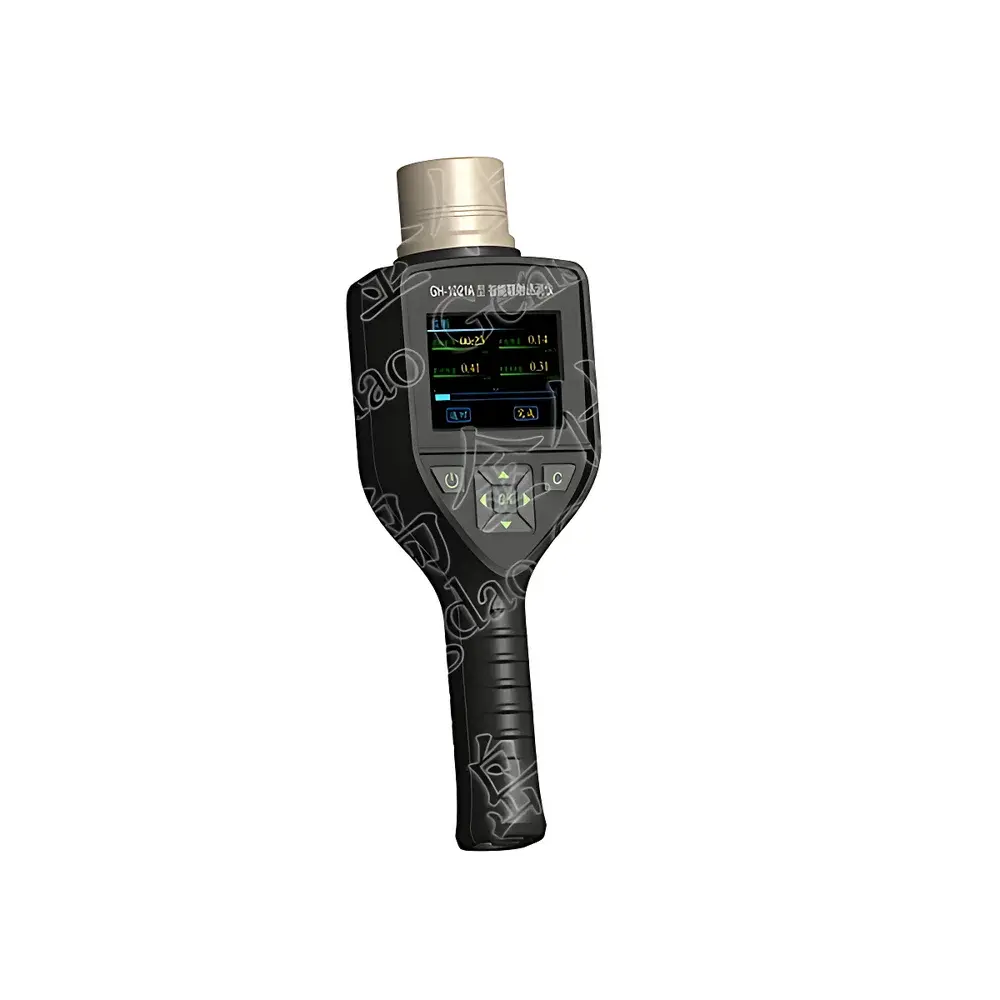
Genetec GH-103A Smart Radiation Survey Meter
| Brand | Genetec |
|---|---|
| Origin | Shandong, China |
| Manufacturer Type | Direct Manufacturer |
| Product Category | Domestic |
| Model | GH-103A |
| Instrument Class | Dose Rate / Dose Meter |
| Form Factor | Portable |
| Detectable Radiation Types | X-ray, γ-ray, and optionally neutron (via configurable detector module) |
| Measurement Modes | Continuous, Pulse, and Source-Localization |
| Compliance Standards | JJG 393–2018, IEC 60846-1:2009 |
| Detector Technology | Scintillation Crystal + Photomultiplier Tube (PMT) and Geiger-Müller (GM) Counter |
| Display | Industrial-grade color touchscreen |
| Environmental Rating | IP65-rated sealed enclosure |
| Data Logging | Time-stamped event recording with alarm timestamping |
| Alarm Functions | Dose rate threshold, accumulated dose threshold, detector fault, and count-rate saturation |
Overview
The Genetec GH-103A Smart Radiation Survey Meter is a portable, multi-radiation detection instrument engineered for field-deployable environmental radiation monitoring and occupational radiation safety assessment. It operates on dual-detector architecture—integrating a high-sensitivity scintillation crystal coupled with a photomultiplier tube (PMT) for low-dose-rate and energy-responsive measurements, and a robust Geiger-Müller (GM) counter for wide-range, high-reliability counting in mixed-field environments. This hybrid design enables accurate quantification of ambient dose equivalent rate H*(10) and accumulated dose over time, in accordance with international metrological requirements for radiation protection instrumentation. The GH-103A meets the performance criteria defined in JJG 393–2018 (Chinese national verification regulation for X/γ radiation survey meters) and IEC 60846-1:2009 (international standard for portable ambient and directional dose equivalent rate meters). Its measurement capability spans multiple decades of dose rate—from background-level monitoring to elevated fields typical in industrial radiography or nuclear facility perimeter surveys—while maintaining stable energy response across low-energy X-rays (≥15 keV), medium-energy γ-rays (e.g., 137Cs at 662 keV), and high-energy photons (>1.25 MeV from 60Co).
Key Features
- Triple-radiation detection capability: factory-configured for X-ray and γ-ray; optional neutron-sensitive module available for extended deployment in mixed neutron/photon fields (e.g., reactor facilities or accelerator vaults)
- 10-decade dynamic range coverage enabled by auto-ranging circuitry and dual-sensor signal fusion logic
- Industrial-grade 5.0-inch color touchscreen interface supporting intuitive parameter configuration, real-time spectral trend visualization, and touch-enabled mode switching
- Three operational modes: continuous integration for routine area monitoring; pulse mode delivering real-time pulse-height distribution, peak amplitude, and statistical averaging; and source-localization mode optimizing directional sensitivity via count-rate gradient analysis
- Comprehensive alarm system with independently configurable thresholds for dose rate, accumulated dose, detector failure, and dead-time saturation—each logged with precise UTC timestamp
- Ruggedized IP65-rated enclosure: impact-resistant polycarbonate housing, sealed against dust ingress and water splashing, suitable for outdoor use in harsh industrial or emergency response conditions
Sample Compatibility & Compliance
The GH-103A is designed for direct measurement of ambient photon fields without sample preparation. It does not require radioactive standards or calibration sources for routine operation but must be calibrated traceably to national standards (e.g., NIM or CNIM in China; NIST-traceable sources internationally) prior to first use and at intervals specified in JJG 393–2018 (typically annually or after repair). Its energy response curve complies with IEC 60846-1:2009 Annex B tolerance limits (±30% deviation from reference response between 48 keV and 1.25 MeV for γ-rays; ±40% for X-rays down to 15 keV). The instrument supports GLP-aligned documentation: all calibrations, firmware updates, and alarm events are stored internally with immutable timestamps and user-accessible export via USB-C.
Software & Data Management
Data acquisition and reporting are managed through embedded firmware supporting CSV export of time-series dose rate logs (1-second resolution), cumulative dose history, and alarm metadata (type, timestamp, measured value, detector status). No proprietary desktop software is required; exported files are compatible with common laboratory data analysis platforms (e.g., MATLAB, Python pandas, Excel). Firmware supports secure over-the-air (OTA) updates signed with manufacturer cryptographic keys, ensuring integrity during maintenance cycles. Audit trail functionality records all configuration changes—including unit selection (µSv/h vs. mR/h), alarm setpoints, and display brightness—enabling compliance with ISO/IEC 17025 internal audit requirements.
Applications
- Environmental radiation surveillance: baseline mapping near nuclear power plants, uranium mining sites, or legacy waste disposal areas
- Occupational health & safety: routine monitoring in radiotherapy departments, industrial radiography bays, and nuclear medicine labs
- Border and customs control: rapid screening of scrap metal, imported goods, or cargo containers for orphan sources or contamination
- Emergency response: first-responder deployment during radiological dispersal device (RDD) incidents or transportation accidents involving radioactive materials
- Decommissioning support: dose rate profiling during dismantling of irradiated equipment or contaminated infrastructure
- Regulatory compliance verification: periodic surveys mandated under national radiation protection regulations (e.g., China’s Regulation on Safety Supervision of Radioactive Isotopes and Radiation Devices)
FAQ
Is neutron detection included as standard?
No. Neutron sensitivity requires installation of an optional 3He or BF3-filled proportional counter module, which must be ordered separately and factory-integrated.
What is the recommended calibration interval?
Per JJG 393–2018, annual calibration is mandatory. Additional verification is required after physical shock, exposure to extreme temperatures (>50 °C or <–10 °C), or any incident affecting detector integrity.
Does the GH-103A support FDA 21 CFR Part 11 compliance?
It does not implement electronic signature or role-based access controls required for Part 11. However, its tamper-evident audit log and UTC-stamped event records meet foundational ALCOA+ principles for regulated environments.
Can measurement data be synchronized wirelessly?
No. Data transfer occurs exclusively via USB-C connection to ensure electromagnetic immunity in high-interference radiation zones. Wi-Fi or Bluetooth are intentionally omitted to prevent RF-induced measurement artifacts.
Is the instrument suitable for underwater or submerged use?
No. While IP65-rated for splash resistance, it is not submersible. Immersion beyond brief surface contact may compromise detector window integrity and PMT vacuum seal.
Related Products







