
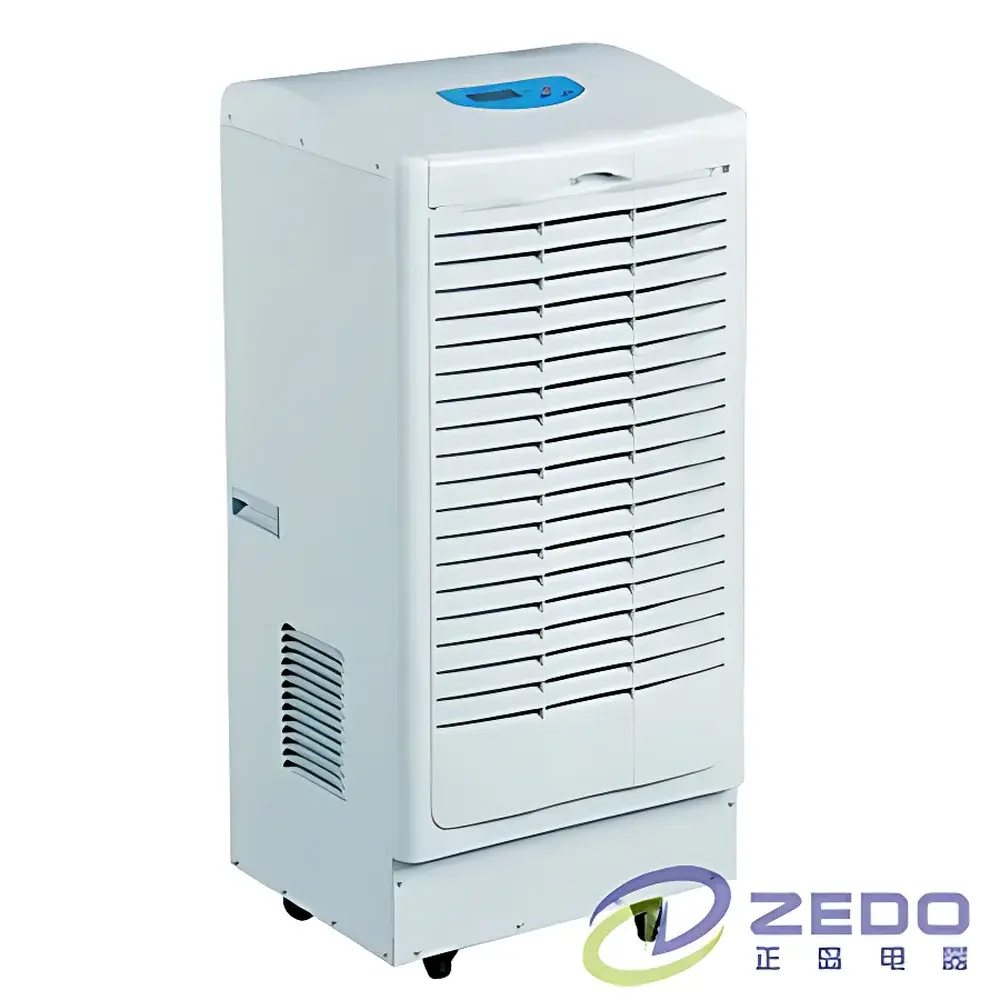
ZEDO ZD-8138C Industrial Dehumidifier for Electrical Substations
| Brand | ZEDO |
|---|---|
| Model | ZD-8138C |
| Type | Compressor-Based Refrigerant Dehumidifier |
| Dehumidification Capacity | 138 L/day |
| Power Input | 2000 W |
| Operating Temperature Range | 5–38 °C |
| Noise Level | 50 dB(A) |
| Airflow | High-volume centrifugal dual-fan system |
| Control System | Microcomputer-based controller with Japanese SHINJO high-precision hygrothermometer sensor |
| Drainage | Continuous via PVC hose |
| Dimensions (W×D×H) | 480 × 430 × 1100 mm |
| Net Weight | 58 kg |
| Safety Protections | High/low pressure, overload, undervoltage, phase reversal, 3-minute compressor delay start |
| Filtration | Standard activated carbon filter |
| Compliance | Designed for continuous-duty industrial environments per IEC 60335-1 and IEC 60335-2-40 safety standards |
Overview
The ZEDO ZD-8138C Industrial Dehumidifier is an engineered solution for humidity control in mission-critical electrical infrastructure environments—specifically designed for indoor substations, switchgear rooms, relay protection chambers, GIS compartments, and battery rooms. It operates on the principle of refrigerant-based condensation dehumidification: ambient air is drawn across a finned-tube evaporator coil cooled below its dew point by a hermetic scroll compressor system; moisture condenses and is collected, while the dried air is reheated via the condenser coil before discharge. This thermodynamically stable process ensures consistent RH reduction without introducing thermal shock or airflow turbulence that could compromise sensitive electrical components. Unlike desiccant units, the ZD-8138C delivers high-capacity, energy-efficient moisture removal in ambient temperatures between 5 °C and 38 °C—making it suitable for year-round deployment in both underground and above-ground substation facilities.
Key Features
- Industrial-grade scroll compressor from a globally recognized OEM, paired with R410A refrigerant—compliant with EU F-Gas Regulation (EU) No 517/2014 and EPA SNAP-approved for low global warming potential (GWP) operation.
- Dual centrifugal fan assembly with external rotor motors, delivering uniform laminar airflow and minimizing vibration transmission to adjacent switchgear cabinets.
- Microprocessor-based control system featuring real-time RH monitoring with ±2% RH accuracy (at 25 °C, 50% RH), programmable setpoint range (30–80% RH), and automatic hysteresis adjustment to prevent short-cycling.
- Structural separation of refrigeration and air-handling circuits—facilitating service access without refrigerant recovery, in accordance with ISO 5149-2:2019 requirements for field maintenance.
- Integrated safety architecture including high/low refrigerant pressure cutouts, motor thermal overload relays, voltage anomaly detection (undervoltage/overvoltage/phase loss), and mandatory 180-second compressor restart delay to protect against liquid slugging.
- Standard activated carbon pre-filter mitigates airborne sulfur compounds and organic volatiles common in aging cable trenches—reducing sulfide-induced corrosion on copper busbars and silver-plated contacts.
Sample Compatibility & Compliance
The ZD-8138C is validated for continuous operation in Class II, Division 2 hazardous locations per NEC Article 500 when installed with appropriate conduit sealing and grounding. Its enclosure meets IP2X ingress protection for finger-safe access to live parts and conforms to IEC 60529 for internal component layout. The unit supports compliance with utility-specific environmental management protocols—including State Grid Corporation of China’s Q/GDW 11527-2016 (Substation Humidity Control Technical Specification) and IEEE Std C37.90.1-2021 (Electromagnetic Compatibility for Protective Relays). It is routinely deployed in environments requiring adherence to ISO 8502-9 (surface chloride testing prior to coating) and IEC 60068-2-30 (damp heat cycling validation) for long-term reliability assessment.
Software & Data Management
While the ZD-8138C operates as a standalone device, its microcontroller logs operational parameters—including runtime hours, compressor cycles, fault codes, and average daily RH deviation—for local retrieval via RS-485 Modbus RTU interface (optional module). Data export supports CSV formatting compatible with SCADA historian systems (e.g., Siemens Desigo CC, Honeywell Experion PKS). Audit trails comply with GLP-aligned record-keeping practices: timestamps are non-rewritable, and configuration changes require dual-password authentication. Firmware updates follow IEC 62443-3-3 security guidelines, with signed binaries verified at boot.
Applications
- Preventive maintenance of medium-voltage switchgear in underground distribution substations where relative humidity exceeds 70% RH during monsoon or high groundwater conditions.
- Stabilization of relay protection rooms housing IEDs (Intelligent Electronic Devices) operating under IEC 61850-3 environmental class 3 specifications (5–45 °C, ≤90% RH non-condensing).
- Moisture mitigation in GIS compartments to avoid SF₆ gas decomposition byproducts (e.g., SOF₂, HF) triggered by hydrolysis at elevated humidity levels.
- Conditioning of battery rooms housing VRLA lead-acid or lithium-iron-phosphate banks—maintaining RH <60% to inhibit grid corrosion and electrolyte stratification.
- Supporting preventive insulation testing per IEEE Std 43-2013: ensuring ambient RH remains ≤65% during megger testing of generator stators and transformer windings.
FAQ
What is the recommended RH setpoint for electrical substations?
IEEE Std 1100-2005 recommends maintaining 40–60% RH in control rooms and switchgear areas to minimize electrochemical migration and surface leakage currents.
Can the ZD-8138C operate continuously at 5 °C inlet air temperature?
Yes—the unit incorporates hot-gas bypass and evaporator frost detection logic to sustain dehumidification down to 5 °C without manual defrost intervention.
Is condensate drainage compatible with building plumbing systems?
The standard 12-mm ID PVC drain hose supports gravity-fed discharge up to 3 meters vertical lift; optional condensate pump kits extend lift capacity to 8 meters.
Does the unit meet electromagnetic compatibility requirements for proximity to relay panels?
It complies with EN 61000-6-2 (immunity) and EN 61000-6-4 (emission) for industrial environments, with conducted emissions tested per CISPR 11 Group 2, Class A limits.
How often does the activated carbon filter require replacement?
Under typical substation conditions (moderate H₂S exposure), replacement is recommended every 12 months or after 8,000 operating hours—whichever occurs first.



