
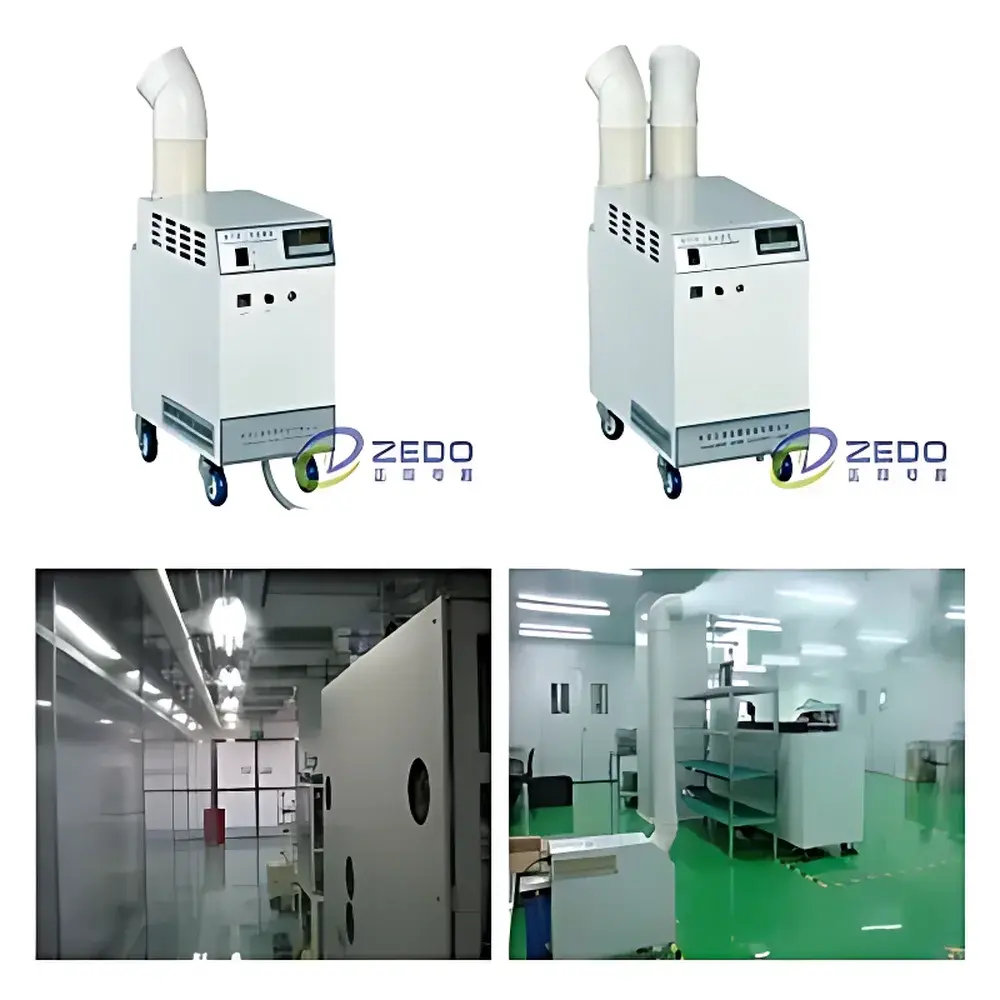
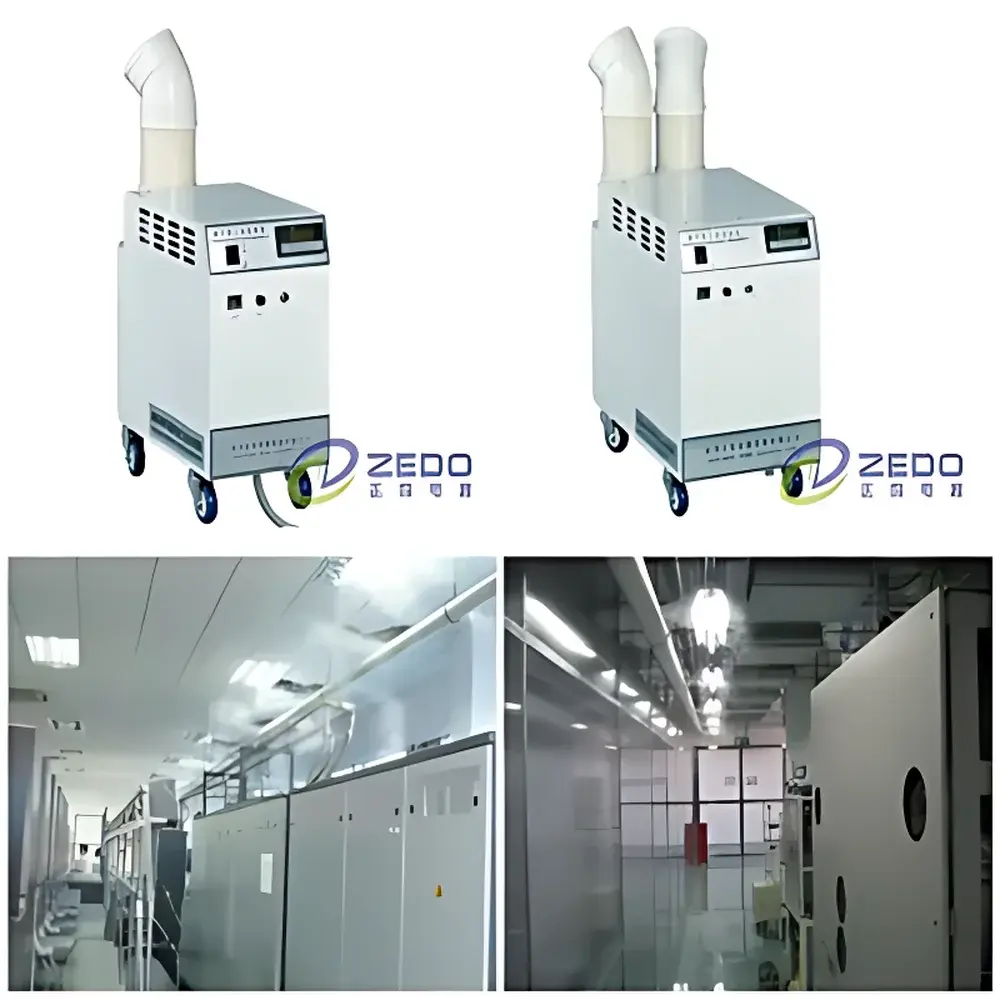
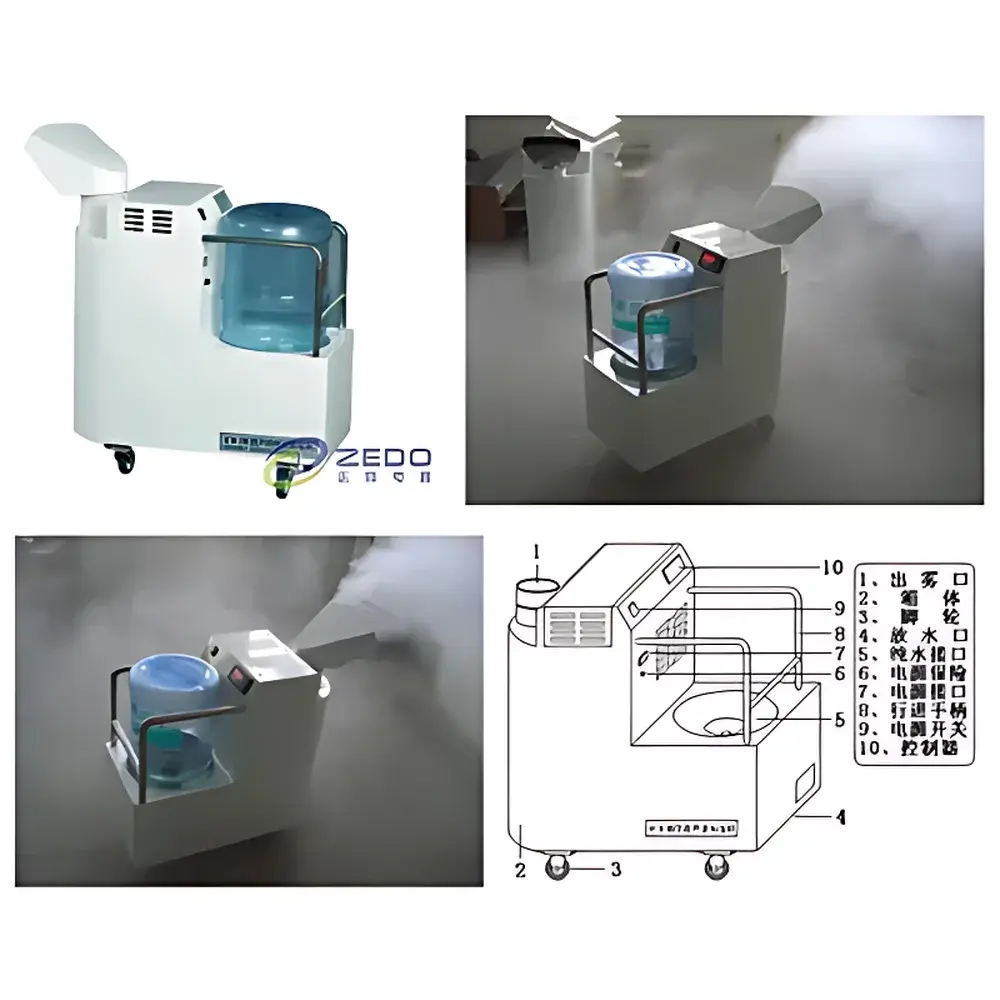
ZEDO ZS-40Z Ultrasonic Industrial Humidifier for ESD-Sensitive Electronics Manufacturing Environments
| Brand | ZEDO |
|---|---|
| Origin | Zhejiang, China |
| Manufacturer Type | OEM/ODM Manufacturer |
| Country of Origin | China |
| Model | ZS-40Z |
| Humidification Capacity | 40 kg/h (nominal) |
| Power Consumption | 1200 W |
| Control Modes | On/Off, Timer, RH Feedback (with optional hygrostat) |
| 雾化方� | �: Single-tube ultrasonic mist outlet |
| Construction | Full stainless steel (304) chassis & tank |
| Water Inlet | Auto-fill with float valve & overflow protection |
| IP Rating | IP68 sealed power supply & fan |
| 雾化片 | Alumina ceramic transducer (alkali/acid resistant, 3000–5000 h lifespan) |
| Fan | 36 V DC waterproof ball-bearing fan |
| Sensor | Japan Shinyo high-accuracy capacitive humidity sensor (±3% RH, 10–90% RH range) |
| Mobility | Four swivel casters with brakes |
Overview
The ZEDO ZS-40Z Ultrasonic Industrial Humidifier is an engineered environmental control solution designed specifically for electrostatic discharge (ESD)-sensitive manufacturing environments—particularly cleanrooms, semiconductor fabrication areas, PCB assembly lines, and precision electronics assembly facilities. It operates on the principle of high-frequency ultrasonic oscillation (1.7 MHz), where piezoelectric ceramic transducers convert electrical energy into mechanical vibrations that atomize deionized or softened water into sub-5 µm droplets. This fine mist ensures rapid vapor-phase integration into ambient air without wetting surfaces—a critical requirement in Class 100–10,000 cleanrooms per ISO 14644-1. Unlike steam or evaporative systems, ultrasonic humidification introduces no thermal load, minimal particulate generation, and zero mineral carryover when used with treated water—making it compliant with stringent air quality protocols required for microelectronics production.
Key Features
- Full 304 stainless steel construction—including tank, chassis, and internal wetted components—ensures corrosion resistance, cleanability, and long-term compliance with ISO 14644-1 particulate control standards.
- IP68-rated hermetically sealed variable-frequency power supply and integrated circuitry, certified to operate continuously submerged at 1 m depth—eliminating moisture ingress failure modes common in industrial settings with high ambient humidity or condensation risk.
- 36 V DC waterproof ball-bearing fan with IP68 rating delivers stable, low-vibration airflow for uniform mist distribution across large-volume spaces (up to 1,200 m³ per unit) or targeted local compensation in tooling enclosures and workstations.
- Alumina-based ceramic ultrasonic transducers engineered for hard-water tolerance and chemical resistance (pH 4–10), rated for 3,000–5,000 operational hours with field-replaceable modular design—reducing mean time to repair (MTTR) and lifecycle cost of ownership.
- Microprocessor-based controller with capacitive relative humidity sensing (Japan Shinyo sensor, ±3% RH accuracy over 10–90% RH range), supporting three operating modes: manual on/off, programmable timer scheduling, and closed-loop RH feedback control (requires external hygrostat input or optional built-in PID algorithm).
- Auto-fill system with stainless steel float valve and redundant overflow cutoff prevents dry-run damage and maintains consistent water level—critical for stable ultrasonic output and avoidance of harmonic resonance-induced transducer fatigue.
Sample Compatibility & Compliance
The ZS-40Z is compatible with deionized (DI), reverse osmosis (RO), or softened water supplies—mandatory for preventing white dust deposition and maintaining ISO Class 5–7 cleanroom particle counts. It meets structural safety requirements per IEC 60335-1 and electromagnetic compatibility (EMC) per EN 61000-6-3/6-4. While not a medical device, its design aligns with GMP Annex 1 (2022) environmental monitoring recommendations for humidity control in aseptic processing zones where static mitigation is co-dependent with microbial control. The unit supports audit-ready operation logs when integrated with external Building Management Systems (BMS) via 0–10 V or 4–20 mA analog interfaces.
Software & Data Management
The ZS-40Z operates as a standalone, firmware-controlled device with no proprietary cloud platform or mandatory software dependency. All configuration—including setpoint adjustment, timer programming, and alarm thresholds—is performed via tactile membrane keypad with LCD status display. For regulated environments, optional analog outputs (0–10 V RH signal) enable connection to validated data loggers compliant with FDA 21 CFR Part 11 (when paired with ALCOA+ compliant logging hardware). Event-based alarms—including low-water, over-humidity, transducer fault, and fan stall—are latched and displayed with timestamped codes for root-cause analysis during GLP/GMP investigations.
Applications
This humidifier is deployed in applications where static charge accumulation must be suppressed below 100 V (per ANSI/ESD S20.20), including: wafer probing stations; solder paste stencil printing rooms; bare-die bonding clean booths; HDD head gimbal assembly areas; and automated optical inspection (AOI) chambers. It is also specified in HVAC retrofits for legacy electronics manufacturing facilities seeking to upgrade from outdated centrifugal or electrode steam systems—offering 40–60% RH stability within ±5% RH tolerance under dynamic load conditions (e.g., door cycling, personnel ingress, process exhaust fluctuations).
FAQ
What is the recommended water quality specification for optimal performance and longevity?
Deionized water with conductivity ≤1 µS/cm or softened water with hardness <1°dH is required to prevent scaling and transducer degradation.
Can the ZS-40Z be integrated into a central BMS for centralized humidity control?
Yes—via standard 0–10 V analog input for RH setpoint modulation and 4–20 mA output for real-time humidity feedback.
Is the unit suitable for use in ISO Class 5 cleanrooms?
When supplied with DI water and installed with HEPA-filtered mist distribution ducting, it meets airborne particle contribution limits per ISO 14644-3 Annex D for ultrasonic humidifiers.
Does the unit include validation documentation (IQ/OQ protocols)?
No—validation documentation must be developed per site-specific qualification protocols; however, all electrical, mechanical, and material certifications are provided upon request.
What maintenance intervals are recommended for routine operation?
Ceramic transducer cleaning every 200 operating hours; full tank and sump inspection quarterly; fan and sensor calibration annually.



