
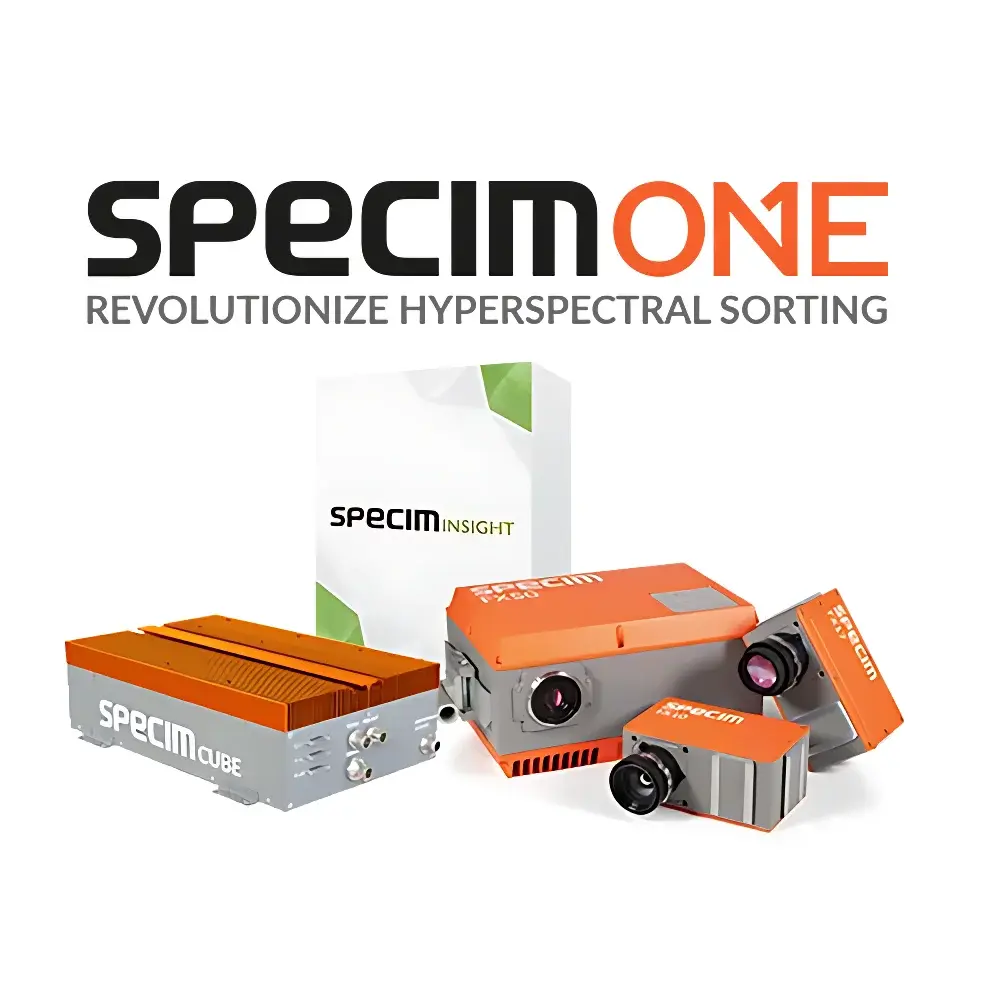
Specim SPECIMONE Hyperspectral Imaging-Based Automated Online Sorting System
| Brand | Specim (Finland) |
|---|---|
| Origin | Finland |
| Model | SPECIMONE |
| Operating Principle | Push-broom |
| Imaging Method | Dispersive |
| Deployment | Ground-based |
| Spectral Range | 400–1000 nm |
| Spectral Resolution | 2 nm |
| Spatial Resolution | 1280 × 1024 pixels |
| Total Field of View (TFOV) | 8° |
| Instantaneous Field of View (IFOV) | 0.18 mrad |
| Frame Rate | 15 fps |
| Certification | CE, FCC, RoHS3 |
| Operating Temperature | −10 °C to +60 °C |
| Operating Humidity | 95% RH (at 40 °C, non-condensing) |
| Data Interface | GigE Vision (RGB8, Mono12, Mono12packed), USB 3.0, RS-232/485, CAN |
| Embedded Platform | NVIDIA Jetson AGX Xavier SoC |
| Onboard Storage | 256 GB |
| Dimensions | 190 × 300 × 90 mm |
| Weight | 4.6 kg |
| Compatible Cameras | Specim FX10, FX17, FX50 |
| OS | Specim CameraOS |
| Web UI | CameraOS webUI |
| Data Format | ENVI-compatible Specim native format |
Overview
The Specim SPECIMONE Hyperspectral Imaging-Based Automated Online Sorting System is an industrial-grade, turnkey solution engineered for real-time material identification and classification in continuous production environments. Built upon push-broom scanning architecture and dispersive spectral separation, the system captures spatially registered spectral cubes—each pixel containing a full reflectance spectrum across the visible to near-infrared (VNIR) range (400–1000 nm). Unlike conventional RGB or multispectral systems, SPECIMONE delivers high-fidelity spectral signatures with 2 nm spectral resolution and sub-milliradian spatial sampling (0.18 mrad IFOV), enabling discrimination of materials with subtle chemical or structural differences—such as polymer types, organic contaminants, or compositional variations in agricultural products. Its ground-deployable design integrates seamlessly into conveyor-based infrastructure, supporting stable operation under industrial ambient conditions (−10 °C to +60 °C, up to 95% RH non-condensing) and complying with CE, FCC, and RoHS3 directives.
Key Features
- Industrial push-broom hyperspectral imaging core using Specim FX-series VNIR cameras (FX10 compatible), optimized for high-speed scanning at 15 fps with 1280 × 1024 spatial resolution
- Dispersive optical design ensuring minimal spectral crosstalk and high radiometric stability across the 400–1000 nm range
- Dedicated real-time inference hardware: Specim CUBE unit powered by NVIDIA Jetson AGX Xavier SoC, delivering deterministic low-latency processing for online sorting decisions
- Integrated CameraOS firmware with web-based user interface (CameraOS webUI) for remote configuration, diagnostics, and firmware updates
- GigE Vision compliance supporting standard machine vision protocols (RGB8, Mono12, Mono12packed); additional interfaces include USB 3.0, RS-232/485, and CAN for PLC synchronization and industrial network integration
- ENVI-compatible native data format ensures interoperability with third-party spectral analysis tools and legacy laboratory workflows
Sample Compatibility & Compliance
SPECIMONE is validated for heterogeneous solid sample streams moving at typical conveyor speeds (up to 2 m/s, depending on spatial resolution and line-scan geometry). It supports reflective measurement modes only and requires calibrated illumination (e.g., halogen or LED line lights with uniform spectral output) for quantitative reflectance estimation. The system meets electromagnetic compatibility (EMC) and safety requirements per EU Directive 2014/30/EU (CE), FCC Part 15 Subpart B (USA), and RoHS3 (2015/863/EU). While not inherently FDA 21 CFR Part 11-compliant out-of-the-box, audit trails, user access control, and data integrity features can be implemented via custom software layers aligned with GMP/GLP documentation frameworks. All optical components are sealed against dust and moisture ingress (IP54-rated enclosure), suitable for Class 10,000 cleanroom-adjacent environments and recycling facility settings.
Software & Data Management
Specim INSIGHT serves as the offline model development environment, providing a validated workflow for spectral data curation, feature extraction, and classifier training. Users import reference spectra or labeled image cubes, visualize spectral curves and PCA score plots, and apply supervised algorithms—including Partial Least Squares Discriminant Analysis (PLS-DA), Spectral Angle Mapper (SAM), and Principal Component Analysis (PCA)—to generate robust classification models. Trained models are exported in binary format and deployed directly to the CUBE unit. CameraOS manages real-time acquisition, onboard preprocessing (dark current correction, flat-field normalization), and pixel-wise inference. All raw and processed data are timestamped, georeferenced (if synchronized with encoder signals), and stored in ENVI header/data pair format—enabling traceable reprocessing, regulatory review, and integration with MES or LIMS platforms via RESTful API extensions.
Applications
- Automated plastic polymer sorting (PET, HDPE, PP, PVC) in post-consumer waste streams based on spectral fingerprinting
- In-line quality assurance of food products—detecting foreign material (FM), bruising, mold, or ripeness variation in fruits, nuts, and baked goods
- Pharmaceutical tablet coating uniformity assessment and counterfeit detection via spectral library matching
- Mineralogical classification in mining ore feed streams for real-time grade control
- Environmental monitoring of soil contamination or vegetation stress indicators using calibrated reflectance indices
- Recycled fiber sorting in paper mills to separate inked vs. de-inked grades or detect synthetic contaminants
FAQ
What spectral calibration standards are supported?
The system supports factory-calibrated radiometric and wavelength calibration; users may perform field recalibration using NIST-traceable white reference panels and spectral line sources (e.g., mercury-argon lamps) following ISO 17025-aligned procedures.
Can SPECIMONE operate without a trained classification model?
Yes—it acquires and stores full hyperspectral cubes in ENVI format for later offline analysis; however, real-time sorting functionality requires a pre-deployed INSIGHT-generated model.
Is GPU-accelerated deep learning inference supported?
The NVIDIA Jetson AGX Xavier platform supports TensorFlow Lite and PyTorch inference; custom CNN or transformer-based models may be deployed via Docker containers, subject to memory and latency constraints.
How is synchronization achieved with conveyor motion?
Encoder pulse input (via RS-485 or CAN) enables precise line-scan triggering and spatial registration; optional strobe output ensures illumination synchronization.
What maintenance intervals are recommended for long-term operational stability?
Optical path inspection every 6 months; annual recalibration of spectral response and spatial alignment recommended under ISO/IEC 17025-accredited service contracts.






