
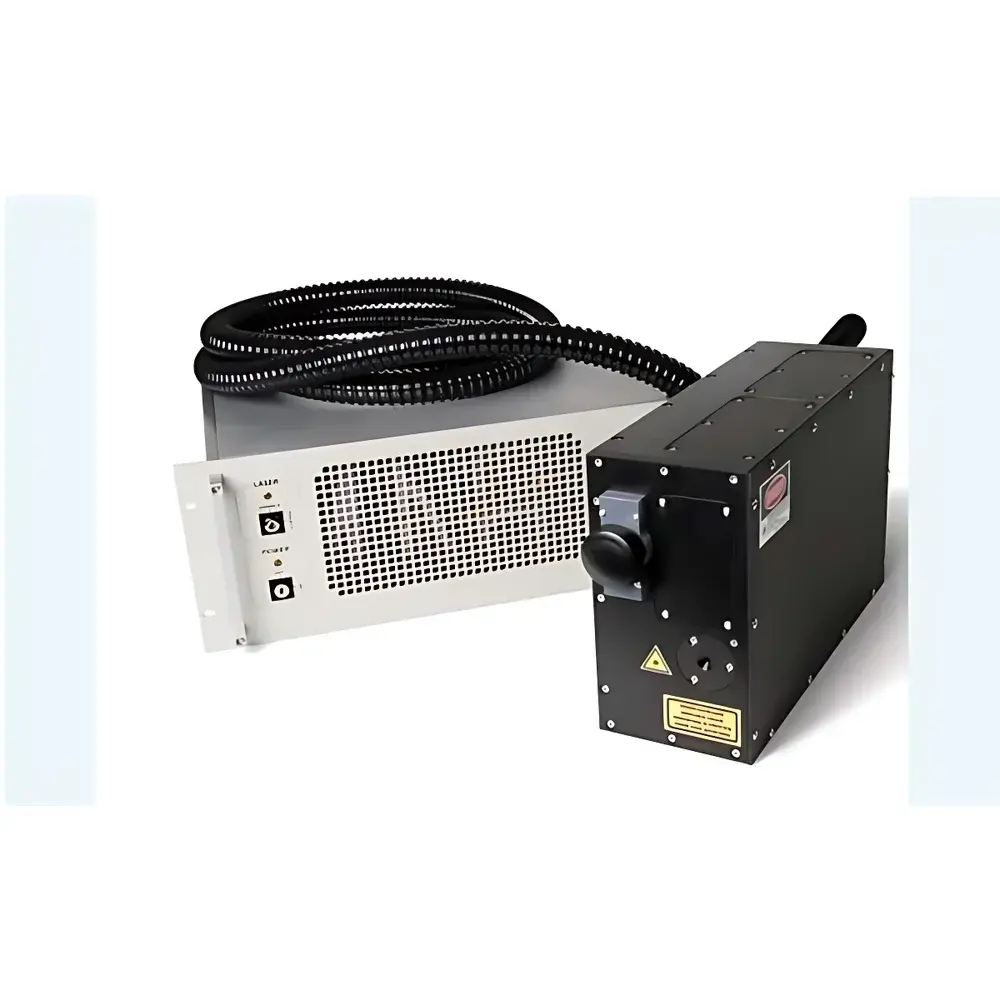
Auniontech MOPAW Master Oscillator with Programmable Amplitude Waveform Laser
| Brand | Auniontech |
|---|---|
| Model | MOPAW |
| Wavelength Options | 1064 nm (standard), 532/355/266 nm (harmonic generation), 1560/780 nm (custom) |
| Pulse Width Range | 2 ns – 17 µs (ps-level customizable) |
| Repetition Rate | Single-shot to 500 kHz (MHz available on request) |
| Pulse Energy | Up to mJ-level |
| Average Power | >25 W |
| Peak Power | >50 kW (>250 kW customizable) |
| Temporal Resolution | 1 ns time step |
| Amplitude Resolution | 8192 intensity levels (13-bit) |
| Beam Quality | Near-diffraction-limited |
| Polarization | Linear, polarization-maintaining output |
| Cooling | Air-cooled, compact architecture |
| Software Control | PC-based waveform editor with 64 stored pulse profiles |
| Compliance | CE marked, RoHS compliant |
| Customization | Available for pulse duration, energy, average power, wavelength, and harmonic conversion modules |
Overview
The Auniontech MOPAW (Master Oscillator with Programmable Amplitude Waveform) is a high-performance, fiber-integrated pulsed laser system engineered for ultra-precise temporal pulse shaping in scientific, industrial, and biomedical applications. Unlike conventional Q-switched or mode-locked lasers, the MOPAW employs a digitally controlled master oscillator architecture coupled with polarization-maintaining (PM) gain fiber amplification—enabling deterministic, user-defined amplitude modulation across the entire pulse envelope. Its core functionality rests on real-time digital-to-analog control of the seed diode’s current drive, allowing sub-nanosecond timing resolution (1 ns step size) and 13-bit (8192-level) intensity quantization per time bin. This architecture supports arbitrary waveform synthesis—from single nanosecond spikes to complex burst trains or smoothly ramped pulses—without mechanical modulators or external pulse pickers. The system operates at 1064 nm by default, with optional intracavity or external harmonic generation yielding stable 532 nm, 355 nm, and 266 nm outputs; custom configurations extend operation to 1560 nm and 780 nm for multiphoton microscopy and optical coherence tomography.
Key Features
- Programmable pulse waveform synthesis with 1 ns temporal resolution and 13-bit amplitude fidelity
- Flexible pulse duration range: 2 ns to 17 µs (ps-level durations available upon customization)
- Adjustable repetition rate from single-shot to 500 kHz (MHz-class variants supported)
- Stable, energy-locked pulse output—maintains constant pulse energy across variable waveforms and repetition rates
- High peak power (>50 kW standard; up to >250 kW with tailored amplifier design)
- Average power exceeding 25 W in air-cooled, benchtop form factor
- Near-diffraction-limited beam quality (M² < 1.3) and linear polarization preservation
- Integrated gain saturation pre-compensation algorithm for improved pulse-to-pulse stability
- Onboard memory for 64 user-defined pulse profiles, recallable via USB or Ethernet interface
- Harmonic generation compatibility: built-in or external modules for 2ω, 3ω, and 4ω outputs
Sample Compatibility & Compliance
The MOPAW laser is designed for integration into ISO-classified cleanrooms, Class 1 laser safety enclosures, and automated manufacturing platforms. Its air-cooled, compact footprint (≤450 × 350 × 120 mm) enables deployment in space-constrained environments including semiconductor fab tools, R&D optical tables, and OEM medical device subsystems. All optical paths are sealed and aligned at factory—no user alignment required. The system complies with IEC 60825-1:2014 (Laser Product Safety) and carries CE marking under the EU Machinery Directive and RoHS 2011/65/EU. For regulated environments—including GMP-compliant photolithography tooling or FDA-submitted ophthalmic devices—the MOPAW supports optional audit-trail logging and password-protected firmware updates compatible with 21 CFR Part 11 requirements when integrated with validated host software.
Software & Data Management
Control is delivered via the proprietary MOPAW Control Suite—a Windows-based application offering intuitive drag-and-drop waveform construction, real-time oscilloscope-style preview, and hardware-synchronized triggering. Pulse definitions are saved as binary .mopaw files containing full temporal-amplitude metadata, timestamp, and calibration checksums. The SDK (C/C++, Python, MATLAB APIs) provides low-level register access for synchronization with motion controllers, galvo scanners, or time-resolved detectors. All waveform edits are non-volatile: 64 profiles persist across power cycles. Optional LabVIEW drivers and OPC UA support enable seamless integration into SCADA and MES platforms used in Industry 4.0 production lines.
Applications
- Stealth dicing of silicon, GaN, and sapphire wafers using tailored thermal stress profiles
- Precision scribing of thin-film solar cells with minimized HAZ and microcrack propagation
- Non-thermal repair of embedded DRAM and NAND flash memory arrays
- High-contrast, subsurface marking of transparent polymers and glass
- Multi-layer ablation of PCB substrates, flexible OLED stacks, and battery separator films
- Time-gated excitation in confocal fluorescence microscopy and STED systems (with 780/1560 nm variants)
- Optical parametric amplifier (OPA) pumping and ultrafast pump-probe spectroscopy
FAQ
What pulse shaping resolution does the MOPAW support?
The MOPAW offers 1 ns temporal sampling resolution and 13-bit (8192-level) amplitude quantization per time bin.
Can I generate burst-mode pulses with variable intra-burst spacing?
Yes—burst envelopes, including inter-pulse delays and amplitude ramping within bursts, are fully programmable via the waveform editor.
Is harmonic generation included as standard equipment?
The base MOPAW system operates at 1064 nm; frequency-doubling (532 nm), tripling (355 nm), and quadrupling (266 nm) modules are available as configurable options.
Does the laser support external trigger synchronization?
Yes—it accepts TTL/LVDS triggers with jitter < 500 ps and provides synchronized output sync signals for multi-laser or detector coordination.
What maintenance is required for long-term stability?
No consumables or periodic alignment is needed; the all-fiber, monolithic oscillator-amplifier design ensures >20,000 hours MTBF with only routine dust filter inspection.






