
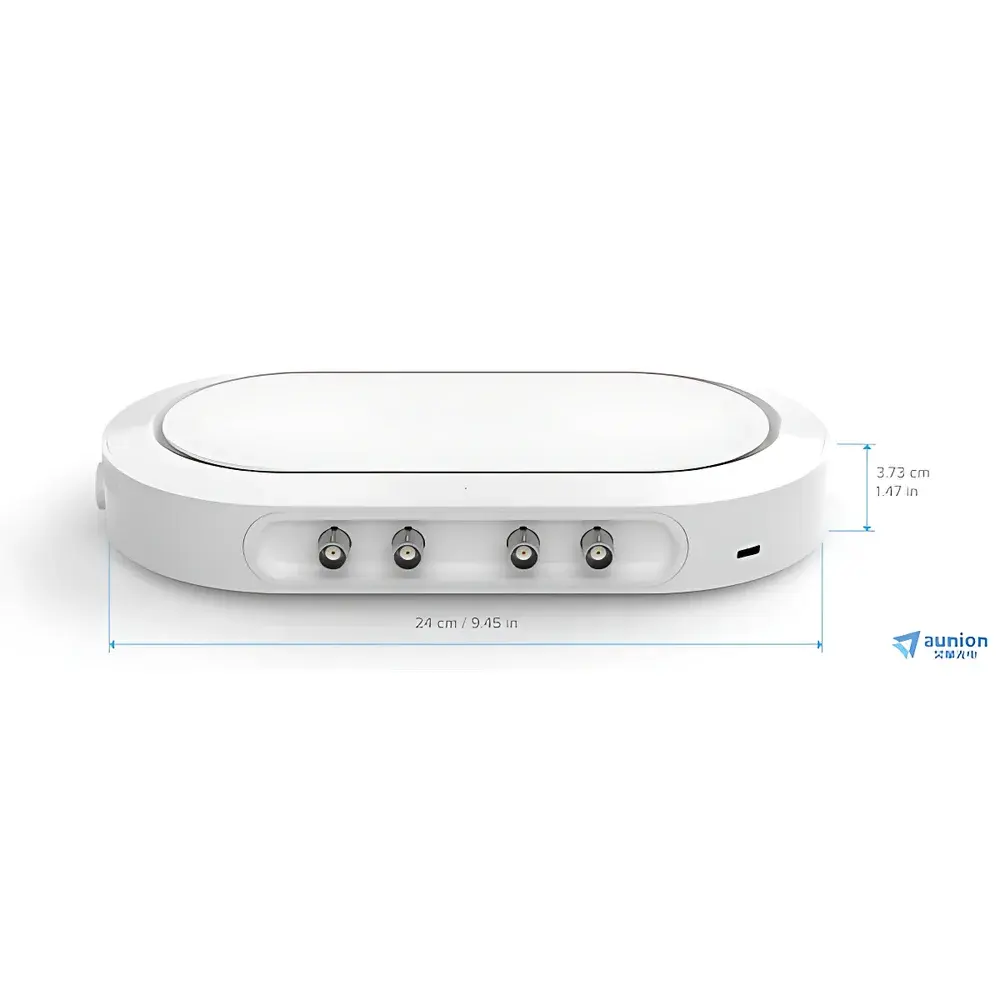
Liquid Instruments Moku:GO Engineering Education Platform
| Brand | Liquid Instruments (LI) |
|---|---|
| Origin | Imported |
| Model | Moku:GO |
| Analog Inputs | 2 × 12-bit, 125 MSa/s, 30 MHz BW, ±25 V range |
| Analog Outputs | 2 × 12-bit, 125 MSa/s, 20 MHz BW, ±5 V max |
| Digital I/O | 16 channels @ 125 MSa/s, 3.3 V logic (5 V tolerant) |
| Programmable Power Supply Options | 2-channel or 4-channel, with multiple voltage/current profiles |
| Integrated Instruments | Arbitrary Waveform Generator, Data Logger, Frequency Response Analyzer, Logic Analyzer / Pattern Generator, Oscilloscope / Voltmeter, PID Controller, Spectrum Analyzer, Waveform Generator |
| Connectivity | USB-C (power + data), Wi-Fi hotspot, Gigabit Ethernet (on select configurations) |
| Software | Native Windows/macOS GUI, Python/MATLAB/LabVIEW APIs, real-time remote lab management capability |
| Compliance | Designed for academic lab environments with electrical isolation, overvoltage protection, and robust ESD immunity per IEC 61000-4-2 |
Overview
Liquid Instruments Moku:GO is a compact, software-defined engineering education platform engineered to support modern undergraduate and graduate curricula in electrical engineering, physics, control systems, signal processing, and embedded systems. Unlike traditional benchtop test equipment, Moku:GO implements eight high-fidelity virtual instruments within a single FPGA-based hardware architecture—each instrument operating with deterministic timing, synchronized sampling, and low-latency real-time processing. Its core measurement principle leverages high-speed mixed-signal acquisition (125 MSa/s, 12-bit resolution) combined with configurable digital signal processing pipelines, enabling precise time-domain, frequency-domain, and control-loop analysis without hardware reconfiguration. The device is purpose-built for pedagogical continuity: from introductory circuits labs through senior capstone design projects, students interact with consistent interfaces, unified calibration frameworks, and reproducible experimental workflows—regardless of physical location.
Key Features
- Eight integrated instruments in one device: Oscilloscope/Voltmeter, Arbitrary Waveform Generator, Spectrum Analyzer, Frequency Response Analyzer (FRA), Data Logger, Logic Analyzer/Pattern Generator, PID Controller, and Waveform Generator—each accessible via intuitive software switching, eliminating instrument swapping and setup drift.
- Portable, lab-in-a-backpack architecture: Compact form factor (142 × 102 × 32 mm), powered exclusively via USB-C (5 V), and operable via built-in Wi-Fi access point—enabling fully wireless lab sessions in classrooms, dormitories, or remote learning environments.
- High-fidelity analog I/O: Dual 12-bit analog inputs with 30 MHz bandwidth, ±25 V input range, AC/DC coupling, and 1 MΩ impedance; dual 12-bit analog outputs with 20 MHz bandwidth and ±5 V output range—supporting both low-voltage precision measurements and robust signal excitation.
- Programmable power supply options: Selectable 2-channel or 4-channel DC supplies with multiple output profiles—including ±5 V @ 150 mA, 0–16 V @ 150 mA, and dual 0.6–5 V @ 1 A rails—enabling direct powering of microcontrollers, sensors, and analog circuitry without external bench supplies.
- Digital I/O subsystem: 16-channel, 125 MSa/s digital I/O bank supporting 3.3 V logic levels (5 V tolerant), suitable for digital protocol analysis (I²C, SPI, UART), FPGA interface validation, and real-time embedded system debugging.
- Open development ecosystem: Native Python, MATLAB, and LabVIEW APIs enable seamless integration into course-specific automation scripts, auto-graded lab assignments, and LMS-linked assessment tools. All APIs expose full instrument configuration, acquisition control, and real-time data streaming capabilities.
Sample Compatibility & Compliance
Moku:GO is designed for use with standard passive and active electronic components (resistors, capacitors, op-amps, transistors, microcontrollers), printed circuit boards, sensor modules, and educational kits (e.g., Arduino, Raspberry Pi, Digilent Basys, Xilinx PYNQ). Its input protection circuitry complies with IEC 61000-4-2 Level 4 (±8 kV contact discharge) and includes current-limited inputs with automatic overvoltage shutdown. Input impedance (1 MΩ) and coupling options (AC/DC) ensure compatibility with both high-impedance sensor outputs and low-impedance power rail monitoring. The device meets CE, FCC Part 15 Class B, and RoHS directives. While not certified for industrial safety standards (e.g., CAT II/III), its electrical isolation and current-limiting design align with university laboratory safety policies for undergraduate teaching environments.
Software & Data Management
The Moku:GO desktop application (Windows/macOS) provides a responsive, multi-tabbed GUI with synchronized timebases across instruments, persistent waveform cursors, math channel support (FFT, differentiation, filtering), and export to CSV, HDF5, and MATLAB .mat formats. All software versions include built-in version-controlled firmware updates and audit-ready logging of user actions (instrument selection, parameter changes, acquisition triggers). For institutional deployment, the platform supports centralized lab management via RESTful API endpoints—enabling instructors to pre-configure instrument states, distribute lab templates, monitor concurrent usage, and retrieve anonymized session metadata for accreditation reporting (ABET Criterion 3 assessment). Data handling conforms to FERPA-compliant storage practices when deployed on institution-managed servers; no telemetry or cloud upload occurs unless explicitly enabled by administrator policy.
Applications
- Introductory electronics labs: Real-time visualization of RC/RL transient response, diode IV curves, and op-amp gain-bandwidth characterization using integrated oscilloscope + waveform generator.
- Signals and systems: Frequency response analysis of filters and amplifiers via FRA; spectral decomposition of modulated signals using spectrum analyzer with adjustable RBW and windowing functions.
- Control systems education: Closed-loop PID tuning with real-time error plotting, step response capture, and Bode plot generation—all within a single instrument session.
- Digital logic and embedded systems: Protocol decoding (SPI/I²C), timing analysis of microcontroller GPIO toggles, and stimulus-response testing using logic analyzer + pattern generator.
- Capstone project prototyping: Rapid iteration of mixed-signal designs (e.g., sensor interface + feedback controller + data logging) without hardware rework or signal integrity degradation from cable chaining.
- Remote and hybrid instruction: Wi-Fi-enabled access allows synchronous lab supervision, shared screen annotation, and instructor-initiated instrument state resets—maintaining pedagogical fidelity in distributed settings.
FAQ
Is Moku:GO suitable for ABET-accredited program assessments?
Yes. Its deterministic sampling, traceable calibration paths, and API-accessible metadata support documented learning outcome mapping per ABET Criterion 3 (student outcomes a–k), particularly for outcomes related to experimental design, data analysis, and instrumentation proficiency.
Does Moku:GO require an internet connection to operate?
No. The onboard Wi-Fi access point operates independently; all instrument processing occurs locally on the FPGA. Internet connectivity is only required for firmware updates or cloud-based license activation (optional for academic site licenses).
Can Moku:GO replace traditional oscilloscopes in advanced labs?
It serves as a primary teaching oscilloscope for educational applications up to 30 MHz bandwidth and 125 MSa/s sampling. For research-grade RF or ultra-high-speed digital analysis (>100 MHz), dedicated bench instruments remain appropriate—but Moku:GO eliminates the need for entry-level scopes in 90% of undergraduate labs.
How is student data privacy maintained during remote lab sessions?
All acquisitions are stored locally on the student’s machine unless explicitly exported. Institutional deployments may route API traffic through on-premise servers; no raw waveform data is transmitted to Liquid Instruments’ infrastructure under default configuration.
Are calibration certificates provided for academic accreditation?
Liquid Instruments provides NIST-traceable factory calibration reports with each unit. Institutions may perform periodic verification using standard signal sources; detailed calibration procedures and tolerance specifications are published in the publicly available Hardware Reference Manual (Rev. 3.2+).



