
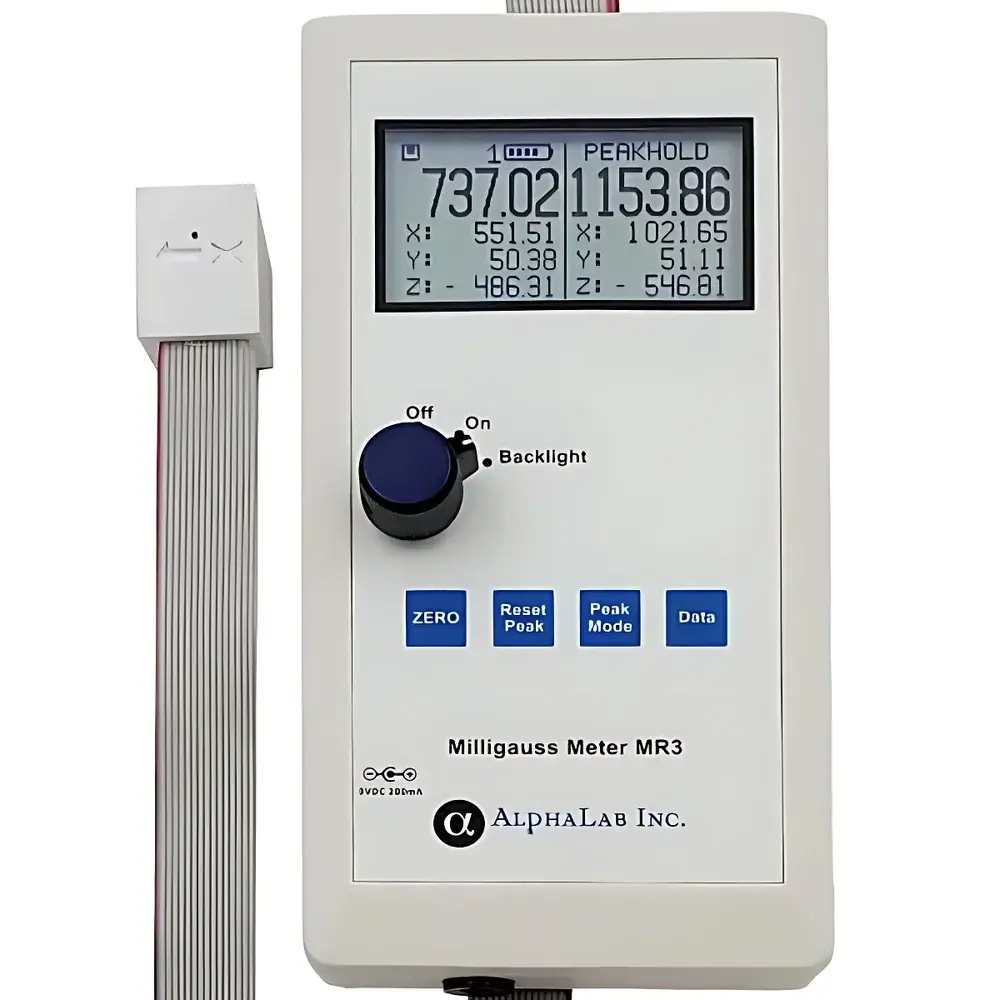
Auniontech MR3 Triaxial Magnetoresistive Milligauss Meter
| Brand | Auniontech |
|---|---|
| Origin | Shanghai, China |
| Model | MR3 Triaxial Milligauss Meter / Tesla Meter |
| Measurement Range | ±1999.99 mG (±199.999 µT) |
| Resolution | 0.01 mG (1 nT) |
| Accuracy | ±0.5% of reading + ±0.50 mG offset |
| Sensor Type | Anisotropic Magnetoresistive (AMR) |
| Axes | X, Y, Z (orthogonal, integrated in 25 mm cube) |
| Sampling Rate | Up to 2 Hz (real-time display) |
| Temperature Stability | Offset drift < 0.01 mG/°C |
| Repeatability | ±0.01 mG (1 nT) at constant temperature |
| Sensor Alignment Tolerance | ±1° (fine alignment marked per unit) |
| Power Supply | 4× AA alkaline batteries (24 h typical, backlight off) or included AC adapter |
| Data Storage | Internal memory for X/Y/Z/M values with peak-hold |
| Calibration | NIST-traceable certificate included |
| Compliance | Designed for GLP-compliant static DC field mapping and low-field metrology applications |
Overview
The Auniontech MR3 Triaxial Magnetoresistive Milligauss Meter is a precision DC magnetic field measurement instrument engineered for high-resolution, vector-based characterization of weak static magnetic fields. Utilizing anisotropic magnetoresistive (AMR) sensor technology, the MR3 delivers stable, low-drift measurements across three orthogonal axes (X, Y, Z) within a compact 25 mm cubic sensing head—positioned at the end of a 100 cm flexible cable for ergonomic and spatially unconstrained deployment. Unlike Hall-effect or fluxgate-based systems, AMR sensors provide superior signal-to-noise ratio and intrinsic linearity in the sub-milligauss regime (1 nT), making the MR3 particularly suited for applications requiring trace-level DC field detection, such as magnetic shielding validation, geomagnetic baseline monitoring, MRI fringe field mapping, and ultra-low-field material characterization. The instrument computes and displays both instantaneous vector components and resultant magnitude (M = √(X² + Y² + Z²)) in real time at a fixed update rate of 2 Hz. Its architecture supports both handheld operation and unattended long-duration logging—enabling rigorous field surveys, environmental monitoring, and laboratory-grade reproducibility studies.
Key Features
- Triaxial AMR sensing with integrated 25 mm³ probe head—sensors embedded ~4 mm beneath surface, precisely marked per unit for orientation-critical measurements
- Full-scale range of ±1999.99 mG (±199.999 µT) with 0.01 mG (1 nT) resolution across all axes simultaneously
- Measurement accuracy of ±0.5% of reading plus a fixed offset error of ±0.50 mG—validated with NIST-traceable calibration certificate
- Thermal stability optimized: offset temperature coefficient < 0.01 mG/°C; gain drift < 0.0015%/°C—ensuring reliable performance across ambient lab conditions (15–35°C)
- Real-time peak-hold function with manual reset—retains maximum observed X, Y, Z, and M values since last clear
- Dual power modes: 4× AA alkaline batteries (24 h typical runtime, backlight off) or included AC adapter for extended deployments
- Zero-offset compensation (“tare”) button enables differential field measurements relative to local background
- USB interface supports both real-time data streaming and offline bulk download—compatible with AlphaApp software for time-series analysis and report generation
Sample Compatibility & Compliance
The MR3 is designed exclusively for static (DC) magnetic field measurement and is not intended for AC, pulsed, or RF field analysis. It is compatible with non-ferromagnetic sample environments and requires no physical contact with the field source—making it suitable for mapping stray fields around electronic enclosures, cryostats, vacuum chambers, and magnetic shielding rooms. The instrument complies with fundamental metrological principles outlined in ISO/IEC 17025 for calibrated measurement devices and supports traceability workflows required under GLP (Good Laboratory Practice) and ISO 9001 quality management systems. While not FDA 21 CFR Part 11 certified out-of-the-box, its deterministic sampling intervals, timestamped internal logging, and immutable data export format (CSV) facilitate audit-ready documentation when used in regulated R&D settings. Annual recalibration services are available through AlphaLab Inc., ensuring ongoing conformance with NIST-traceable standards.
Software & Data Management
Data acquisition and visualization are managed via AlphaApp—a cross-platform desktop application supporting Windows, macOS, and Linux. AlphaApp enables real-time plotting of X, Y, Z, and M channels with configurable time axes, statistical overlays (min/max/mean/std dev), and user-defined alarm thresholds. Logged datasets include full metadata: timestamp (UTC), sensor ID, battery voltage, and measurement mode. Internal memory capacity supports up to ~18 hours of continuous logging at 2 Hz (0.5 s interval) or ~47 days at 30 s intervals—subject to available power and storage headroom. All data exports as plain-text CSV files with UTF-8 encoding, enabling direct import into MATLAB, Python (NumPy/Pandas), LabVIEW, or statistical analysis platforms. No proprietary binary formats or vendor-locked ecosystems are employed—ensuring long-term data accessibility and interoperability.
Applications
- Characterization of magnetic shielding effectiveness (e.g., Mu-metal enclosures, Helmholtz coil cancellation zones)
- Verification of zero-field environments in quantum sensing labs (SQUID, NV-center, atomic magnetometers)
- Stray field mapping around MRI systems, particle accelerators, and high-current power supplies
- Quality control of permanent magnets and magnetic assemblies during manufacturing
- Geophysical survey support—baseline drift correction and local anomaly detection
- Educational use in undergraduate physics laboratories for vector field visualization and superposition experiments
FAQ
What is the difference between milligauss (mG) and microtesla (µT)?
1 mG = 0.1 µT = 100 nT. The MR3 displays readings in mG by default but supports unit conversion in AlphaApp for µT or nT output.
Can the MR3 measure alternating (AC) magnetic fields?
No—the MR3 is optimized for static (DC) fields only. Its AMR sensors lack bandwidth for AC response above ~1 Hz.
How is sensor alignment verified on each unit?
Each MR3 probe is manually marked with X/Y/Z orientation indicators near the sensing surface; alignment tolerance is ±1°, with fine adjustment capability to ±0.1° using optional alignment fixtures.
Is the USB data log time-stamped?
Yes—every recorded sample includes a UTC timestamp generated by the host PC’s system clock during acquisition.
Does the MR3 support external triggering or synchronization?
No—data acquisition is internally clocked. Synchronization with external events requires post-hoc alignment using shared time references in AlphaApp.



